
Types of Butterflies in Colorado
Colorado is home to about 80 species of butterflies, the most common being black swallowtail, two-tailed swallowtail, western swallowtail, monarch, mourning cloak, variegated fritillary, Weidemeyer’s admiral, painted lady and checkered skipper.
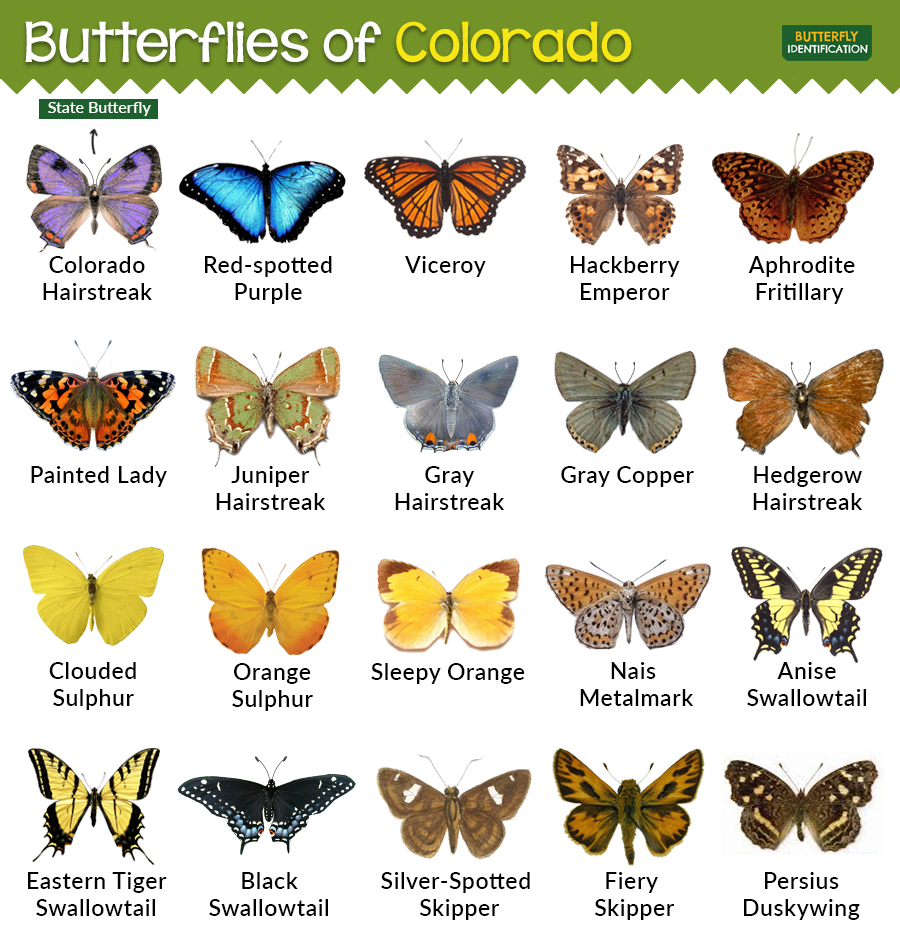
Colorado hairstreak butterfly (Hypaurotis crysalus) is the state butterfly, designated in 1996.
Brush-Footed (Nymphalidae)
- Red-spotted Purple (Limenitis arthemis)
- Viceroy (Limenitis archippus)
- Weidemeyer’s Admiral (Limenitis weidemeyerii)
- Astyanax‘ Red-spotted Purple (Limenitis arthemis astyanax)
- Ruddy Daggerwing (Marpesia petreus)
- Hackberry Emperor (Asterocampa celtis)
- Aphrodite Fritillary (Speyeria aphrodite)
- Great Spangled Fritillary (Speyeria cybele)
- Hydaspe Fritillary (Speyeria hydaspe)
- Mormon Fritillary (Speyeria mormonia)
- Nokomis Fritillary (Speyeria nokomis)
- Northwestern Fritillary (Speyeria hesperis)
- Regal Fritillary (Speyeria idalia)
- Zerene Fritillary (Speyeria zerene)
- Arctic Fritillary (Boloria chariclea)
- Relict Fritillary (Boloria kriemhild)
- Silver-bordered Fritillary (Boloria selene)
- Meadow Fritillary (Boloria bellona)
- Gulf Fritillary (Agraulis vanillae)
- Julia Heliconian (Dryas julia)
- Variegated Fritillary (Euptoieta claudia)
- Zebra Heliconian (Heliconius charithonius)
- Monarch (Danaus plexippus)
- Queen (Danaus gilippus)
- Soldier (Danaus eresimus)
- American Snout (Libytheana carinenta)
- American Lady (Vanessa virginiensis)
- West Coast Lady (Vanessa annabella)
- Painted Lady (Vanessa cardui)
- Red Admiral (Vanessa atalanta)
- California Tortoiseshell (Nymphalis californica)
- Mourning Cloak (Nymphalis antiopa)
- Compton Tortoiseshell (Nymphalis vaualbum)
- Eastern Comma (Polygonia comma)
- Gray Comma (Polygonia progne)
- Green Comma (Polygonia faunus)
- Hoary Comma (Polygonia gracilis)
- Question Mark (Polygonia interrogationis)
- Graphic Crescent (Phyciodes graphica)
- Mylitta Crescent (Phyciodes mylitta)
- Northern Crescent (Phyciodes cocyta)
- Painted Crescent (Phyciodes picta)
- Field Crescent (Phyciodes pulchellus)
- Pale Crescent (Phyciodes pallida)
- Pearl Crescent (Phyciodes tharos)
- Phaon Crescent (Phyciodes phaon)
- Variable Checkerspot (Euphydryas chalcedona)
- Edith’s Checkerspot (Euphydryas editha)
- Gillette’s Checkerspot (Euphydryas gillettii)
- Gorgone Checkerspot (Chlosyne gorgone)
- Northern Checkerspot (Chlosyne palla)
- Fulvia Checkerspot (Thessalia fulvia)
- Leanira Checkerspot (Thessalia leanira)
- Common Buckeye (Junonia coenia)
- Milbert’s Tortoiseshell (Aglais milberti)
- Dotted Checkerspot (Poladryas minuta)
Gossamer-Winged (Lycaenidae)
- Gray Copper (Lycaena dione)
- Edith’s Copper (Lycaena editha)
- Blue Copper (Lycaena heteronea)
- Lustrous Copper (Lycaena cupreous)
- Juniper Hairstreak (Callophrys gryneus siva)
- Thicket Hairstreak (Callophrys spinetorum)
- Brown Elfin (Callophrys augustinus)
- Moss’ Elfin (Callophrys mossii)
- Hoary Elfin (Callophrys polios)
- Western Pine Elfin (Callophrys eryphon)
- Behr’s Hairstreak (Satyrium behrii)
- Coral Hairstreak (Satyrium titus)
- Banded Hairstreak (Satyrium calanus)
- Hedgerow Hairstreak (Satyrium saepium)
- Gray Hairstreak (Strymon melinus)
Whites and Sulphurs (Pieridae)
- Pine White (Neophasia menapia)
- Olympia Marble (Euchloe olympia)
- Cabbage White (Pieris rapae)
- Large Marble(Euchloe ausonides)
- Clouded Sulphur (Colias philodice)
- Orange Sulphur (Colias eurytheme)
- Queen Alexandra’s Sulphur (Colias alexandra)
- Southern Dogface (Zerene cesonia)
- Sleepy Orange (Eurema nicippe)
- Mexican Yellow (Eurema mexicana)
- Mead’s Sulphur (Colias meadii)
- Dainty Sulphur (Nathalis iole)
Metalmark Butterflies (Riodinidae)
- Nais Metalmark (Apodemia nais)
Swallowtails (Papilionidae)
- Anise Swallowtail (Papilio zelicaon)
- Black Swallowtail (Papilio polyxenes)
- Eastern Tiger Swallowtail (Papilio glaucus)
- Giant Swallowtail (Papilio cresphontes)
- Indra Swallowtail (Papilio indra)
- Old World Swallowtail (Papilio machaon)
- Pale Swallowtail (Papilio eurymedon)
- Spicebush Swallowtail (Papilio troilus)
- Thoas Swallowtail (Papilio thoas)
- Two-tailed Swallowtail (Papilio multicaudata)
- Western Tiger Swallowtail (Papilio rutulus)
- Pipevine Swallowtail (Battus philenor)
- Clodius Parnassian (Parnassius clodius)
- Rocky Mountain Parnassian (Parnassius smintheus)
Skippers (Hesperiidae)
- Silver-Spotted Skipper (Epargyreus clarus)
- Northern Cloudywing (Thorybes pylades)
- Mexican Cloudywing (Thorybes mexicanus)
- Dreamy Duskywing (Erynnis icelus)
- Rocky Mountain Duskywing (Erynnis telemachus)
- Mottled Duskywing (Erynnis martialis)
- Pacuvius Duskywing (Erynnis pacuvius)
- Afranius Duskywing (Erynnis afranius)
- Persius Duskywing (Erynnis persius)
- Russet Skipperling (Piruna pirus)
- Garita Skipperling (Oarisma garita)
- Least Skipper (Ancyloxyphia numitor)
- “Leonard’s” Pawnee Skipper (Hesperia leonardus)
- Juba Skipper (Hesperia juba)
- Pahaska Skipper (Hesperia pahaska)
- Green Skipper (Hesperia viridis)
- Sandhill Skipper (Polites sabuleti)
- Sachem (Atalopedes campestris)
- Fiery Skipper (Hylephila phyleus)
- Draco Skipper (Polites draco)
- Tawny-Edged Skipper (Polites themistocles)
- Long Dash (Polites mystic)