
Types of Butterflies in Maine
Maine, the northeastern U.S. state, is home to about 103 species of butterflies and skippers. The distinguishing feature of these butterflies is that they have bright wing tops and dull wing-bottoms. The most commonly spotted species are Spring Azures, Mourning Cloaks, Cabbage White. Migratory species, such as the Monarch butterfly lay their eggs in summer, and the caterpillars hatch from the eggs in early May.
This U.S. state still has no designated state butterflies.
Brush-Footed (Nymphalidae)
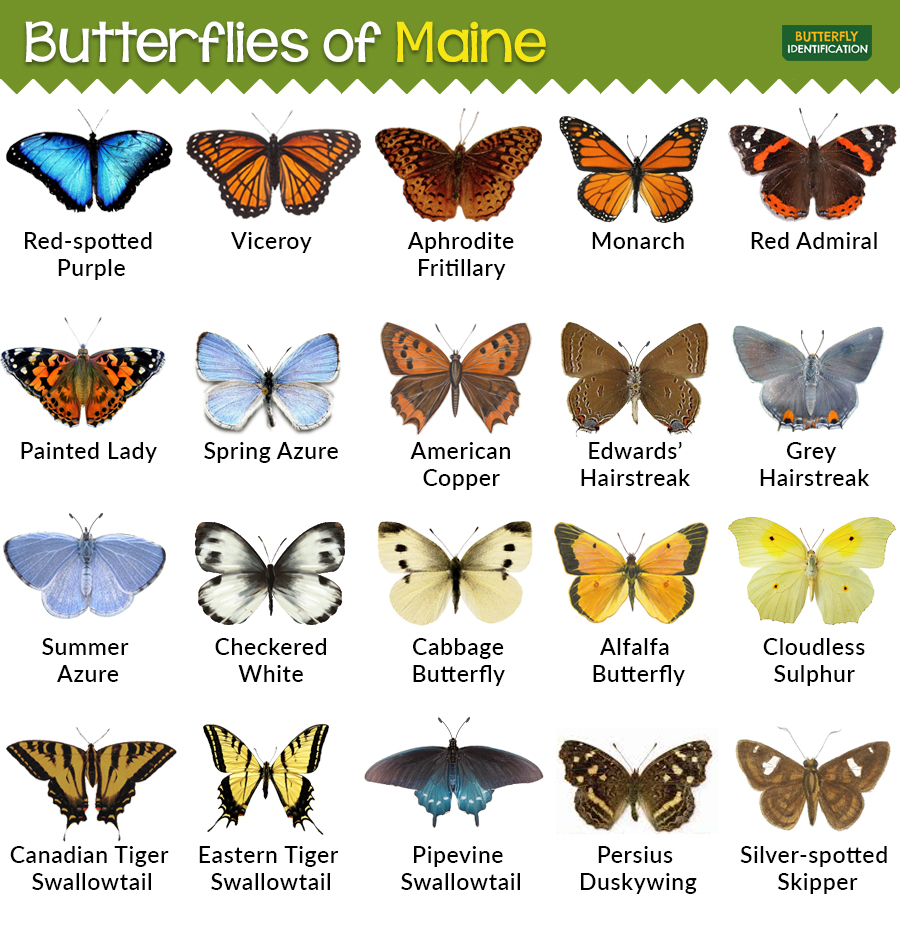
- Red-spotted Purple (Limenitis arthemis)
- White Admiral (Limenitis arthemis arthemis)
- ‘Astyanax‘ Red-spotted Purple (Limenitis arthemis astyanax)
- Viceroy (Limenitis archippus)
- Aphrodite Fritillary (Speyeria aphrodite)
- Atlantis Fritillary (Speyeria atlantis)
- Great Spangled Fritillary (Speyeria cybele)
- Regal Fritillary (Speyeria idalia)
- Bog Fritillary (Boloria eunomia)
- Arctic Fritillary (Boloria chariclea)
- Meadow Fritillary (Boloria bellona)
- Silver-bordered Fritillary (Boloria selene)
- Variegated Fritillary (Euptoieta claudia)
- Monarch (Danaus plexippus)
- American Snout (Libytheana carinenta)
- American Lady (Vanessa virginiensis)
- Painted Lady (Vanessa cardui)
- Red Admiral (Vanessa atalanta)
- Mourning Cloak (Nymphalis antiopa)
- Compton Tortoiseshell (Nymphalis vaualbum)
- Hoary Comma (Polygonia gracilis)
- Question Mark (Polygonia interrogationis)
- Eastern Comma (Polygonia comma)
- Satyr Comma (Polygonia satyrus)
- Gray Comma (Polygonia progne)
- Green Comma (Polygonia faunus)
- Pearl Crescent (Phyciodes tharos)
- Tawny Crescent (Phyciodes batesii)
- Northern Crescent (Phyciodes cocyta)
- Silvery Checkerspot (Chlosyne nycteis)
- Harris’ Checkerspot (Chlosyne harrisii)
- Baltimore (Euphydryas phaeton)
- Common Buckeye (Junonia coenia)
- Milbert’s Tortoiseshell (Aglais milberti)
Gossamer-Winged (Lycaenidae)
- Harvester (Feniseca tarquinius)
- Spring azure (Celastrina ladon)
- American Copper (Lycaena phlaeas)
- Bronze Copper (Lycaena hyllus)
- Bog Copper (Lycaena epixanthe)
- Clayton’s Copper (Lycaena dorcas)
- Hessel’s Hairstreak (Callophrys hesseli)
- Olive Hairstreak (Callophrys gryneus)
- Brown Elfin (Callophrys augustinus)
- Hoary Elfin (Callophrys polios)
- Frosted Elfin (Callophrys irus)
- Henry’s Elfin (Callophrys henrici)
- Bog Elfin (Callophrys lanoraieensis)
- Eastern Pine Elfin (Callophrys niphon)
- Western Pine Elfin (Callophrys eryphon)
- Coral Hairstreak (Satyrium titus)
- Acadian Hairstreak (Satyrium acadica)
- Edwards’ Hairstreak (Satyrium edwardsii)
- Banded Hairstreak (Satyrium calanus)
- Striped Hairstreak (Satyrium liparops)
- Grey Hairstreak (Strymon melinus)
- Early Hairstreak (Erora laeta)
- Eastern Tailed Blue (Cupido comyntas)
- Western Tailed Blue (Cupido amyntula)
- Spring Azure/Cherry Gall Azure (Celastrina lucia)
- Summer Azure (Celastrina neglecta)
- Silvery Blue (Glaucopsyche lygdamus)
- Crowberry Blue (Plebejus idas)
- Karner Blue (Plebejus Melissa)
- Greenish Blue (Plebejus saepiolus)
Sulphurs and Whites (Pieridae)
- Checkered White (Pontia protodice)
- Cabbage Butterfly (Pieris rapae)
- Mustard White (Pieris oleracea)
- Clouded Sulphur (Colias philodice)
- Alfalfa Butterfly (Colias eurytheme)
- Pink-edged Sulphur (Colias interior)
- Cloudless Sulphur (Phoebis sennae)
- Orange-barred Sulphur (Phoebis philea)
- Large Sulphur (Phoebis agarithe)
- Little Sulphur (Pyrisitia lisa)
Swallowtail (Papilionidae)
- Black Swallowtail (Papilio polyxenes)
- Canadian Tiger Swallowtail (Papilio canadensis)
- Eastern Tiger Swallowtail (Papilio glaucus)
- Giant Swallowtail (Papilio cresphontes)
- Spicebush Swallowtail (Papilio troilus)
- Pipevine Swallowtail (Battus philenor)
Skipper (Hesperiidae)
- Dreamy Duskywing (Erynnis icelus)
- Juvenal’s Duskywing (Erynnis juvenalis)
- Persius Duskywing (Erynnis persius)
- Sleepy Duskywing (Erynnis brizo)
- Northern Cloudywing (Thorybes pylades)
- Southern Cloudywing (Thorybes bathyllus)
- Silver-spotted Skipper (Epargyreus clarus)
- Common Sootywing (Pholisora catullus)