
Types of Butterflies in Mississippi
About 147 butterfly species colonize the US state of Mississippi, of which some are common and found across the state, while others are quite rare. All the butterflies require host plants where they lay eggs. While the caterpillars feed on host plants, adults eat nectar from flowering plants.
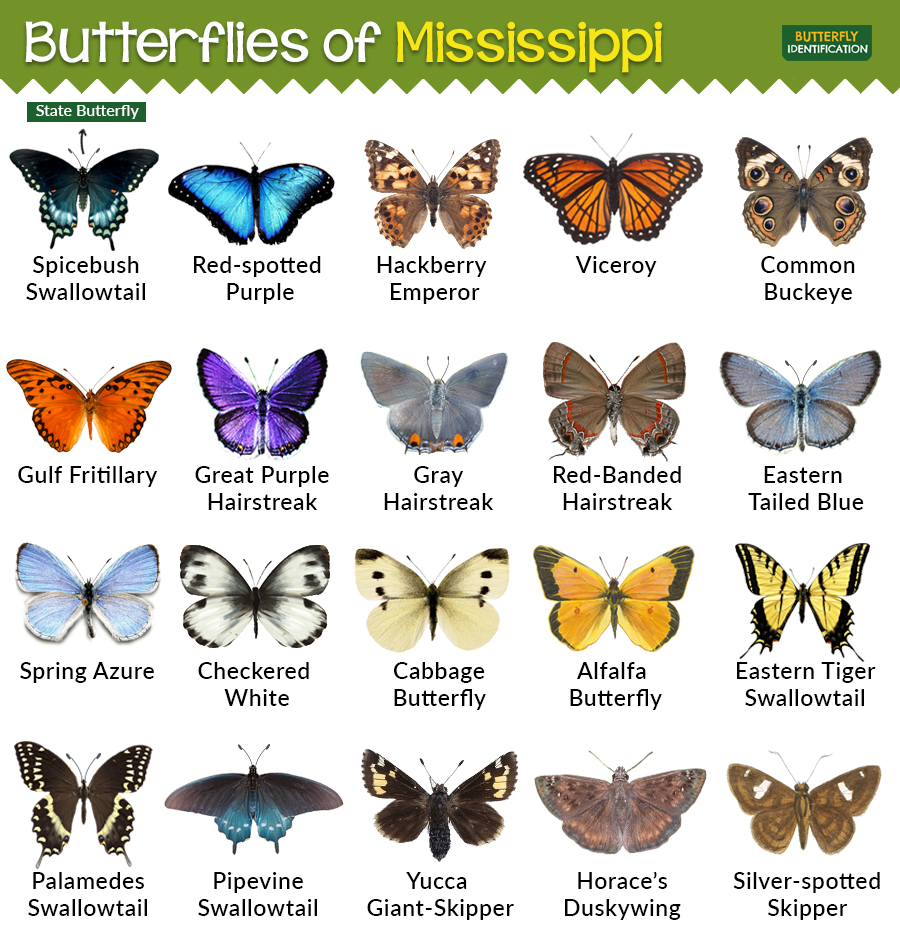
The most common species is the Spicebush Swallowtail (Papilio troilus), which occurs throughout Mississippi and being the state-butterfly.
Brush-Footed (Nymphalidae)
- ‘Astyanax’ Red-spotted Purple (Limenitis arthemis astyanax)
- Red-spotted Purple (Limenitis arthemis)
- Viceroy (Limenitis archippus)
- Hackberry Emperor (Asterocampa celtis)
- Tawny Emperor (Asterocampa clyton)
- Goatweed Leafwing (Anaea andria)
- Diana (Speyeria diana)
- Great Spangled Fritillary (Speyeria cybele)
- Gulf Fritillary (Agraulis vanillae)
- Variegated Fritillary (Euptoieta claudia)
- Zebra Heliconian (Heliconius charithonius)
- Monarch (Danaus plexippus)
- Queen (Danaus gilippus)
- American Snout (Libytheana carinenta)
- American Lady (Vanessa virginiensis)
- Baltimore (Euphydryas phaeton)
- Common Buckeye (Junonia coenia)
- Eastern Comma (Polygonia comma)
- Gorgone Checkerspot (Chlosyne gorgone)
- Mimic (Hypolimnas misippus)
- Mourning Cloak (Nymphalis antiopa)
- Painted Lady (Vanessa cardui)
- Pearl Crescent (Phyciodes tharos)
- Phaon Crescent (Phyciodes phaon)
- Question Mark (Polygonia interrogationis)
- Red Admiral (Vanessa atalanta)
- Silvery Checkerspot (Chlosyne nycteis)
- Texan Crescent (Phyciodes texana)
- White Peacock (Anartia jatrophae)
Gossamer-Winged (Lycaenidae)
- Harvester (Feniseca tarquinius)
- Bronze Copper (Hyllolycaena hyllus)
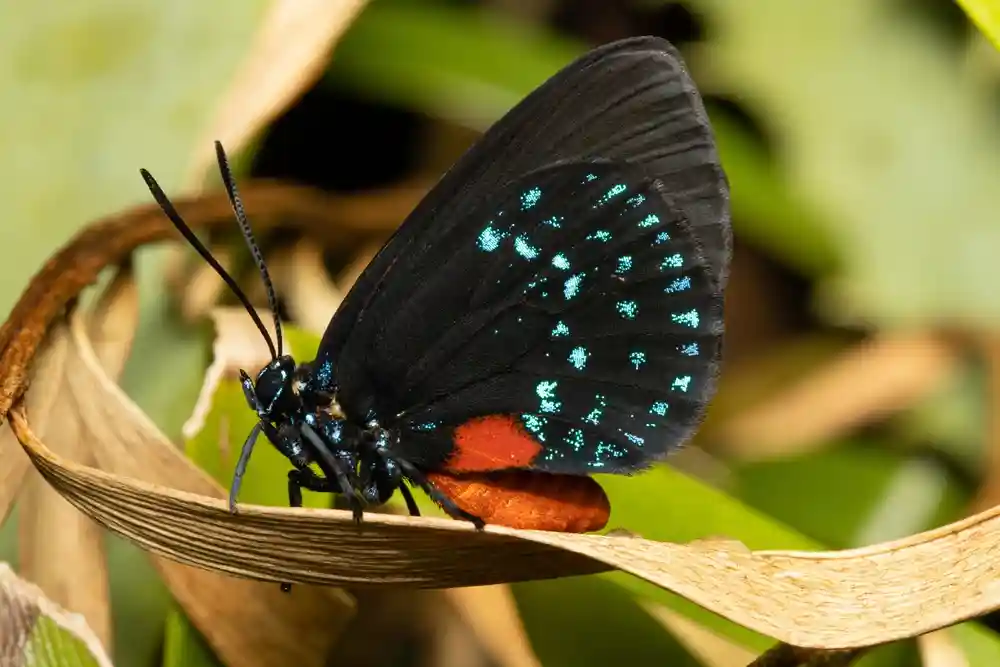
- Atala (Eumaeus atala)
- Great Purple Hairstreak (Atlides halesus)
- Mopsus Butterfly (Harkenclenus titus)
- Falacer Hairstreak (Satyrium calanus )
- King’s Hairstreak (Satyrium kingi)
- Southern Striped Hairstreak (Satyrium liparops)
- Red-Banded Hairstreak (Calycopis cecrops)
- Dusky Blue Hairstreak (Calycopis isobeon)
- Olive Hairstreak (Mitoura grynea)
- Southern Brown Elfin (Incisalia augustinu)
- Henry’s Elfln (Incisalia henrici)
- Eastern Pine Elfin (Incisalia niphon)
- Northern Hairstreak (Fixsenia Ontario)
- White-M Hairstreak (Parrhasius m-album)
- Gray Hairstreak (Strymon melinus melinus)
- Eastern Pygmy Blue (Brephidium isophthalma pseudofea)
- Marine Blue (Leptotes marina)
- Ceraunus Blue (Hemiargus ceraunus antibubastus)
- Reakirt’s Blue (Hemiargus isola alce)
- Eastern Tailed Blue (Everes comyntas comyntas)
- Spring Azure (Celastrina argiolus ladon)
Whites and Sulphurs (Pieridae)
- Checkered White (Pontia protodice)
- Cabbage Butterfiy (Pieris rapae)
- Great Southern White (Ascia monuste phileta)
- Falcate Orange Tip (Paramidea midea midea)
- Clouded Sulfur (Colias philodice philodice)
- Alfalfa Butterfly (Colias eurytheme)
- Dog Face (Zerene cesonia cesonia)
- Yellow Brimstone (Anteos maerula)
- Cloudless Sulfur (Phoebis sennae eubule)
- Orange-Barred Sulfur (Phoebis philea philea)
- Barred Yellow (Eurema daira daira)
- Mexican Sulfur (Eurema mexicanum)
- Little Sulfur (Eurema lisa)
- Sleepy Orange (Eurema nicippe)
- Dainty Sulfur (Nathalis iole)
Metalmark (Riodinidae)
- Little Metalmark (Calephelis virginiensis)
Swallowtail (Papilionidae)
- Black Swallowtail (Papilio polyxenes)
- Eastern Tiger Swallowtail (Papilio glaucus)
- Giant Swallowtail (Papilio cresphontes)
- Palamedes Swallowtail (Papilio palamedes)
- Pipevine Swallowtail (Battus philenor)
- Spicebush Swallowtail (Papilio troilus)
- Zebra Swallowtail (Eurytides marcellus)
Skipper (Hesperiidae)
- Yucca Giant-Skipper (Megathymus yuccae)
- Common Checkered-Skipper (Pyrgus communis)
- Common Sootywing (Pholisora catullus)
- Confusing Cloudywing (Thorybes confusis)
- Dorantes Longtail (Urbanus dorantes)
- Funereal Duskywing (Erynnis funeralis)
- Golden Banded-Skipper (Autochton cellus)
- Hayhurst’s Scallopwing (Staphylus hayhurstii)
- Hoary Edge (Achalarus lyciades)
- Horace’s Duskywing (Erynnis horatius)
- Juvenal’s Duskywing (Erynnis juvenalis)
- Long-tailed Skipper (Urbanus proteus)
- Mottled Duskywing (Erynnis martialis)
- Northern Cloudywing (Thorybes pylades)
- Silver-spotted Skipper (Epargyreus clarus)
- Sleepy Duskywing (Erynnis brizo)
- Southern Cloudywing (Thorybes bathyllus)
- Tropical Checkered-Skipper (Pyrgus oileus)
- White Checkered-Skipper (Pyrgus albescens)
- Wild Indigo Duskywing (Erynnis baptisiae)
- Zarucco Duskywing (Erynnis zarucco)