
Types of Butterflies in Montana
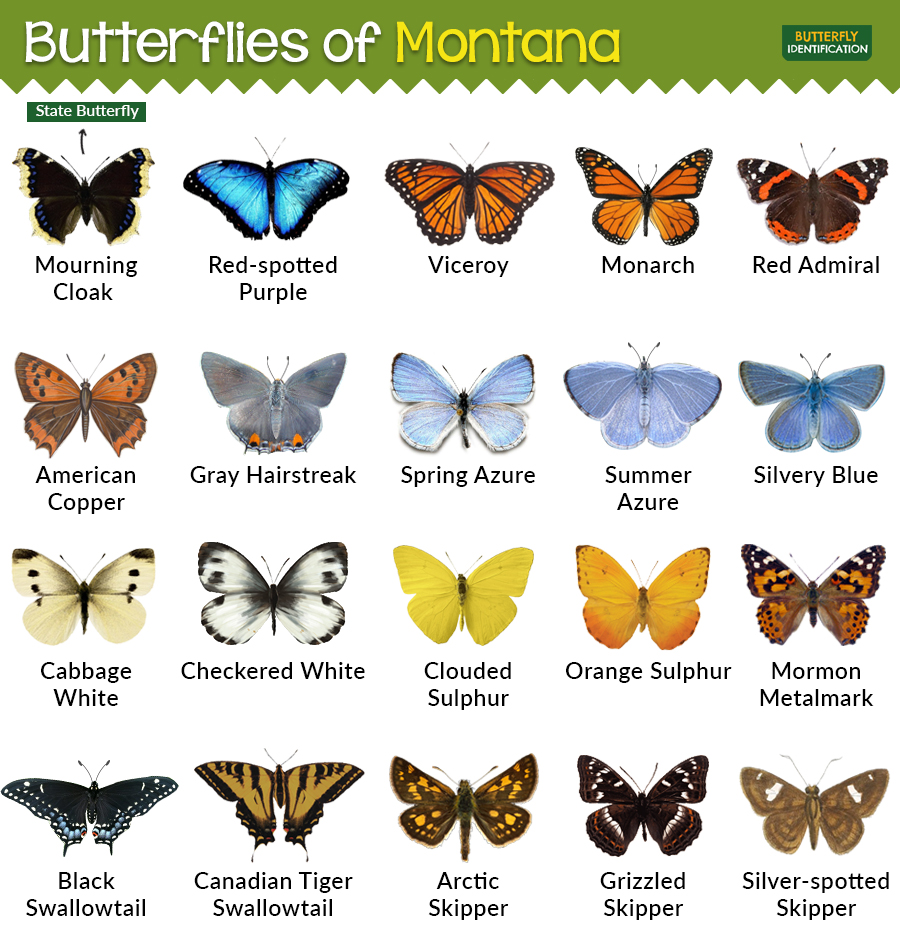
Montana hosts close to 200 species of butterflies that inhabit the various National Parks, National Wildlife Refuges, and State Parks. Butterfly species from all the six butterfly families can be spotted here.
The Mourning Cloak butterfly (Nymphalis antiopa) has been the designated state butterfly since 1996.
Brush-Footed (Nymphalidae)
- ‘Astyanax’ Red-spotted Purple (Limenitis arthemis astyanax)
- Lorquin’s Admiral (Limenitis lorquini)
- Red-spotted Purple (Limenitis arthemis)
- Viceroy (Limenitis archippus)
- Weidemeyer’s Admiral (Limenitis weidemeyerii)
- White Admiral (Limenitis arthemis arthemis)
- Alberta Fritillary (Boloria alberta)
- Aphrodite Fritillary (Speyeria aphrodite)
- Arctic Fritillary (Boloria chariclea)
- Astarte Fritillary (Boloria astarte)
- Bog Fritillary (Boloria eunomia)
- Callippe Fritillary (Speyeria callippe)
- Coronis Fritillary (Speyeria coronis)
- Edwards’ Fritillary (Speyeria edwardsii)
- Freija Fritillary (Boloria freija)
- Frigga Fritillary (Boloria frigga)
- Great Basin Fritillary (Speyeria egleis)
- Great Spangled Fritillary (Speyeria cybele)
- Hydaspe Fritillary (Speyeria hydaspe)
- Meadow Fritillary (Boloria bellona)
- Mormon Fritillary (Speyeria mormonia)
- Northwestern Fritillary (Speyeria hesperis)
- Pacific Fritillary (Boloria epithore)
- Regal Fritillary (Speyeria idalia)
- Relict Fritillary (Boloria kriemhild)
- Silver-bordered Fritillary (Boloria selene)
- Variegated Fritillary (Euptoieta claudia)
- Zerene Fritillary (Speyeria zerene)
- Monarch (Danaus plexippus)
- American Lady (Vanessa virginiensis)
- California Tortoiseshell (Nymphalis californica)
- Compton Tortoiseshell (Nymphalis vaualbum)
- Eastern Comma (Polygonia comma)
- Edith’s Checkerspot (Euphydryas editha)
- Field Crescent (Phyciodes pulchellus)
- Gillette’s Checkerspot (Euphydryas gillettii)
- Gorgone Checkerspot (Chlosyne gorgone)
- Gray Comma (Polygonia progne)
- Green Comma (Polygonia faunus)
- Hoary Comma (Polygonia gracilis)
- Milbert’s Tortoiseshell (Aglais milberti)
- Mourning Cloak (Nymphalis antiopa)
- Mylitta Crescent (Phyciodes mylitta)
- Northern Checkerspot (Chlosyne palla)
- Northern Crescent (Phyciodes cocyta)
- Painted Lady (Vanessa cardui)
- Pale Crescent (Phyciodes pallida)
- Pearl Crescent (Phyciodes tharos)
- Red Admiral (Vanessa atalanta)
- Rockslide Checkerspot (Chlosyne whitneyi)
- Sagebrush Checkerspot (Chlosyne acastus)
- Satyr Comma (Polygonia satyrus)
- Silvery Checkerspot (Chlosyne nycteis)
- Tawny Crescent (Phyciodes batesii)
- Variable Checkerspot (Euphydryas chalcedona)
- West Coast Lady (Vanessa annabella)
Gossamer-Winged (Lycaenidae)
- American Copper (Lycaena phlaeas)
- Lustrous Copper (Lycaena cuprea)
- Ruddy Copper (Lycaena rubidus)
- Gray Copper (Lycaena dione)
- Purplish Copper (Lycaena helloides)
- Edith’s Copper (Lycaena editha)
- Bronze Copper (Lycaena hyllus)
- Blue Copper (Lycaena heteronea)
- Lilac-bordered Copper (Lycaena nivalis)
- Mariposa Copper (Lycaena mariposa)
- Blue Copper (Lycaena heteronea)
- Coral Hairstreak (Satyrium titus)
- Gray Hairstreak (Strymon melinus)
- Banded Hairstreak (Satyrium calanus)
- Striped Hairstreak (Satyrium liparops)
- Acadian Hairstreak (Satyrium acadica)
- Thicket Hairstreak (Callophrys spinetorum)
- Olive (Juniper) Hairstreak (Callophrys gryneus)
- Brown Elfin (Callophrys augustinus)
- Hoary Elfin (Callophrys polios)
- Moss’ Elfin (Callophrys mossii)
- Western Pine Elfin (Callophrys eryphon)
- Western Green Hairstreak (Callophrys affinis)
- Sheridan’s Green Hairstreak (Callophrys sheridanii)
- Nelson’s Hairstreak (Callophrys nelsoni)
- California Hairstreak (Satyrium californica)
- Sylvan Hairstreak (Satyrium sylvinum)
- Hedgerow Hairstreak (Satyrium saepium)
- Sooty Hairstreak (Satyrium fuliginosum)
- Marine Blue (Leptotes marina)
- Spring Azure (Celastrina ladon)
- Echo Azure (Celastrina echo)
- Northern Azure (Celastrina lucia)
- Summer Azure (Celastrina neglecta)
- Eastern Tailed-Blue (Cupido comyntas)
- Western Tailed-Blue (Cupido amyntula)
- Hops Azure (Celestrina humulus)
- Arrowhead Blue (Glaucopsyche piasus)
- Silvery Blue (Glaucopsyche lygdamus)
- Western Square-dotted Blue (Euphilotes battoides)
- Rocky Mountain Dotted-Blue (Euphilotes ancilla)
- Reakirt’s Blue (Echinargus isola)
- Northern Blue (Plebejus idas)
- Melissa Blue (Plebejus melissa)
- Greenish Blue (Icaricia saepiolus)
- Shasta Blue (Icaricia shasta)
- Boisduval’s Blue (Aricia icarioides)
Whites and Sulphurs (Pieridae)
- Stella Orangetip (Anthocharis stella)
- Large Marble (Euchloe ausonides)
- Olympia Marble (Euchloe olympia)
- Desert Marble (Euchloe lotta)
- Northern Marble (Euchloe creusa)
- Pine White (Neophasia menapia)
- Margined White (Pieris marginalis)
- Cabbage White (Pieris rapae)
- Becker’s White (Pontia beckerii)
- Checkered White (Pontia protodice)
- Western White (Pontia occidentalis)
- Spring White (Pontia sisymbrii)
- Clouded Sulphur (Colias philodice)
- Orange Sulphur (Colias eurytheme)
- Pelidne Sulphur (Colias pelidne)
- Pink-edged Sulphur (Colias interior)
- Queen Alexandra’s Sulphur (Colias alexandra)
- Mead’s Sulphur (Colias meadii)
- Labrador Sulphur (Colias nastes)
- Giant Sulphur (Phoebis sennae)
- Western Sulphur (Colias occidentalis)
- Christina Sulphur (Colias christina)
- Cloudless Sulphur (Phoebis sennae)
- Sleepy Orange (Eurema nicippe)
Metalmark (Riodinidae)
- Mormon Metalmark (Apodemia mormo)
Swallowtail (Papilionidae)
- Clodius Parnassian (Parnassius clodius)
- Rocky Mountain Parnassian (Parnassius smintheus)
- Anise Swallowtail (Papilio zelicaon)
- Black Swallowtail (Papilio polyxenes)
- Canadian Tiger Swallowtail (Papilio canadensis)
- Eastern Tiger Swallowtail (Papilio glaucus)
- Indra Swallowtail (Papilio indra)
- Old World Swallowtail (Papilio machaon)
- Pale Swallowtail (Papilio eurymedon)
- Two-tailed Swallowtail (Papilio multicaudata)
- Western Tiger Swallowtail (Papilio rutulus)
Skipper (Hesperiidae)
- Afranius Duskywing (Erynnis afranius)
- Arctic Skipper (Carterocephalus palaemon)
- Arogos Skipper (Atrytone arogos)
- Assiniboine Skipper (Hesperia assiniboia)
- Common Branded Skipper (Hesperia comma)
- Common Checkered-Skipper (Pyrgus communis)
- Common Least Skipper (Ancyloxypha numitor)
- Common Roadside-Skipper (Amblyscirtes vialis)
- Common Sootywing (Pholisora catullus)
- Crossline Skipper (Polites origenes)
- Delaware Skipper (Anatrytone logan)
- Draco Skipper (Polites draco)
- Dreamy Duskywing (Erynnis icelus)
- Dun Skipper (Euphyes vestries)
- Dusted Skipper (Atrytonopsis hianna)
- European Skipper (Thymelicus lineola)
- Garita Skipperling (Oarisma garita)
- Grizzled Skipper (Pyrgus centaureae)
- Hobomok Skipper (Poanes hobomok)
- Juba Skipper (Hesperia juba)
- Juvenal’s Duskywing (Erynnis juvenalis)
- Leonard’s Skipper (Hesperia leonardus)
- Long Dash (Polites mystic)
- Mohave Sootywing (Hesperopsis libya)
- Nevada Skipper (Hesperia Nevada)
- Northern Cloudywing (Thorybes pylades)
- Oslar’s Roadside-Skipper (Amblyscirtes oslari)
- Ottoe Skipper (Hesperia ottoe)
- Pacuvius Duskywing (Erynnis pacuvius)
- Pahaska Skipper (Hesperia pahaska)
- Peck’s Skipper (Polites peckius)
- Persius Duskywing (Erynnis persius)
- Rhesus Skipper (Polites rhesus)
- Saltbush Sootywing (Hesperopsis alpheus)
- Sandhill Skipper (Polites sabuleti)
- Silver-spotted Skipper (Epargyreus clarus)
- Simius Roadside Skipper (Notamblyscirtes simius)
- Small Checkered Skipper (Pyrgus scriptura)
- Sonoran Skipper (Polites sonora)
- Strecker’s Giant Skipper (Megathymus streckeri)
- Tawny-edged Skipper (Polites Themistocles)
- Two-banded Checkered-skipper (Pyrgus ruralis)
- Uncas Skipper (Hesperia uncas)
- Western Branded Skipper (Hesperia Colorado)
- Woodland Skipper (Ochlodes sylvanoides)