
Types of Butterflies in Nevada
The western state of Nevada has a wide variety of butterfly species. Among the 222 species that are spotted, about 17 are found in the Mojave Desert, the nearby mountain ranges, and the national parks. The others inhabit parts of the Great Basin national park, Spring Mountains, and Humboldt-Toiyabe National Forest.
Nevada has not designated any butterfly species as its state butterfly.
Brush-Footed (Nymphalidae)
- California Sister (Adelpha bredowii)
- Lorquin’s Admiral (Limenitis lorquini)
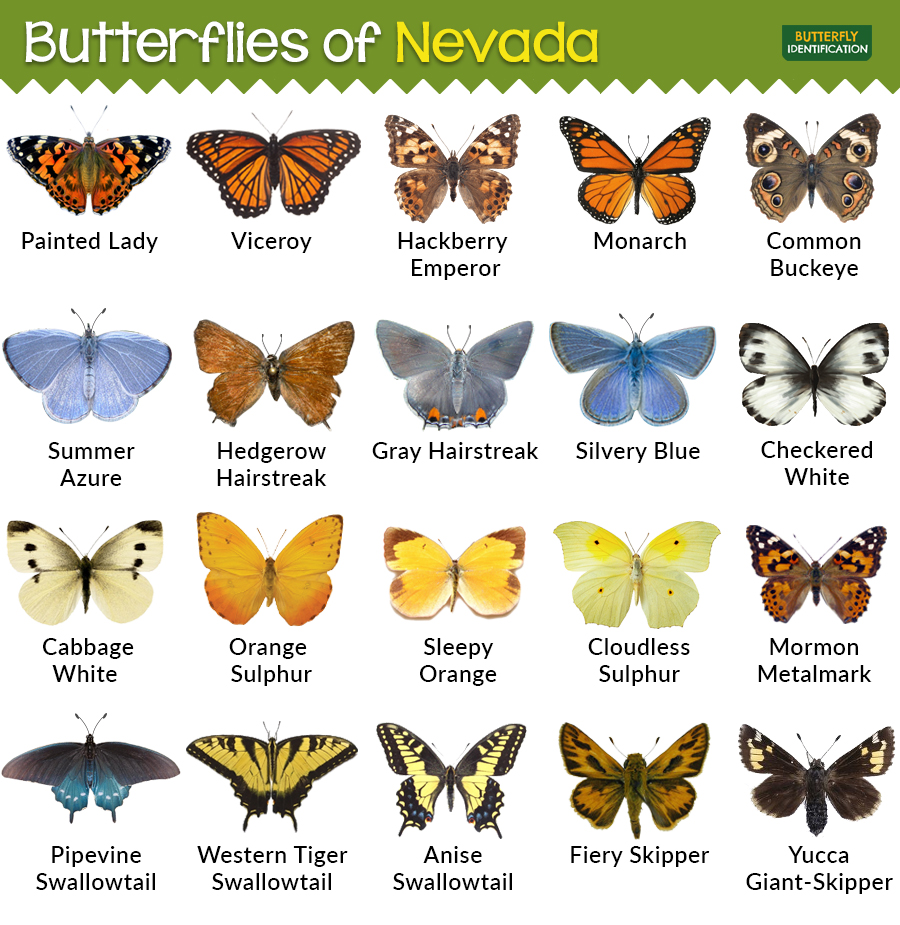
- Viceroy (Limenitis archippus)
- Weidemeyer’s Admiral (Limenitis weidemeyerii)
- Hackberry Emperor (Asterocampa celtis)
- Callippe Fritillary (Speyeria callippe)
- Carol’s Fritillary (Speyeria carolae)
- Coronis Fritillary (Speyeria coronis)
- Great Basin Fritillary (Speyeria egleis)
- Great Spangled Fritillary (Speyeria cybele)
- Gulf Fritillary (Agraulis vanillae)
- Mormon Fritillary (Speyeria mormonia)
- Nokomis Fritillary (Speyeria nokomis)
- Northwestern Fritillary (Speyeria hesperis)
- Pacific Fritillary (Boloria epithore)
- Variegated Fritillary (Euptoieta claudia)
- Zerene Fritillary (Speyeria zerene)
- Monarch (Danaus plexippus)
- Queen (Danaus gilippus)
- American Snout (Libytheana carinenta)
- American Lady (Vanessa virginiensis)
- Bordered Patch (Chlosyne lacinia)
- California Crescent (Phyciodes orseis)
- California Patch (Chlosyne californica)
- California Tortoiseshell (Nymphalis californica)
- Common Buckeye (Junonia coenia)
- Compton Tortoiseshell (Nymphalis vaualbum)
- Dotted Checkerspot (Poladryas minuta)
- Edith’s Checkerspot (Euphydryas editha)
- Field Crescent (Phyciodes pulchellus)
- Fulvia Checkerspot (Thessalia fulvia)
- Gray Comma (Polygonia progne)
- Green Comma (Polygonia faunus)
- Hoary Comma (Polygonia gracilis)
- Hoffmann’s Checkerspot (Chlosyne hoffmanni)
- Leanira Checkerspot (Thessalia leanira)
- Milbert’s Tortoiseshell (Aglais milberti)
- Mourning Cloak (Nymphalis antiopa)
- Mylitta Crescent (Phyciodes mylitta)
- Northern Checkerspot (Chlosyne palla)
- Northern Crescent (Phyciodes cocyta)
- Painted Lady (Vanessa cardui)
- Pale Crescent (Phyciodes pallida)
- Pearl Crescent (Phyciodes tharos)
- Phaon Crescent (Phyciodes phaon)
- Red Admiral (Vanessa atalanta)
- Sagebrush Checkerspot (Chlosyne acastus)
- Satyr Comma (Polygonia satyrus)
- Tawny Crescent (Phyciodes batesii)
- Texan Crescent (Phyciodes texana)
- Tropical Buckeye (Junonia genoveva)
- Variable Checkerspot (Euphydryas chalcedona)
- West Coast Lady (Vanessa annabella)
- Common Ringlet (Coenonympha tullia)
- Common Wood Nymph (Cercyonis pegala)
- Great Basin Wood Nymph (Cercyonis sthenele)
- Small Wood Nymph (Cercyonis oetus)
- Ridings’ Satyr (Neominois ridingsii)
- Chryxus Arctic (Oeneis chryxus)
Gossamer-Winged (Lycaenidae)
- Tailed Copper (Lycaena arota)
- Ruddy Copper (Lycaena rubidus)
- Blue Copper (Lycaena heteronea)
- Purplish Copper (Lycaena helloides)
- Lilac-bordered Copper (Lycaena nivalis)
- Coral Hairstreak (Satyrium titus)
- Behr’s Hairstreak (Satyrium behrii)
- California Hairstreak (Satyrium californica)
- Sylvan Hairstreak (Satyrium sylvinus)
- Hedgerow Hairstreak (Satyrium saepium)
- Western Green Hairstreak (Callophrys affinis)
- Brown Elfin (Callophrys augustinus)
- Desert Elfin (Callophrys fotis)
- Western Pine Elfin (Callophrys eryphon)
- Thicket Hairstreak (Callophrys spinetorum)
- Gray Hairstreak (Strymon melinus)
- Western Pygmy-Blue (Brephidium exile)
- Marine Blue (Leptotes marina)
- Ceraunus Blue (Hemiargus ceraunus)
- Reakirt’s Blue (Hemiargus isola)
- Western Tailed-Blue (Everes amyntula)
- Spring Azure (Celastrina ‘ladon’)
- Bernardino Dotted-Blue (Euphilotes bernardino)
- Rocky Mountain Dotted-Blue (Euphilotes ancilla)
- Pallid Dotted-Blue (Euphilotes pallescens)
- Spalding’s Dotted-Blue (Euphilotes spaldingi)
- Arrowhead Blue (Glaucopsyche piasus)
- Silvery Blue (Glaucopsyche lygdamus)
- Melissa Blue (Lycaeides melissa)
- Greenish Blue (Plebeius saepiolus)
- Boisduval’s Blue (Plebeius icarioides)
- Shasta Blue (Plebeius shasta)
- Lupine Blue (Plebeius lupini)
Whites and Sulphurs (Pieridae)
- Pine White (Neophasia menapia)
- Becker’s White (Pontia beckerii)
- Spring White (Pontia sisymbrii)
- Checkered White (Pontia protodice)
- Western White (Pontia occidentalis)
- Margined White (Pieris marginalis)
- Cabbage White (Pieris rapae)
- Large Marble (Euchloe ausonides)
- Desert Marble (Euchloe lotta)
- Southwestern Orangetip (Anthocharis thoosa)
- Clouded Sulphur (Colias philodice)
- Orange Sulphur (Colias eurytheme)
- Queen Alexandra’s Sulphur (Colias alexandra)
- Southern Dogface (Zerene cesonia)
- Cloudless Sulphur (Phoebis sennae)
- Sleepy Orange (Eurema nicippe)
- Dainty Sulphur (Nathalis iole)
Metalmark (Riodinidae)
- Mormon Metalmark (Apodemia mormo)
Swallowtail (Papilionidae)
- Clodius Parnassian (Parnassius clodius)
- Rocky Mountain Parnassian (Parnassius smintheus)
- Anise Swallowtail (Papilio zelicaon)
- Black Swallowtail (Papilio polyxenes)
- Giant Swallowtail (Papilio cresphontes)
- Indra Swallowtail (Papilio indra)
- Old World Swallowtail (Papilio machaon)
- Pale Swallowtail (Papilio eurymedon)
- Pipevine Swallowtail (Battus philenor)
- Two-tailed Swallowtail (Papilio multicaudata)
- Western Tiger Swallowtail (Papilio rutulus)
Skipper (Hesperiidae)
- Dreamy Duskywing (Erynnis icelus)
- Rocky Mountain Duskywing (Erynnis telemachus)
- Persius Duskywing (Erynnis persius)
- Small Checkered-Skipper (Pyrgus scriptura)
- Common Checkered-Skipper (Pyrgus communis)
- Northern White-Skipper (Heliopetes ericetorum)
- Mohave Sootywing (Hesperopsis libya)
- Fiery Skipper (Hylephila phyleus)
- Uncas Skipper (Hesperia uncas)
- Juba Skipper (Hesperia juba)
- Western Branded Skipper (Hesperia colorado)
- Pahaska Skipper (Hesperia pahaska)
- Sandhill Skipper (Polites sabuleti)
- Woodland Skipper (Ochlodes sylvanoides)
- Yuma Skipper (Ochlodes yuma)
- Yucca Giant-Skipper (Megathymus yuccae)