
Types of Butterflies in New Jersey
There are about 125 butterfly species spotted in this northeastern US state, with the most common being tiger swallowtail, spicebush swallowtail, orange sulphur, American copper, red-banded hairstreak, eastern tailed-blue, and American lady. Among the 125 species, seven have been listed as threatened or endangered, including the Frosted Elfin, Silver-bordered Fritillary, and Checkered White. The places in New Jersey where you can frequently spot these butterflies are the Wharton State Forest, Colliers Mills Wildlife area, Cheesequake State Park, and Atlantic coastal areas.
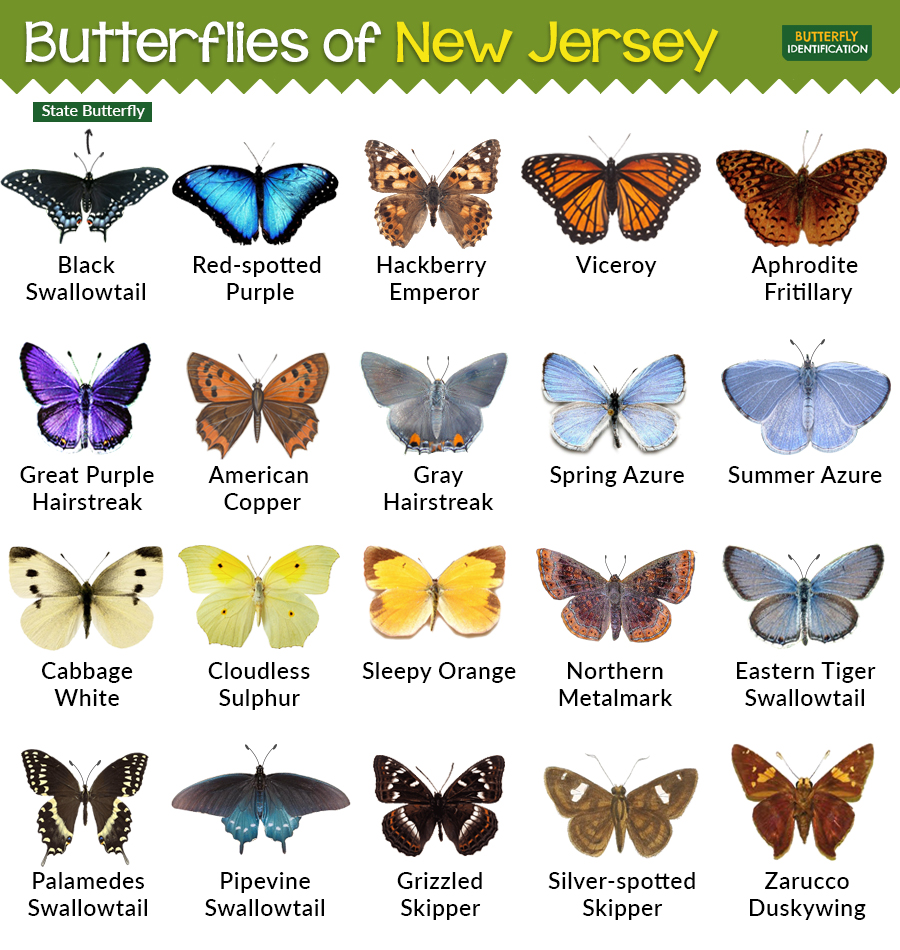
The state has designated the Black Swallowtail Butterfly (Papilio polyxenes) as the official state-butterfly in 2015.
Brush-Footed (Nymphalidae)
- ‘Astyanax’ Red-spotted Purple (Limenitis arthemis astyanax)
- Red-spotted Purple (Limenitis arthemis)
- Viceroy (Limenitis archippus)
- White Admiral (Limenitis arthemis arthemis)
- Hackberry Emperor (Asterocampa celtis)
- Tawny Emperor (Asterocampa clyton)
- Aphrodite Fritillary (Speyeria aphrodite)
- Atlantis Fritillary (Speyeria atlantis)
- Great Spangled Fritillary (Speyeria cybele)
- Gulf Fritillary (Agraulis vanillae)
- Meadow Fritillary (Boloria bellona)
- Regal Fritillary (Speyeria idalia)
- Silver-bordered Fritillary (Boloria selene)
- Variegated Fritillary (Euptoieta claudia)
- Monarch (Danaus plexippus)
- American Snout (Libytheana carinenta)
- American Lady (Vanessa virginiensis)
- Baltimore (Euphydryas phaeton)
- Common Buckeye (Junonia coenia)
- Compton Tortoiseshell (Nymphalis vaualbum)
- Eastern Comma (Polygonia comma)
- Gray Comma (Polygonia progne)
- Green Comma (Polygonia faunus)
- Harris’ Checkerspot (Chlosyne harrisii)
- Milbert’s Tortoiseshell (Aglais milberti)
- Mourning Cloak (Nymphalis antiopa)
- Northern Crescent (Phyciodes cocyta)
- Painted Lady (Vanessa cardui)
- Pearl Crescent (Phyciodes tharos)
- Question Mark (Polygonia interrogationis)
- Red Admiral (Vanessa atalanta)
- Silvery Checkerspot (Chlosyne nycteis)
- Tawny Crescent (Phyciodes batesii)
- White Peacock (Anartia jatrophae)
Gossamer-Winged (Lycaenidae)
- Harvester (Feniseca tarquinius)
- American Copper (Lycaena phlaeas)
- Bronze Copper (Lycaena hyllus)
- Bog Copper (Lycaena epixanthe)
- Great Purple Hairstreak (Atlides halesus)
- Olive (Juniper) Hairstreak (Callophrys gryneus)
- Hessel’s Hairstreak (Callophrys hesseli)
- Early Hairstreak (Erora laeta)
- White-M Hairstreak (Parrhasius m-album)
- Coral Hairstreak (Satyrium titus)
- Gray Hairstreak (Strymon melinus)
- Banded Hairstreak (Satyrium calanus)
- Striped Hairstreak (Satyrium liparops)
- Acadian Hairstreak (Satyrium acadica)
- Edwards’ Hairstreak (Satyrium edwardsii)
- Oak Hairstreak (Satyrium favonius)
- Red-banded Hairstreak (Calycopis cecrops)
- Hickory Hairstreak (Satyrium caryaevorus)
- Northern’ Southern Hairstreak (Satyrium favonius ontario)
- Henry’s Elfin (Callophrys henrici)
- Eastern Pine Elfin (Callophrys niphon)
- Frosted Elfin (Callophrys irus)
- Brown Elfin (Callophrys augustinus)
- Hoary Elfin (Callophrys polios)
- Spring Azure (Celastrina ladon)
- Summer Azure (Celastrina neglecta)
- Eastern Tailed-Blue (Cupido comyntas)
- Northern Azure (Celastrina lucia)
- Appalachian Azure (Celastrina neglectamajor)
- Holly Azure (Celastrina idella)
- Melissa Blue (Plebejus melissa)
- Lupine Blue (Plebejus lupini)
Whites and Sulphurs (Pieridae)
- Falcate Orangetip (Anthocharis midea)
- Mustard White (Pieris oleracea)
- Cabbage White (Pieris rapae)
- Checkered White (Pontia protodice)
- Western White (Pontia occidentalis)
- West Virginia White (Pieris virginiensis)
- Cloudless Sulphur (Phoebis sennae)
- Large Orange Sulphur (Phoebis agarithe)
- Orange-barred Sulphur (Phoebis philea)
- Sleepy Orange (Eurema nicippe)
- Little Yellow (Pyrisitia lisa)
Metalmark (Riodinidae)
- Northern Metalmark (Calephelis borealis)
Swallowtail (Papilionidae)
- Black Swallowtail (Papilio polyxenes)
- Eastern Tiger Swallowtail (Papilio glaucus)
- Giant Swallowtail (Papilio cresphontes)
- Palamedes Swallowtail (Papilio palamedes)
- Pipevine Swallowtail (Battus philenor)
- Spicebush Swallowtail (Papilio troilus)
- Zebra Swallowtail (Eurytides marcellus)
Skipper (Hesperiidae)
- Columbine Duskywing (Erynnis lucilius)
- Common Checkered-Skipper (Pyrgus communis)
- Common Sootywing (Pholisora catullus)
- Confusing Cloudywing (Thorybes confusis)
- Dreamy Duskywing (Erynnis icelus)
- Golden Banded-Skipper (Autochton cellus)
- Grizzled Skipper (Pyrgus centaureae)
- Hayhurst’s Scallopwing (Staphylus hayhurstii)
- Hoary Edge (Achalarus lyciades)
- Horace’s Duskywing (Erynnis horatius)
- Juvenal’s Duskywing (Erynnis juvenalis)
- Long-tailed Skipper (Urbanus proteus)
- Mottled Duskywing (Erynnis martialis)
- Northern Cloudywing (Thorybes pylades)
- Persius Duskywing (Erynnis persius)
- Silver-spotted Skipper (Epargyreus clarus)
- Sleepy Duskywing (Erynnis brizo)
- Southern Cloudywing (Thorybes bathyllus)
- Wild Indigo Duskywing (Erynnis baptisiae)
- Zarucco Duskywing (Erynnis zarucco)