
Types of Butterflies in Vermont
The north-eastern US state is home to about 103 species of butterfly, of which half are spotted in 8 biophysical regions. Some migratory species include the Vanessa butterflies, American Lady, Painted Lady, and Red Admiral. These species fly towards the north during the breeding season and return to the south for the winter.
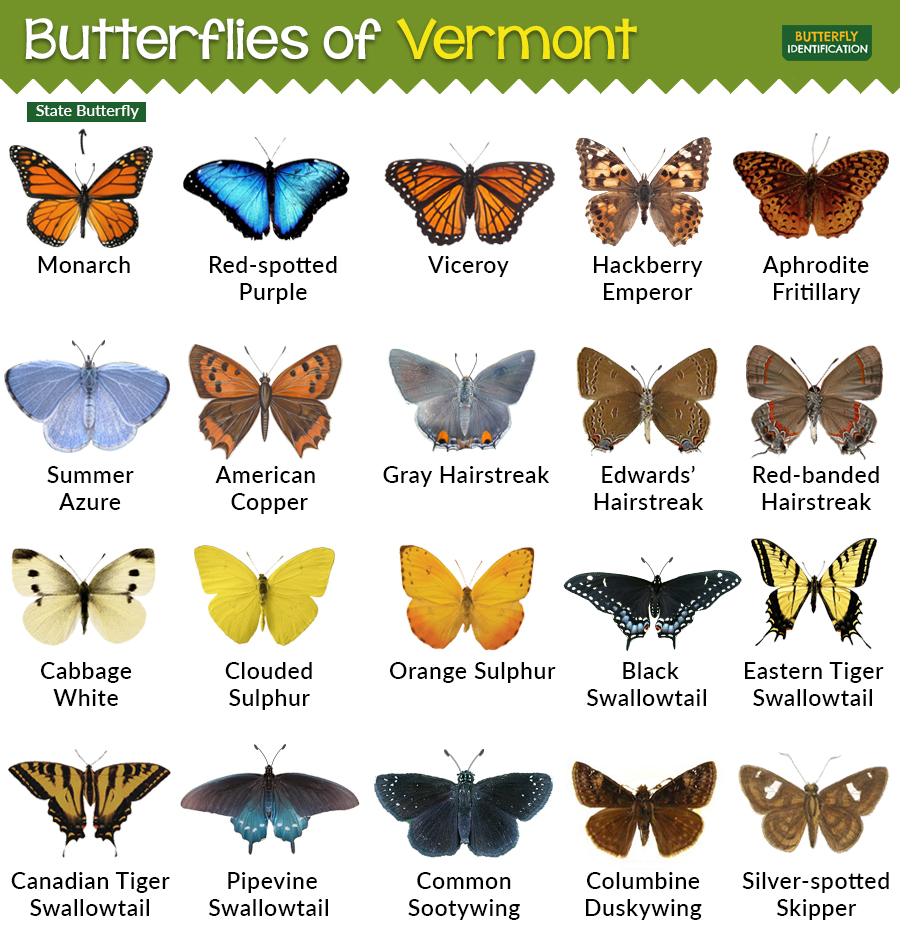
The Monarch butterfly (Danaus plexippus) is the official state butterfly of Vermont.
Brush-Footed (Nymphalidae)
- ‘Astyanax’ Red-spotted Purple (Limenitis arthemis astyanax)
- Red-spotted Purple (Limenitis arthemis)
- Viceroy (Limenitis archippus)
- White Admiral (Limenitis arthemis arthemis)
- Hackberry Emperor (Asterocampa celtis)
- Aphrodite Fritillary (Speyeria aphrodite)
- Atlantis Fritillary (Speyeria atlantis)
- Great Spangled Fritillary (Speyeria cybele)
- Meadow Fritillary (Boloria bellona)
- Silver-bordered Fritillary (Boloria selene)
- Variegated Fritillary (Euptoieta claudia)
- Monarch (Danaus plexippus)
- American Snout (Libytheana carinenta)
- American Lady (Vanessa virginiensis)
- Baltimore (Euphydryas phaeton)
- California Tortoiseshell (Nymphalis californica)
- Compton Tortoiseshell (Nymphalis vaualbum)
- Eastern Comma (Polygonia comma)
- Gray Comma (Polygonia progne)
- Green Comma (Polygonia faunus)
- Harris’ Checkerspot (Chlosyne harrisii)
- Milbert’s Tortoiseshell (Aglais milberti)
- Mourning Cloak (Nymphalis antiopa)
- Northern Crescent (Phyciodes cocyta)
- Painted Lady (Vanessa cardui)
- Pearl Crescent (Phyciodes tharos)
- Question Mark (Polygonia interrogationis)
- Red Admiral (Vanessa atalanta)
- Silvery Checkerspot (Chlosyne nycteis)
- Tawny Crescent (Phyciodes batesii)
Gossamer-Winged (Lycaenidae)
- Harvester (Feniseca tarquinius)
- Brown Elfin (Callophrys augustinus)
- Henry’s Elfin (Callophrys henrici)
- Eastern Pine Elfin (Callophrys niphon)
- Olive (Juniper) Hairstreak (Callophrys gryneus)
- Bog Elfin (Callophrys lanoraieensis)
- Summer Azure (Celastrina neglecta)
- Nothern Azure (Celastrina lucia)
- Cherry Gall Azure (Celastrina serotina)
- Eastern Tailed-Blue (Cupido comyntas)
- American Copper (Lycaena phlaeas)
- Bog Copper (Lycaena epixanthe)
- Bronze Copper (Lycaena hyllus)
- Coral Hairstreak (Satyrium titus)
- Striped Hairstreak (Satyrium liparops)
- Gray Hairstreak (Strymon melinus)
- Banded Hairstreak (Satyrium calanus)
- White “M” Hairstreak (Parrhasius m-album)
- Edwards’ Hairstreak (Satyrium edwardsii)
- Hickory Hairstreak (Satyrium caryaevorus)
- Acadian Hairstreak (Satyrium acadica)
- Southern (Oak) Hairstreak (Satyrium favonius)
- Red-banded Hairstreak (Calycopis cecrops)
- Early Hairstreak (Erora laeta)
Whites and Sulphurs (Pieridae)
- Mustard White (Pieris oleracea)
- West Virginia White (Pieris virginiensis)
- Cabbage White (Pieris rapae)
- Clouded Sulphur (Colias philodice)
- Orange Sulphur (Colias eurytheme)
- Pink-edged Sulphur (Colias interior)
- Little Yellow (Eurema lisa)
Swallowtail (Papilionidae)
- Black Swallowtail (Papilio polyxenes)
- Canadian Tiger Swallowtail (Papilio canadensis)
- Eastern Tiger Swallowtail (Papilio glaucus)
- Pipevine Swallowtail (Battus philenor)
- Spicebush Swallowtail (Papilio troilus)
Skipper (Hesperiidae)
- Columbine Duskywing (Erynnis lucilius)
- Common Sootywing (Pholisora catullus)
- Dreamy Duskywing (Erynnis icelus)
- Hoary Edge (Achalarus lyciades)
- Juvenal’s Duskywing (Erynnis juvenalis)
- Long-tailed Skipper (Urbanus proteus)
- Northern Cloudywing (Thorybes pylades)
- Persius Duskywing (Erynnis persius)
- Silver-spotted Skipper (Epargyreus clarus)
- Wild Indigo Duskywing (Erynnis baptisiae)