
Skipper (Hesperiidae)
Skippers are the roughly 4,000 species of the family Hesperiidae — small, stout, fast-flying butterflies with a large head, a thick moth-like body and an antennal club that bends back into a tiny hook. They fly worldwide except Antarctica, with about 300 species north of Mexico, and their caterpillars live inside leaf shelters tied with silk. Despite the moth-like build, current classification places them firmly inside the butterflies.

On this page
- Butterflies in this family
- What are skippers (Hesperiidae)?
- Are skippers true butterflies?
- How to identify a skipper
- Life cycle of the Hesperiidae
- Host plants and adult food
- Where skippers live
- Behavior: darting flight, perching and puddling
- Families and groups that look similar
- Did you know?
- Frequently asked questions
What are skippers (Hesperiidae)?
Skippers are the Hesperiidae, a family of about 4,000 described species in some 570 genera — the third largest butterfly family after the brush-foots and the gossamer-wings. They occur on every continent except Antarctica, are most diverse in the Neotropics, and around 300 species fly in the United States and Canada.
Two features define them. The first is the antenna: the club at the tip is drawn out and bent backwards into a small hook, the apiculus, which no other butterfly family has. The second is the build — a thick, muscular thorax, a head as wide as the thorax, widely spaced antennal bases and short, triangular wings. Together they produce the buzzing, darting flight that gave the group its name. Older accounts describe roughly eight families within the skippers; they are in fact about eight subfamilies, including the grass skippers (Hesperiinae), the spread-wing skippers (Pyrginae and Eudaminae) and the awls (Coeliadinae).
Are skippers true butterflies?
Yes. The question comes up constantly because skippers look halfway to a moth, and because for most of the twentieth century field guides placed them in a superfamily of their own, Hesperioidea, set apart from the "true butterflies" of the Papilionoidea. Molecular phylogenies published from the mid-2000s onwards dismantled that split: the skippers sit inside Papilionoidea alongside the swallowtails, the whites, the blues and the brush-foots, and the current classification recognises them simply as one of the butterfly families.
They remain the most moth-like of the butterflies: stout-bodied, heavily muscled, and unique in that many species spin a loose silken shelter around the pupa that is close to a true cocoon. What keeps them unmistakably butterflies is the antenna — clubbed, hooked at the tip and never feathery or thread-like the way a moth's is. Our guide to the parts of a butterfly shows where to look.
How to identify a skipper
Most skippers span 0.8–2.4 in (20–60 mm), with the tropical giants of the genus Megathymus and some awls larger still. Colours are usually orange, tawny, brown, grey or near-black, patterned with translucent glassy windows, silver patches or pale chevrons rather than bright pigment — the bold silver blotch on the underside of the silver-spotted skipper is a good example, as is the chequered grey-and-white of the grizzled skipper.
Resting posture separates the two big groups instantly. Grass skippers, including the fiery skipper, perch with the forewings held up at roughly 45 degrees while the hindwings stay flat — a jet-plane silhouette found in no other butterfly. Spread-wing skippers, such as the long-tailed skipper with its iridescent blue-green body and paired hindwing tails, open both pairs flat against a leaf. Males of many grass skippers carry a black, felt-like stigma of scent scales along the forewing, an obvious sex mark absent in females.
Life cycle of the Hesperiidae
Eggs
Skipper eggs are small domes or hemispheres, often finely ribbed or pitted, laid singly and glued to a leaf of the host plant — usually the underside in grass skippers rather than the top surface. They are white, cream or pale green and often develop a coloured ring as the embryo grows, hatching within four to ten days; the general pattern is covered in our guide to butterfly eggs.
Caterpillar
The larva is the easiest skipper stage to name. It has an oversized, often dark head held apart from a smooth, tapering body by a sharply constricted neck, and almost no hair or spines. Nearly every species builds a shelter: the caterpillar cuts a flap of leaf or draws two grass blades together and ties them with silk, feeding at the edges and retreating inside between meals. Silver-spotted skipper larvae go further and flick their frass pellets a metre or more away, removing the scent trail parasitic wasps follow. See our guide to butterfly caterpillars.
Chrysalis
Pupation happens inside the final larval shelter or in leaf litter at the base of the plant. The chrysalis is slender, smooth and usually pale green, brown or whitish, held by a cremaster and a silk girdle, often dusted with a white waxy bloom and wrapped in loose silk — as close to a cocoon as any butterfly gets.
Adult butterfly
Adults generally live two to four weeks. Northern grass skippers such as the Dakota skipper have one brood and fly for only two or three weeks in early summer, while subtropical species produce three or more generations a year. Most skippers overwinter as a full-grown caterpillar sealed in its shelter; a smaller number as a pupa.
Host plants and adult food
The family splits cleanly by diet. Grass skippers (Hesperiinae) feed on monocots — panic grass, bluestem, bermuda grass, switchgrass, sedges, palms and bamboo — which is why the fiery skipper is a familiar lawn insect across the southern United States. The spread-wing skippers go to dicots, above all the pea family: black locust and wisteria for the silver-spotted skipper, beans and other legumes for the long-tailed skipper, which growers know as the bean leafroller. Duskywings use oaks and willows, and the grizzled skipper lays on wild strawberry, cinquefoil and agrimony in the rose family — see our guide to butterfly host plants.
Adults take nectar from low, flat-topped flowers — milkweed, thistle, clover, vervain, lantana, dogbane — often in the jet-plane pose. Males also gather at damp sand, dung and carrion, where they are taking up sodium and amino acids rather than the "vitamins" older sources mention.
Where skippers live
Skippers are worldwide butterflies, absent only from Antarctica and a few remote islands. More than half of all species live in Central and South America, and the family is also rich in tropical Africa and Asia; Europe has only a few dozen, and Australia has the endemic Trapezitinae. Roughly 300 species reach North America, with the greatest diversity in the hot south — Texas alone records well over a hundred.
Habitat follows the host plants. Grass skippers belong to prairie, meadow, salt marsh, lawn and roadside; spread-wings prefer woodland edges, scrub, gardens and forest clearings. Some are among the most habitat-restricted butterflies anywhere: the Dakota skipper survives only in remnant native tallgrass and mixed-grass prairie and is federally listed as threatened in the United States, while the grizzled skipper has declined sharply across Britain as coppiced woodland and chalk grassland were lost.
Behavior: darting flight, perching and puddling
Skipper flight is the family signature — short, explosive bursts that look more like a hovering bee than a butterfly, produced by a large thorax packed with flight muscle relative to a small wing area. They accelerate and change direction faster than any other butterfly, which is why they are so hard to photograph; the mechanics are explained in our guide to how butterflies fly.
Males are usually perchers rather than patrollers. A male picks a prominent grass stem, leaf tip or bare patch of ground, holds it as a territory through the warm hours, darts out at anything that passes and returns to the same spot within seconds. Basking is done open-winged on bare soil early in the day, and puddling clusters form at wet sand after rain. Many spread-wing skippers roost under a leaf with the wings held flat, which is also how they escape the midday heat.
Butterflies in this family
5 skipper butterflies profiles on Butterfly Identification, each with pictures of the egg, caterpillar, chrysalis and adult, identification marks, host plants, range and FAQ.
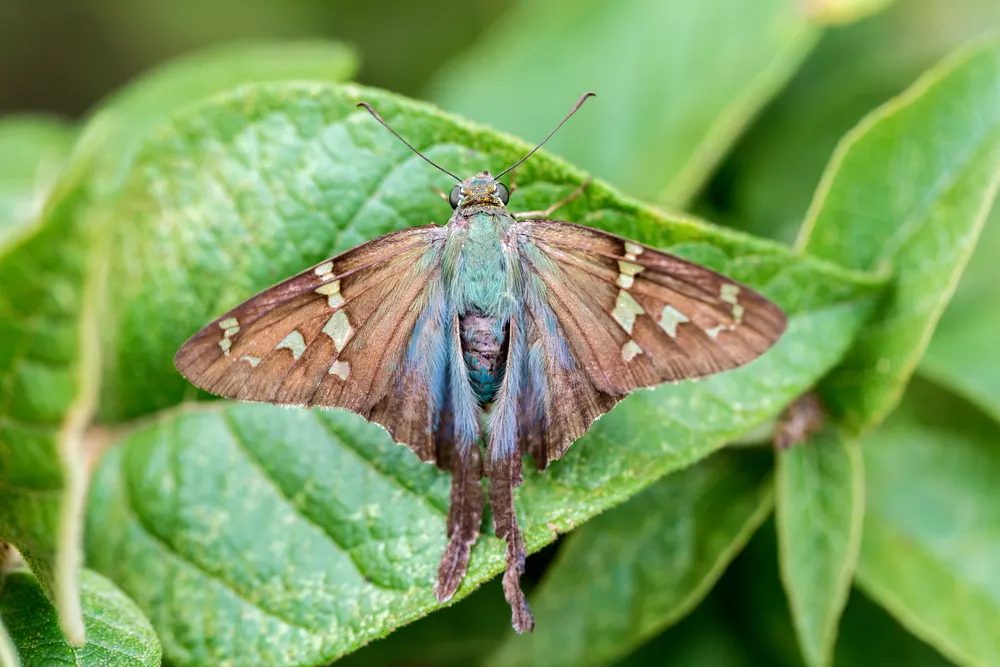 Urbanus proteusLong-tailed Skipper (Urbanus proteus)A stocky brown skipper with a shimmer of blue-green over its body and wing bases and two long tails trailing from the hindwings, the long-tailed skipp
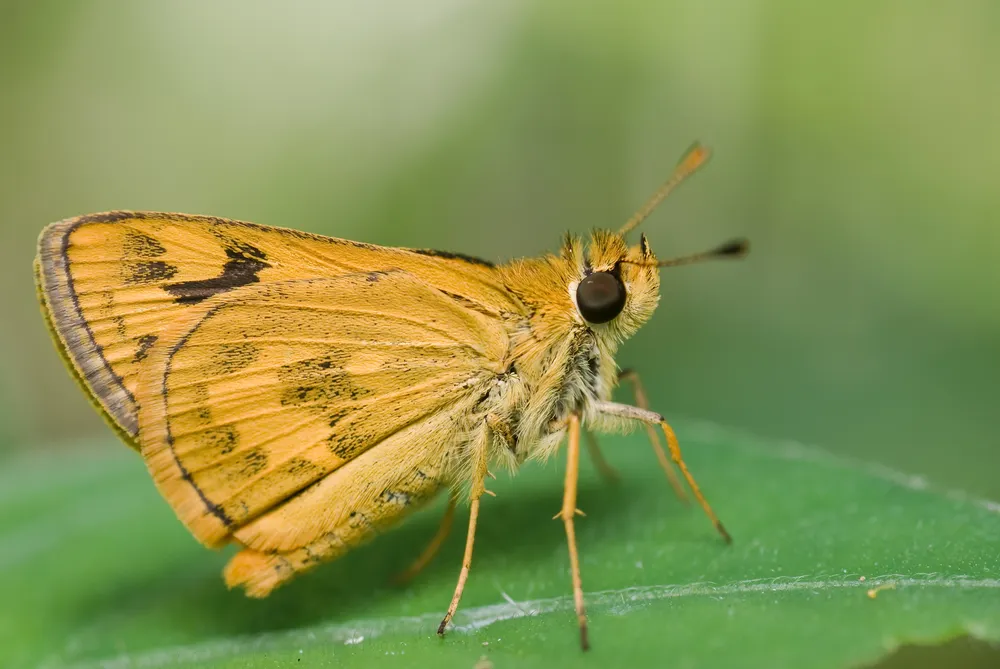 Hylephila phyleusFiery Skipper (Hylephila phyleus)A small orange rocket of a butterfly that sits on a flower with its forewings cocked up and its hindwings flat, the fiery skipper is one of the most f
 Hesperia dacotaeDakota Skipper (Hesperia dacotae)The Dakota skipper (Hesperia dacotae) is a small tawny-orange grass skipper that survives only on remnant native prairie in Manitoba, Saskatchewan, th
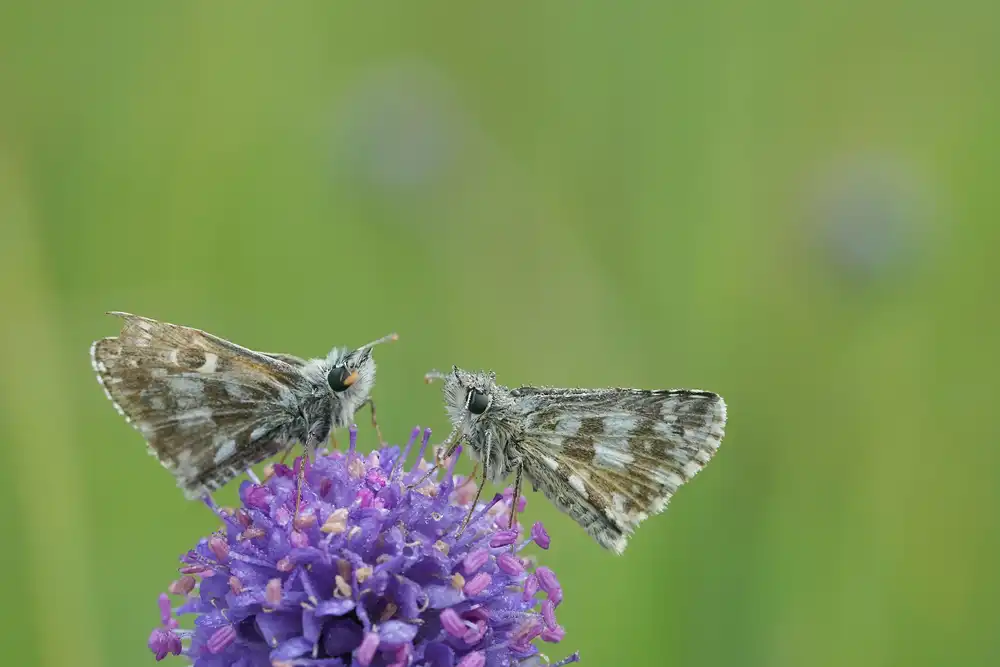 Pyrgus malvaeGrizzled Skipper (Pyrgus malvae)The grizzled skipper (Pyrgus malvae) is a very small black-and-white chequered butterfly of warm, sheltered grassland and woodland clearings across Eu
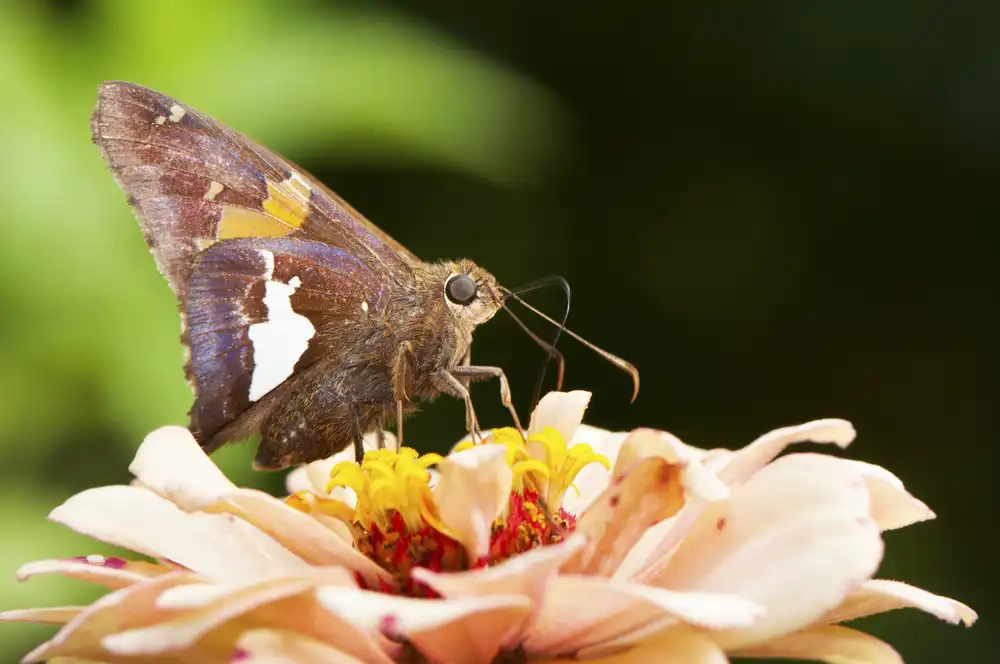 Epargyreus clarusSilver-spotted Skipper (Epargyreus clarus)The silver-spotted skipper is a large, chocolate-brown butterfly of gardens, field edges and woodland clearings across almost the whole of North Ameri
Families and groups that look similar
| Group | Looks like | How to tell them apart |
|---|---|---|
| Day-flying moths | Stout body, fast buzzing flight, dull brown or orange wings | A skipper's antenna ends in a club with a backward hook; moth antennae are feathery or thread-like and never clubbed that way |
| Gossamer-winged (Lycaenidae) | Small brown and grey species at a distance | Lycaenids have slim bodies and small heads with a straight antennal club; skipper heads are as wide as the thorax and the body is thick |
| Metalmark (Riodinidae) | Small dark butterflies that perch with wings spread | Metalmarks show metallic silver or gold marks and a slender body, and their antennal club is not hooked |
| Brush-footed (Nymphalidae) | Small brown satyrs and crescents share the same grassland | Brush-foots stand on four legs with the front pair reduced; skippers use all six and never rest in the jet-plane pose |
Did you know?
- The name comes from the flight: skippers dart and skip between perches instead of gliding.
- The hooked tip of the antennal club, the apiculus, is unique to this family and is the most reliable field mark.
- Silver-spotted skipper caterpillars fire their droppings well over a metre from the leaf shelter — a defence against wasps that hunt by scent.
- Skippers come closest of all butterflies to spinning a cocoon: the pupa usually sits inside a silk-lined leaf shelter, often coated with white wax.
- The Dakota skipper is protected as a threatened species in the United States, and the grizzled skipper is a conservation priority in the United Kingdom.
- Grass skippers rest in a posture no other butterfly uses, forewings raised and hindwings flat.
In summary
The Hesperiidae, the skippers, are roughly 4,000 stout, fast-flying butterflies recognised by a hooked antennal club, a wide head and short triangular wings. Their caterpillars have a huge head on a narrow neck and live in silk-tied leaf shelters, feeding on grasses or legumes. Moth-like as they look, skippers are true butterflies within the superfamily Papilionoidea.
Frequently asked questions about skipper butterflies
Are skippers butterflies or moths?
Skippers are butterflies. They were once placed in a separate superfamily, Hesperioidea, but molecular studies moved them inside Papilionoidea with the swallowtails, whites, blues and brush-foots. The give-away is the antenna: skippers have a clubbed antenna with a hooked tip, while moths have feathery or thread-like antennae and mostly fly at night.
How do I tell a skipper from a moth in the field?
Check the antennae first. A skipper's antenna widens into a club that bends backwards into a small hook; no moth has that. Skippers also fly by day, have large eyes set in a wide head, and many rest with the forewings raised and the hindwings flat, a posture moths never use.
What butterflies are in the skipper family?
The Hesperiidae contain about 4,000 species in roughly eight subfamilies, including grass skippers, spread-wing skippers, duskywings and awls. Widely known members are the silver-spotted skipper, long-tailed skipper, fiery skipper, common checkered skipper, European grizzled skipper and the prairie-restricted Dakota skipper of North America.
What do skipper caterpillars eat?
It depends on the subfamily. Grass skipper caterpillars eat grasses and sedges such as bluestem, panic grass, bermuda grass and switchgrass. Spread-wing skippers eat broad-leaved plants, especially legumes: black locust and wisteria for the silver-spotted skipper, beans for the long-tailed skipper, plus oaks, willows and rose-family plants for others.
Why do skipper caterpillars roll leaves?
The rolled leaf is a shelter. A skipper caterpillar cuts a flap or ties blades together with silk, then feeds at the edges and hides inside between meals, which protects it from birds, wasps, heat and rain. Most species also pupate in that shelter, and many overwinter inside it as full-grown larvae.
Are skipper butterflies harmful?
Not to people. Skippers do not bite or sting and are not poisonous. A few are minor crop or lawn pests: fiery skipper larvae can brown patches of turf grass, and the long-tailed skipper is known as the bean leafroller where it feeds on beans and peas. The adults are useful pollinators.
How big is a skipper butterfly?
Most skippers have a wingspan of 0.8–2.4 in (20–60 mm), making them small to medium butterflies. Grass skippers are usually at the smaller end, around 1 in, while spread-wing skippers such as the silver-spotted skipper reach around 2 in. A few tropical awls and giant skippers are larger still.
How long do skipper butterflies live?
Adult skippers usually live two to four weeks. The complete cycle from egg to adult takes one to three months, though northern species such as the Dakota skipper spend most of the year as a caterpillar and fly for only two or three weeks in early summer. Subtropical species raise several broods annually.
Where do skippers live?
Skippers occur on every continent except Antarctica, with more than half of the roughly 4,000 species in Central and South America. Around 300 fly in the United States and Canada. Grass skippers use prairie, meadow, salt marsh and lawns, while spread-wing skippers prefer woodland edges, scrub, gardens and forest clearings.
Why do skippers fly so fast?
Skippers have an unusually large thorax filled with flight muscle in proportion to short, triangular wings, so they beat faster and accelerate harder than other butterflies. The result is the darting, bee-like flight the family is named for. It helps them hold small perching territories and escape birds in open grassland.
5 species profiles · Last updated September 20, 2026