
Butterflies in Malaysia
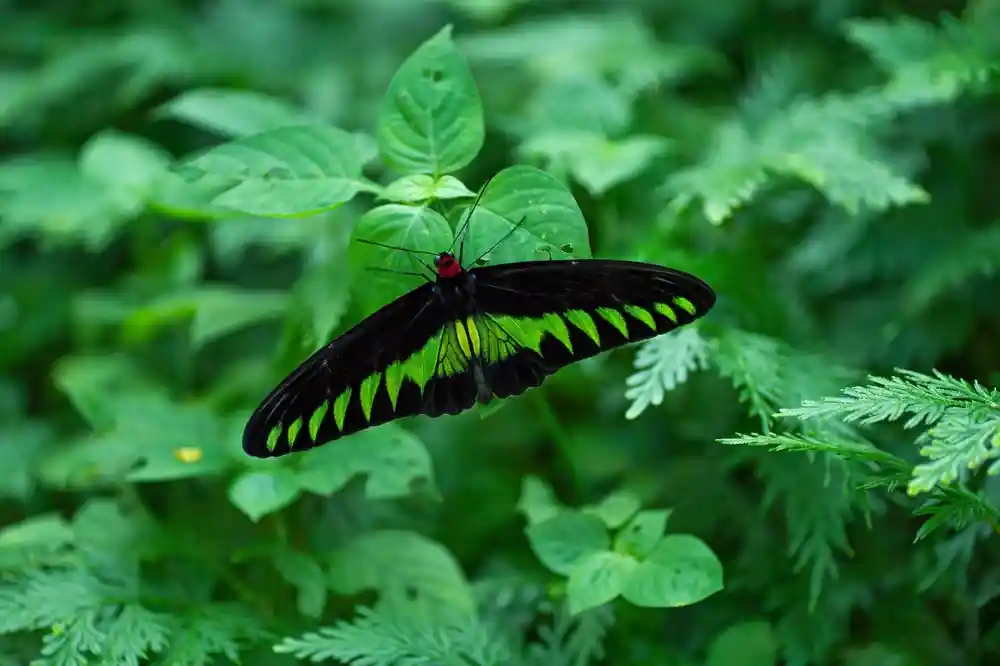
Malaysia has well over 1,000 butterfly species, with about 1,030 recorded in Peninsular Malaysia alone and hundreds more in Sabah and Sarawak on Borneo, which makes it one of the richest butterfly countries on Earth for its size. The national butterfly is Rajah Brooke's Birdwing, a huge black-and-electric-green swallowtail that gathers in crowds at forest hot springs. Birdwings, Mormons, tigers, crows and pansies are the butterflies visitors notice first, but most of the fauna is made up of small oakblues, ceruleans, lineblues and skippers of the lowland rainforest.

On this page
- Butterflies found in Malaysia
- Butterflies of Malaysia at a glance
- Signature Malaysian butterflies
- The Malaysian butterfly calendar
- Where to see butterflies in Malaysia
- Host plants and butterfly gardening in Malaysia
- Conservation and protected butterflies in Malaysia
- How to identify butterflies in Malaysia
- Frequently asked questions
Butterflies of Malaysia at a glance
Malaysia sits near the equator in two halves, the peninsula south of Thailand and the states of Sabah and Sarawak on northern Borneo, both covered, where the forest survives, by some of the oldest rainforest in the world. That is why a country smaller than California holds more butterflies than the whole of North America. The standard reference for the peninsula, Corbet and Pendlebury's Butterflies of the Malay Peninsula, now lists about 1,030 species, and Malaysian Borneo adds several hundred more, many of them found only on that island.
Unlike Europe or North America, the gossamer-winged butterflies are the largest family here, and the oakblues of the genus Arhopala alone run to about 90 species, most of them iridescent blue or purple above and brown below and very hard to separate. The brush-footed butterflies come next, with the tigers and crows of the milkweed group, the pansies, sailers, barons and nawabs and a huge set of browns and rings, then the skippers, the whites and sulphurs, some 40 swallowtails and about 20 metalmarks, a family that is far better represented in Malaysia than anywhere else in Asia.
Signature Malaysian butterflies
Malaysia's national butterfly is Rajah Brooke's Birdwing, described by Alfred Russel Wallace in 1855 from Sarawak and named for the White Rajah. The male is velvet black with a chain of electric-green triangles along each wing and a crimson collar, and its wingspan reaches about 170 mm. Males gather by the dozen at mineral seeps and hot springs, most famously at Kuala Woh and Ulu Geroh in Perak, while the larger brown-and-white females stay in the canopy on pipevines.
The other giants are the Common Birdwing (Troides helena) and the Golden Birdwing (Troides amphrysus), black and yellow swallowtails that sail slowly along forest edges, and the Great Mormon, whose females come in several forms that mimic the poisonous roses and windmills. The Common Mormon (Papilio polytes), Red Helen, Banded Peacock (Papilio palinurus) with its metallic green bands, and the Tailed Jay (Graphium agamemnon) are common garden swallowtails, and the White Dragontail (Lamproptera curius), a tiny black-and-white swallowtail with tails longer than its body, hovers at stream edges beside its cousin the Green Dragontail.

Among the brush-foots, the Tree Nymph or Paper Kite (Idea leuconoe) floats through the Langkawi mangroves like a piece of paper, the Plain Tiger, Common Tiger and Malay Tiger are the orange milkweed butterflies of open ground, and the Striped Blue Crow and Magpie Crow are their dark relatives. The Blue Pansy, Peacock Pansy, Chocolate Pansy and Grey Pansy are the everyday butterflies of lawns and roadsides, the Leopard and Cruiser (Vindula erota) are the orange ones of forest edges, and the Common Fourring is the small brown butterfly of every grassy clearing. The Common Nawab and its relative the Blue Nawab are powerful fliers that come down to rotting fruit, and the Malayan Eggfly and Courtesan are famous mimics.

The small specialities are the Centaur Oakblue, Malay Red Flash, Fluffy Tit and Long-tailed Blue among the blues, and the Harlequin, Malay Red Harlequin and Punchinello among the metalmarks, which flash their red-and-white undersides on the forest floor.
The Malaysian butterfly calendar
There is no winter on the equator, so Malaysian butterflies fly all year and most species have several overlapping generations. What changes is the rain. On the west coast of the peninsula the drier months of February to April bring the most butterflies to the puddling grounds and flowering trees, while the east coast and Sabah are drenched by the north-east monsoon from November to February and come alive from March onwards. In Sarawak the pattern is less marked, and the best days are simply sunny mornings after a night of rain.
Timing within the day matters more than the month. Puddling birdwings, jays, swallowtails and blues gather at damp sand and hot springs between about nine and eleven in the morning; our guide to what butterflies eat explains why they need the salts. Crows, tigers and tree nymphs stay active through the heat, the browns and rings fly at dawn and dusk under the trees, and the skippers dart around palms and bamboo in the early sun. The Tawny Coster, which spread into Peninsular Malaysia from the north in the 1990s and now breeds on passionflower in every town, can be relied on in any month.
Where to see butterflies in Malaysia
Malaysia's butterflies are easy to find because so much of the country is still forest, and a few places have become classic sites.
- Kuala Woh and Ulu Geroh, Perak — the hot springs and river sandbars where Rajah Brooke's Birdwings puddle in numbers from mid-morning.
- Cameron Highlands and Fraser's Hill — cool montane forest with a different set of species, including the highland birdwings and many oakblues.
- Taman Negara and Endau-Rompin — lowland rainforest of the peninsula, with river trails for jays, swallowtails and the fruit-feeding nawabs and barons.
- Kinabalu Park and the Crocker Range, Sabah — Bornean montane species, with Danum Valley and Tabin for the lowland fauna.
- Bako, Kubah and Mulu, Sarawak — accessible Bornean forest close to Kuching and Miri.
- Entopia in Penang and the KL Butterfly Park — walk-through gardens for a first look at the birdwings and Great Mormons.
Malaysia shares almost all of its butterflies with neighbouring Thailand to the north, with Singapore at the tip of the peninsula, and with Sumatra and Kalimantan in Indonesia.
Host plants and butterfly gardening in Malaysia
A Malaysian garden can hold a startling number of species because many butterflies breed on plants that grow happily in towns. Plant caterpillar host plants as well as nectar, and expect the Common Mormons and Lime Butterflies within weeks.
- Lime, pomelo and curry-leaf trees — Common Mormon, Great Mormon and Lime Butterfly.
- Pipevine (Aristolochia) — the birdwings, Common Rose and Common Clubtail; Aristolochia tagala is the vine used by Rajah Brooke's Birdwing.
- Crown flower and other milkweeds — Plain and Common Tigers.
- Passionflower — Tawny Coster and the Leopard Lacewing.
- Bananas and palms — Banana Skipper, Coconut Skipper and Palm King.
- Ixora, lantana and Stachytarpheta — the standard nectar plants.
- Rotting fruit on a tray — nawabs, barons, archdukes and the Cruiser, which rarely visit flowers.
Keep a damp patch of sand in the sun, and the jays, blues and swallowtails will puddle in it on hot mornings.
Conservation and protected butterflies in Malaysia
Malaysia's butterflies live or die with its lowland forest, and the peninsula has lost most of its lowland dipterocarp forest to oil palm, rubber and towns since the 1970s, with Sabah and Sarawak following. Species that never leave the trees, above all the oakblues, metalmarks and many skippers, disappear when the forest is cleared, while the pansies, tigers and grass yellows of open ground have thrived.
Rajah Brooke's Birdwing and the Troides birdwings are protected under the Wildlife Conservation Act 2010 and listed on CITES Appendix II, which regulates the trade in dead specimens that once emptied the puddling sites. The birdwings are now bred in butterfly farms, but wild populations depend on the pipevines of intact hill forest, and the puddling grounds in Perak survive because local communities protect them for visitors. The butterfly habitat guide explains why forest specialists cannot simply move to the plantations that replace their trees.
Butterflies found in Malaysia
203 species listed for Malaysia, grouped by family. Linked names have a full profile on this site with pictures of every life stage.
Brush-Footed (Nymphalidae)
Show all 39 brush-footed species names
- Common Fourring (Ypthima huebneri)
- Courtesan (Euripus nyctelius)
- Royal Assyrian (Terinos terpander)
- Tawny Coster (Acraea violae)
- Polyura athamas athamas
- Chersonesia risa risa
- Danaus chrysippus chrysippus
- Danaus affinis malayanus
- Danaus genutia genutia
- Euploea klugii erichsonii
- Bassarona teuta goodrichi
- Euploea mulciber mulciber
- Euploea radamanthus radamanthus
- Parantica aglea melanoides
- Parantica agleoides agleoides
- Tirumala septentrionis septentrionis
- Cupha erymanthis lotis
- Phalanta phalantha phalantha
- Athyma perius perius
- Junonia orithya wallacei
- Athyma selenophora selenophora
- Lasippa tiga camboja
- Neptis harita harita
- Pantoporia hordonia hordonia
- Pantoporia paraka paraka
- Dophla evelina compta
- Hestina mimetica ruvanella
- Hypolimnas anomala anomala
- Idea leuconoe chersonesia
- Junonia almana javana
- Junonia atlites atlites
- Junonia hedonia seitzi
- Junonia iphita horsfieldi
- Laringa castelnaui castelnaui
- Lexias dirtea iwasakii
- Vagrans egista macromalayana
- Vindula erota chersonesia
- Lethe vindhya luaba
- Mycalesis intermedia distanti
Gossamer-Winged (Lycaenidae)
Show all 79 gossamer-winged species names
- Abnormal Flash (Rapala duma)
- Baby Royal (Bullis buto)
- Bhutya Lineblue (Prosotas bhutea)
- Blue Brilliant (Simiskina phalia)
- Bright Oakblue (Arhopala sublustris)
- Burmese Caerulean (Jamides philatus)
- Cardinal (Thamala marciana)
- Centaur Oakblue (Arhopala centaurus)
- Common Darkie (Allotinus horsfieldi)
- Common Tinsel (Catapaecilma major)
- Dark Grass Blue (Zizeeria karsandra)
- Dark Posy (Drupadia theda)
- De Niceville's Oakblue (Arhopala agrata)
- Dingy Lineblue (Petrelaea dana)
- Doherty's Green Oakblue (Arhopala hellenore)
- Dusky Bushblue (Arhopala paraganesa)
- Fluffy Tit (Zeltus amasa)
- Forest Quaker (Pithecops corvus)
- Glazed Oakblue (Arhopala paralea)
- Glistening Cerulean (Jamides elpis)
- Gracile Line-blue (Prosotas gracilis)
- Gray-washed Oakblue (Arhopala aurelia)
- Green Flash (Artipe eryx)
- Jewel Fourline Blue (Nacaduba sanaya)
- Little Cerulean Oakblue (Arhopala ammonides)
- Long-tailed Blue (Lampides boeticus)
- Malay Red Flash (Rapala damona)
- Moonstone Oakblue (Arhopala camdana)
- Pale Mottle (Logania marmorata)
- Pale Yellow Oakblue (Arhopala moolaiana)
- Papuan Line-blue (Catopyrops ancyra)
- Pitcher Blue (Virachola kessuma)
- Pointed Lineblue (Ionolyce helicon)
- Purple-brown Tailless Oakblue (Arhopala arvina)
- Purple-glazed Oakblue (Arhopala agaba)
- Scarce Guava Blue (Virachola smilis)
- Spotted Royal (Tajuria maculata)
- Tailless Plushblue (Flos areste)
- Una (Una usta)
- Vinous Oakblue (Arhopala athada)
- Violet 4-lineblue (Nacaduba subperusia)
- White Cerulean (Jamides pura)
- White Imperial (Neomyrina nivea)
- White-stained Oakblue (Arhopala aida)
- Yellow Tailed Oakblue (Arhopala elopura)
- Yellow-disk Tailless Oakblue (Arhopala perimuta)
- Zambra Oakblue (Arhopala zambra)
- Amblypodia anita anita
- Ancema ctesia ctesia
- Arhopala atosia
- Arhopala atosia
- Arhopala avatha
- Arhopala bazaloides bazaloides
- Arhopala cleander
- Arhopala corinda
- Arhopala corinda
- Arhopala milleri
- Arhopala silhetensis silhetensis
- Bindahara phocides phocides
- Castalius rosimon rosimon
- Catochrysops panormus exiguus
- Catochrysops strabo strabo
- Euchrysops cnejus cnejus
- Flos apidanus ahamus
- Heliophorus ila
- Luthrodes pandava pandava
- Megisba malaya sikkima
- Nacaduba kirtoni
- Nacaduba pavana vajuva
- Nacaduba solta
- Neopithecops zalmora zalmora
- Prosotas lutea sivoka
- Rapala scintilla scintilla
- Rapala varuna orseis
- Semanga superba
- Udara aristinus
- Udara dilecta dilecta
- Logania distanti massalia
- Taraka hamada mendesia
Whites and Sulphurs (Pieridae)
Show all 9 whites and sulphurs species names
- Common Wanderer (Pareronia anais)
- Catopsilia pomona pomona
- Catopsilia pyranthe pyranthe
- Eurema andersonii andersonii
- Eurema hecabe contubernalis
- Appias albina albina
- Appias lyncida vasava
- Leptosia nina nina
- Pieris canidia canidia
Metalmark (Riodinidae)
Show all 18 metalmark species names
- Abisara geza niya
- Abisara kausambi kausambi
- Abisara kausambi kausambi
- Abisara neophron chelina
- Abisara saturata kausambioides
- Abisara savitri savitri
- Dodona deodata anu
- Dodona egeon confluens
- Dodona eugenes chaseni
- Laxita thuisto thuisto
- Paralaxita damajanti damajanti
- Paralaxita orphna laocoon
- Paralaxita telesia lyclene
- Stiboges nymphidia nymphidia
- Taxila haquinus haquinus
- Zemeros emesoide emesoides
- Zemeros flegyas albipunctatus
- Zemeros flegyas allica
Swallowtail (Papilionidae)
Show all 11 swallowtail species names
- Burmese Raven (Papilio mahadeva)
- Chilasa clytia clytia
- Graphium agamemnon agamemnon
- Lamproptera curius curius
- Papilio helenus helenus
- Papilio memnon agenor
- Papilio palinurus palinurus
- Papilio paris paris
- Papilio polytes romulus
- Troides helena cerberus
- Troides amphrysus ruficollis
Skipper (Hesperiidae)
Show all 47 skipper species names
- Banded Straw Ace (Pithauria marsena)
- Branded Orange Awlet (Burara oedipodea)
- Brown Pied Flat (Coladenia agni)
- Ceylon Dartlet (Oriens goloides)
- Chequered Lancer (Plastingia naga)
- Coconut Skipper (Hidari irava)
- Common Redeye (Matapa aria)
- Continental Swift (Parnara ganga)
- Full Stop Swift (Caltoris cormasa)
- Grass Demon (Udaspes folus)
- Gray-banded Redeye (Matapa druna)
- Large Dart (Potanthus serina)
- Light Straw Ace (Pithauria stramineipennis)
- Maculate Lancer (Salanoemia sala)
- Moore's Ace (Halpe porus)
- Rounded Palm-redeye (Erionota torus)
- Sikkim Ace (Halpe sikkima)
- Veined Palmer (Hidari bhawani)
- Wax Dart (Cupitha purreea)
- Badamia exclamationis
- Hasora badra badra
- Hasora chromus chromus
- Baoris farri farri
- Caltoris brunnea caere
- Caltoris cahira austeni
- Cephrenes trichopepla
- Erionota thrax thrax
- Gangara thyrsis thyrsis
- Hyarotis adrastus praba
- Iambrix salsala salsala
- Iton semamora semamora
- Notocrypta feisthamelii alysos
- Notocrypta paralysos asawa
- Oriens gola pseudolus
- Parnara bada bada
- Pelopidas agna agna
- Pelopidas assamensis
- Pelopidas mathias mathias
- Polytremis lubricans lubricans
- Potanthus confucius dushta
- Suastus gremius gremius
- Telicota bambusae bambusae
- Telicota colon stinga
- Celaenorrhinus leucocera
- Chamunda chamunda
- Gerosis phisara phisara
- Sarangesa dasahara dasahara
How to identify butterflies in Malaysia
With more than a thousand species, Malaysian identification starts with the family and the habit. Huge black butterflies sailing slowly along a forest edge are birdwings if they show green or yellow, and Great Mormons or Red Helens if black with white; a black swallowtail with a red body is one of the poisonous roses or windmills, or a Common Mormon female imitating them. Orange butterflies with black veins on open ground are tigers, dark ones with white spots and a purple sheen are crows, and a butterfly that looks like a scrap of tissue paper drifting over mangroves is a Tree Nymph.
The pansies are told by the eyespots, the sailers and sergeants by the arrangement of their white bands, and the browns, rings and bushbrowns by the number and size of their underside ocelli. The blues are the hard part: a bright blue upperside and a plain brown underside means an oakblue, a line of pale streaks below means a lineblue or cerulean, and tails with a red patch mean a flash or a tit. Browse other countries under Butterflies of the World to compare.
Frequently asked questions about Malaysian butterflies
How many species of butterflies are found in Malaysia?
Well over 1,000 butterfly species have been recorded in Malaysia. The standard reference for Peninsular Malaysia lists about 1,030 species, and Sabah and Sarawak on Borneo add several hundred more, many of them Bornean endemics. That is more species than the whole of North America, packed into a country a little smaller than California.
What is the national butterfly of Malaysia?
Rajah Brooke's Birdwing (Trogonoptera brookiana) is Malaysia's national butterfly. It is a large black swallowtail with a chain of electric-green triangles along each wing, a red collar and a wingspan of about 170 mm. It was described by Alfred Russel Wallace in 1855 from Sarawak and is protected under Malaysian law.
What are the main butterfly families in Malaysia?
The gossamer-winged butterflies, the blues, hairstreaks and oakblues, are the largest family in Malaysia, followed by the brush-footed butterflies, which include the tigers, crows, pansies, sailers, barons, nawabs and browns. Skippers, whites and sulphurs, swallowtails and metalmarks make up the rest, and Malaysia has more metalmark species than any other part of Asia.
Where can I see Rajah Brooke's Birdwing in Malaysia?
The easiest places are the hot springs and river sandbars at Kuala Woh and Ulu Geroh near Gopeng in Perak, where dozens of males gather to drink minerals between about nine and eleven in the morning. They also occur in Taman Negara, the Cameron Highlands, Endau-Rompin and the forests of Sabah and Sarawak, and can be seen in the Penang and Kuala Lumpur butterfly parks.
Are there blue butterflies in Malaysia?
Yes, hundreds. The oakblues of the genus Arhopala alone run to about 90 Malaysian species, most with brilliant blue or purple uppersides, and the ceruleans, lineblues, Long-tailed Blue and Dark Grass Blue add more. Among the brush-foots, the Blue Pansy of open ground and the Striped Blue Crow of forest edges both show blue, and the male Malayan Eggfly has a violet sheen.
What is the Common Fourring butterfly?
The Common Fourring (Ypthima huebneri) is a small greyish-brown butterfly with a large eyespot near each forewing tip and four small ringed eyespots on the underside of each hindwing, which give it its name. It is one of the most abundant butterflies in Malaysia, flying weakly through grassy clearings, roadsides and gardens in every month of the year.
Which pansy butterflies live in Malaysia?
Malaysia has the Blue Pansy, Peacock Pansy, Grey Pansy, Chocolate Pansy and Chocolate Soldier, all in the genus Junonia. They are medium-sized, fast-flying butterflies of lawns, roadsides and open scrub, told apart by their eyespots: large orange-ringed spots on the Peacock Pansy, a blue hindwing on the male Blue Pansy and plain brown wings on the Chocolate Pansy.
Which tiger butterflies are found in Malaysia?
The Plain Tiger, Common Tiger and Malay Tiger, all in the genus Danaus, are the orange milkweed butterflies of Malaysian open ground, together with the Glassy Tigers and Dark Glassy Tiger of Parantica and the Blue Glassy Tiger of Tirumala. All are poisonous to birds because their caterpillars feed on milkweeds, and they are mimicked by several harmless species.
When is the best time to see butterflies in Malaysia?
Butterflies fly all year in Malaysia, but the drier months of February to April on the west coast of the peninsula bring the biggest gatherings at puddling sites and flowering trees. On the east coast and in Sabah wait for the north-east monsoon to end in March. On any day the best hours are the sunny mid-morning after overnight rain.
What is the largest butterfly in Malaysia?
Rajah Brooke's Birdwing and the Golden Birdwing (Troides amphrysus) are the largest, with female wingspans reaching about 170 mm. The Common Birdwing and Great Mormon are close behind at around 150 mm. The smallest Malaysian butterflies are the grass blues and the Pale Mottle, with wingspans of barely 15 to 20 mm.
Published November 10, 2023 · Last updated September 21, 2026