
Butterflies in the Maldives
The Maldives has one of the smallest butterfly faunas of any country: only a few dozen species have ever been recorded across its 1,200 coral islands, and none is endemic. Every one is an Indian or Sri Lankan butterfly that crossed the sea, so the list is dominated by strong fliers and habitual migrants such as the Great Eggfly, the Plain Tiger, the Lemon Migrant and the grass yellows. Butterflies fly all year in the equatorial climate, with the best numbers on the larger, greener islands in the weeks after monsoon rain.

On this page
- Butterflies found in the Maldives
- Butterflies of the Maldives at a glance
- Signature species and how they got here
- Seasons and the monsoon calendar
- Where to see butterflies in the Maldives
- Host plants and butterfly gardening on the islands
- Conservation on low coral islands
- How to identify butterflies in the Maldives
- Frequently asked questions
Butterflies of the Maldives at a glance
The Maldives is a chain of 26 coral atolls strung across 870 kilometres of the Indian Ocean, and almost nothing about it favours butterflies. The islands are tiny, flat and sandy, most stand less than two metres above the sea, and the nearest mainland, the southern tip of India and Sri Lanka, lies several hundred kilometres to the north-east. The native cover is coconut, screw-pine and beach scrub, so there are not many caterpillar food plants to go round.
The result is a list that can be written on a single page. Only a few dozen species have ever been recorded in the country, and the 27 on this page are the ones seen repeatedly. Five families are present. The brush-footed butterflies supply the most species, led by the milkweed butterflies and the eggflies; the blues and the whites and yellows add the small, abundant garden species; two swallowtails and three skippers complete the set. There is no endemic butterfly and no national butterfly: every Maldivian species also flies in Kerala, Tamil Nadu or Sri Lanka, which is where they came from.
Signature species and how they got here
The Great Eggfly, known elsewhere as the Blue Moon, is the showiest resident. The velvet-black male carries a white spot ringed with violet on each wing, and defends a sunny patch of garden for days on end, chasing off anything that passes. The larger brown female lays on weeds of disturbed ground such as sida and purslane, which is why the species does so well on inhabited islands. Its relative the Danaid Eggfly is more remarkable still: its female is a near-perfect copy of the Plain Tiger, whose milkweed diet makes it distasteful to birds.

The Plain Tiger itself is probably the butterfly most visitors notice, a tawny-orange milkweed butterfly with a black, white-spotted wing tip that sails slowly around crown-flower shrubs on the beach edge. The Blue Tiger, pale blue-grey with black veins, belongs to the same group and is a famous long-distance migrant across southern India and Sri Lanka; Maldivian sightings tend to come in pulses, which suggests it arrives from the mainland rather than breeding here in numbers.
The Blue Pansy is the jewel of the open, sandy ground: the male's hindwings glow electric blue and each wing carries an orange-ringed eyespot. The Painted Lady, the most widely distributed butterfly on earth, turns up during the north-east monsoon, when winds blow from India, and is best treated as a visitor rather than a resident. The two swallowtails are the largest butterflies in the country: the Crimson Rose, black with white forewing patches and crimson hindwing spots, and the Common Mormon, whose female may mimic the rose so closely that the two are routinely confused.

Seasons and the monsoon calendar
Lying just north of the equator, the Maldives has no winter and no true dormant season for butterflies; temperatures hover around 30 °C every month. What changes is the rain. The south-west monsoon, roughly May to October, brings the wet season and a flush of fresh growth on grasses, legumes and weeds, and butterfly numbers climb a few weeks behind the rain as caterpillars raised on the new leaves emerge. The drier north-east monsoon, November to April, is the tourist season and still produces butterflies, but fewer, and mostly on islands with irrigated gardens.
The north-east winds also matter for arrivals. Several species on this list are habitual migrants on the mainland, among them the Lemon Migrant, the Blue Tiger, the Crimson Rose and the Painted Lady, and a sea crossing of a few hundred kilometres downwind is well within their range. That is how the fauna was assembled, and why a species can be common one year and absent the next. Our guide to butterfly migration explains how these journeys work.
One resident keeps unusual hours. The Common Evening Brown, a large grass-feeding satyrine, rests in leaf litter through the day and flies at dusk, so the brown butterfly flushed from under a hedge at sunset is almost always this species.
Where to see butterflies in the Maldives
There are no butterfly reserves or organised butterfly walks in the Maldives, and a one-island resort with manicured lawns may hold only three or four species. The best butterfly islands are the large, populated ones with home gardens, waste ground and some freshwater.
- Hulhumalé and the Malé area — planted parks and roadside verges attract grass yellows, grass blues, the Plain Tiger and the Great Eggfly.
- Fuvahmulah — the country's only island with freshwater lakes and marsh, plus taro fields and mango groves, and consequently one of the richest islands for insects.
- Addu Atoll (Gan, Hithadhoo) — the large southern islands with linked causeways, wetland and old plantations.
- Laamu and Gaafu atolls — long agricultural islands with banana, papaya and legume plots where skippers and blues breed.
On any island, look along sunny scrub edges in the first hours after sunrise, around lantana and ixora, and on damp sand, where blues and skippers drink.
Host plants and butterfly gardening on the islands
Because the plant list is short, the connection between a butterfly and its food plant is easy to see in the Maldives, and a garden can be planted to bring almost the whole national list to the door. The caterpillar host plants that matter here are mostly common village plants.
- Crown flower and other milkweeds — the Plain Tiger and Blue Tiger; the shrub grows wild on sandy ground near the beach.
- Citrus and curry leaf — the Common Mormon, whose green caterpillar sits along the leaf midrib.
- Senna and cassia — the Lemon Migrant and the Common Grass Yellow.
- Cowpea, beans and other legumes — the Gram Blue, which is a minor pest of bean pods on farming islands, and the grass blues.
- Coconut and other palms — the Indian Palm Bob, a skipper whose caterpillar rolls a palm leaflet into a shelter.
- Grasses — the Common Evening Brown, the bushbrowns, the Rice Swift and the Paintbrush Swift.
- Passion vine — the Tawny Coster, an orange butterfly that has spread through the region in recent decades.
For nectar the reliable plants are lantana, ixora, tridax daisy and the flowers of the crown flower itself. The Apefly is the exception to every rule above: its caterpillar eats mealybugs on shrubs rather than leaves, one of the very few carnivorous butterfly larvae in the world.
Conservation on low coral islands
No Maldivian butterfly is threatened at species level, because every one has a huge mainland range. The concern is local: an island fauna this small can lose species one by one and have nothing to replace them. Land reclamation and resort construction remove the scrub and weedy ground that the eggflies and blues depend on, insecticide fogging against mosquitoes kills caterpillars along with the target, and rising seas and storm surges push salt water into the small freshwater lenses that support the greener vegetation.
The flip side is that recolonisation is constant: butterflies lost from one island after a storm return from neighbouring islands or from India within a few seasons. Anyone keeping records adds real value, since the Maldives remains one of the least-surveyed butterfly faunas in Asia.
Butterflies found in the Maldives
27 species listed for the Maldives, grouped by family. Linked names have a full profile on this site with pictures of every life stage.
Brush-Footed (Nymphalidae)
Hypolimnas bolinaBlue Moon (Hypolimnas bolina)The blue moon, or great eggfly, is a black tropical butterfly whose white wing patches burn electric blue when the light strikes them at the right ang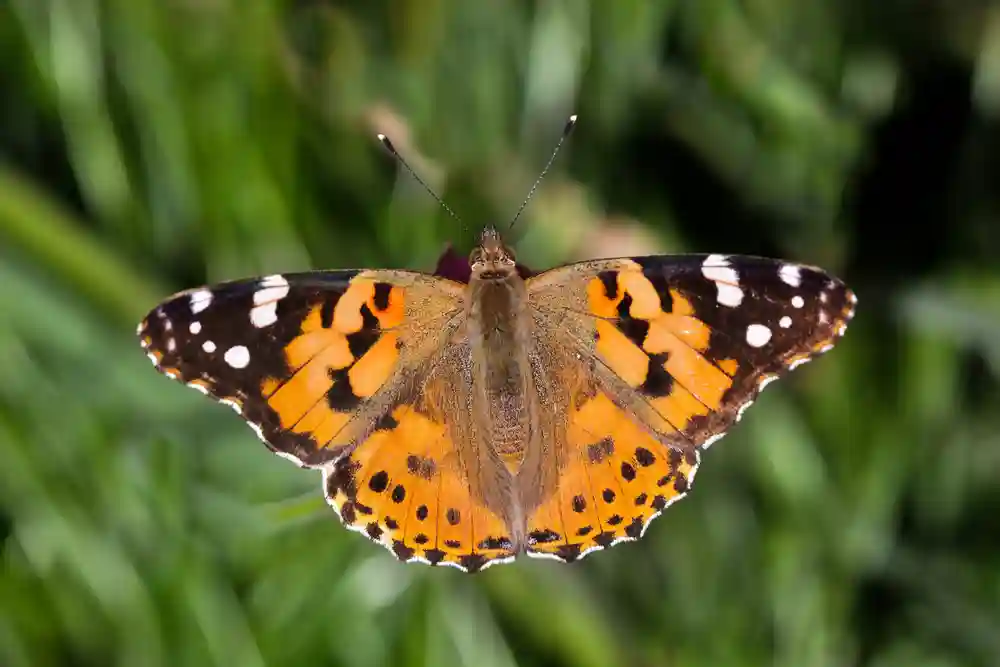 Vanessa carduiPainted Lady (Vanessa cardui)No other butterfly lives on so much of the planet.Junonia orithyaBlue Pansy (Junonia orithya)The male blue pansy has hindwings of electric cobalt set with orange-ringed eyespots, and he spends the day sitting on a patch of bare sunlit earth ch
Show all 8 other brush-footed species names
- Common Evening Brown (Melanitis leda)
- Tamil Bushbrown (Mycalesis subdita)
- Plain Tiger (Danaus chrysippus)
- Danaid Eggfly (Hypolimnas misippus)
- Tawny Coster (Acraea terpsicore)
- Blue Tiger (Tirumala limniace)
- Common Palmfly (Elymnias hypermnestra)
- Dusky Bush-brown (Orsotriaena medus)
Gossamer-Winged (Lycaenidae)
- Gram Blue (Euchrysops cnejus)
- Dingy Lineblue (Petrelaea dana)
- Apefly (Spalgis epius)
- Lesser Grass-blue (Zizina otis)
- Dark Grass Blue (Zizeeria karsandra)
- Zizula hylax
Whites and Sulphurs (Pieridae)
- No-brand Grass-yellow (Eurema brigitta)
- Common Grass Yellow (Eurema hecabe)
- White Albatross (Appias albina)
- Lemon Migrant (Catopsilia pomona)
- Small Grass-yellow (Eurema smilax)
Swallowtail (Papilionidae)
- Common Mormon (Papilio polytes)
- Crimson Rose (Pachliopta hector)
Skipper (Hesperiidae)
- Indian Palm Bob (Suastus gremius)
- Rice Swift (Borbo cinnara)
- Paintbrush Swift (Baoris farri)
How to identify butterflies in the Maldives
With a list this short, a Maldivian butterfly can usually be named on the spot. Anything large, slow and orange with black-and-white wing tips is the Plain Tiger, unless it is a female Danaid Eggfly, which reveals itself by a darting flight and, in the male, by the white-spotted black wings of its mate. Pale blue-grey with black veins is the Blue Tiger. A big black butterfly is one of the two swallowtails or the Great Eggfly; red spots on the body and hindwing mean the Crimson Rose, a white band across the hindwing suggests the Common Mormon. Anything small and yellow is a grass yellow or the larger Lemon Migrant; anything small and blue is a grass blue, with the Gram Blue told by its tiny tails and orange-ringed hindwing spots.
Most Maldivian species have fuller treatments on the pages for Sri Lanka and India, where the same butterflies are joined by hundreds of others, and the whole set of country lists is gathered under Butterflies of the World.
Frequently asked questions about Maldives butterflies
How many butterfly species are there in the Maldives?
Only a few dozen butterfly species have ever been recorded in the Maldives, and 27 of them are listed on this page. The islands are small, flat, sandy and far from the mainland, so few caterpillar food plants grow there. Every Maldivian butterfly is also found in southern India and Sri Lanka.
What is the most common butterfly in the Maldives?
The Plain Tiger, a slow-flying orange milkweed butterfly, is the species most people notice, along with the Great Eggfly and the small yellow grass yellows. On farming islands the grass blues and the Gram Blue are the most numerous butterflies, breeding on beans and other legumes in gardens and plots.
Are there any endemic butterflies in the Maldives?
No. The Maldives has no endemic butterfly species or subspecies. Its entire fauna was assembled by butterflies flying or drifting across the sea from India and Sri Lanka, and every species on the national list still breeds on the mainland. Populations on individual islands come and go and are topped up by fresh arrivals.
Are there swallowtail butterflies in the Maldives?
Yes, two swallowtails are recorded: the Common Mormon, whose caterpillars feed on citrus and curry leaf, and the Crimson Rose, a black butterfly with crimson body and hindwing spots that eats pipevines and is a well-known migrant in southern India. Both are the largest butterflies in the country but are far from common.
When is the best time to see butterflies in the Maldives?
Butterflies fly all year because the Maldives has no cold season. Numbers are highest a few weeks after the south-west monsoon rains, from about June to October, when fresh growth lets caterpillars complete their development. During the drier north-east monsoon, November to April, migrants such as the Painted Lady and Blue Tiger may arrive on the wind.
Where is the best place to see butterflies in the Maldives?
There are no butterfly reserves, so the best places are large, populated islands with home gardens, farm plots and some freshwater: Fuvahmulah, the Addu Atoll islands, Hulhumalé and the agricultural islands of Laamu and Gaafu. Look along sunny scrub edges in the early morning and around lantana, ixora and crown-flower blossom.
Is the Painted Lady a resident of the Maldives?
The Painted Lady is best treated as a visitor. It is the world's most widespread butterfly and a powerful migrant, and it reaches the Maldives during the north-east monsoon when winds blow from India. It may breed briefly on thistle-like weeds, but there is no evidence of a permanent population on the islands.
Which family does the Gram Blue belong to?
The Gram Blue, Euchrysops cnejus, is a gossamer-winged butterfly of the family Lycaenidae. It is small, pale violet-blue above with a fine tail on each hindwing and orange-ringed black spots underneath. Its caterpillars eat the flowers and pods of beans, cowpea and other legumes, so it thrives on farming islands.
Which Maldivian butterfly flies at dusk?
The Common Evening Brown, Melanitis leda, is the country's crepuscular butterfly. A large, dull brown satyrine with a dead-leaf underside, it spends the day resting in leaf litter and shade and takes flight around sunset, so a big brown butterfly flushed from a hedge in the evening is almost always this species.
Is the Danaid Eggfly the same as the Plain Tiger?
No, but the female Danaid Eggfly is a mimic of the Plain Tiger, copying its orange wings and black-and-white tips so closely that birds avoid it. The male Danaid Eggfly looks completely different, black with large white patches. The Plain Tiger is genuinely distasteful because its caterpillars feed on milkweed.
Published November 10, 2023 · Last updated September 21, 2026