
Butterflies in Sri Lanka
Sri Lanka has about 245 butterfly species, and around thirty of them live nowhere else on Earth, which is a remarkable share for an island the size of Ireland. The national butterfly is the endemic Sri Lankan Birdwing, the largest butterfly on the island, and other specialities include the Ceylon Rose, Ceylon Tree Nymph, Ceylon Blue Oakleaf and Ceylon Tiger. Common Tigers, Crows, Pansies, Grass Yellows and the Common Leopard fly everywhere, and in the months after the north-east monsoon the island stages one of Asia's best-known butterfly migrations.

On this page
- Butterflies found in Sri Lanka
- Butterflies of Sri Lanka at a glance
- Signature and endemic Sri Lankan butterflies
- The Sri Lankan butterfly calendar and the great migration
- Where to see butterflies in Sri Lanka
- Host plants and butterfly gardening in Sri Lanka
- Threatened butterflies and conservation
- How to identify a butterfly in Sri Lanka
- Frequently asked questions
Butterflies of Sri Lanka at a glance
Sri Lanka is small, but it packs three climates into 65,000 square kilometres, and each has its own butterflies. The wet zone of the south-west, with more than 2,500 mm of rain a year, holds the last lowland rainforest and most of the endemics; the dry zone of the north and east is monsoon scrub and open woodland where the tigers, crows and pansies of peninsular India are at home; and the central highlands rise above 2,000 metres into cloud forest and grassland with a cool-climate fauna of its own. Around 245 species have been recorded, and a long separation from India has produced roughly 26 to 31 species and dozens of subspecies found only here.
The brush-footed butterflies are the largest family, with the milkweed-feeding tigers and crows, the bushbrowns and evening browns of the forest floor, the pansies of open ground and the oakleafs, barons and nawabs of the canopy. The blues, lineblues and royals come next, followed by a strong set of whites and sulphurs, fifteen swallowtails including the birdwing and three roses, a single metalmark, the Plum Judy, and nearly forty skippers.
Signature and endemic Sri Lankan butterflies
The Sri Lankan Birdwing (Troides darsius) is the national butterfly and the largest on the island, a black-and-gold giant with a wingspan approaching 17 cm in the female. It breeds on Aristolochia vines in forest and even large gardens, and its slow, high flight along the treeline in the early morning is unmistakable. Close behind it in size are the Blue Mormon, the Red Helen and the Common Banded Peacock, whose green-banded black wings flash in the wet-zone forests.
The swallowtail family also supplies the island's rarest butterfly, the Ceylon Rose (Pachliopta jophon), a Critically Endangered endemic of the rainforest canopy, alongside the widespread Common Rose and Crimson Rose, all three protected by the toxins of their pipevine hosts. The endemic Ceylon Tree Nymph (Idea iasonia) drifts through the same forests like a piece of paper, a close relative of the Paper Kite of South-east Asia, and the Ceylon Blue Oakleaf (Kallima philarchus) vanishes the moment it lands, its closed wings a perfect dead leaf; the mainland Orange Oakleaf plays the same trick from India to China.

Higher up, the Ceylon Tiger (Parantica taprobana) replaces the lowland tigers in the montane forests, and the Sri Lanka Treebrown and Ceylon Forester haunt the bamboo and shade. In the lowlands the everyday species are the Common Tiger, Plain Tiger and Common Crow on milkweeds, the Blue Pansy, Lemon Pansy and Peacock Pansy on bare ground, the Common Leopard on flowering shrubs, the Great Eggfly in every garden and the Common Mormon on citrus, while the Sri Lankan Lesser Albatross and the Ceylon Cerulean are endemic even among the commonest whites and blues.

The Sri Lankan butterfly calendar and the great migration
Butterflies fly all year in Sri Lanka, but numbers rise sharply after each monsoon, when fresh growth feeds the caterpillars. The north-east monsoon ends in February, and March to May is the best season across the island; the south-west monsoon fades in September, and October and November bring a second, smaller peak, especially in the dry zone. The Painted Lady and other cool-climate species are most obvious in the highlands during the drier months.
The island's most famous butterfly event is the migration that follows the north-east monsoon. From about February to April, streams of Lemon Emigrants, Common and Lesser Albatrosses, Mottled Emigrants, Blue Tigers, Dark Blue Tigers and Common Crows move across the country in a steady one-way flow that can last for weeks. Sinhalese tradition holds that they are flying to Adam's Peak, whose old name Samanalakanda means Butterfly Mountain; in practice the flights head broadly from the dry zone towards the wet zone as the dry-zone vegetation withers. Our guide to butterfly migration explains how such mass movements are driven by rainfall and host-plant flushes rather than by any fixed destination.
Where to see butterflies in Sri Lanka
- Sinharaja Forest Reserve — the UNESCO-listed lowland rainforest and the best single site for endemics: Tree Nymph, Blue Oakleaf, Ceylon Rose, Sri Lankan Birdwing and the endemic bushbrowns.
- Kanneliya and the Kitulgala forests — easier wet-zone alternatives with most of the same species.
- Knuckles Range and Riverston — mid-elevation forest and grassland where lowland and montane faunas overlap.
- Horton Plains and the Nuwara Eliya highlands — the Ceylon Tiger, Sri Lanka Treebrown and the highland whites and blues.
- Ritigala, Wasgamuwa, Wilpattu and Yala — dry-zone reserves where the tigers, crows, pansies, leopards and Joker are abundant after the rains, and the migration passes in spring.
- Udawattakele Sanctuary, Kandy — an easy forest walk in the middle of the city with birdwings and Mormons.
Most Sri Lankan species are shared with southern India, but the endemics are not, and the fauna thins to a handful of migrants on the low coral islands of the Maldives to the west.
Host plants and butterfly gardening in Sri Lanka
A Sri Lankan garden can hold thirty or forty species if it grows the right caterpillar host plants and is not sprayed.
- Indian birthwort (Aristolochia indica) — Common Rose, Crimson Rose and, near forest, the Sri Lankan Birdwing.
- Citrus and curry leaf — Common Mormon, Lime Blue and the Red Helen; cinnamon — Common Mime and Blue Mormon.
- Crown flower and other milkweeds — Plain Tiger and Common Tiger; oleander — Common Crow.
- Castor — Angled and Common Castors; passion vine — Tawny Coster; sennas — the emigrants and grass yellows.
- Native grasses and bamboo left uncut — bushbrowns, evening browns, four-rings and many skippers.
For nectar, lantana, ixora, pagoda flower, Stachytarpheta and the small weeds of a lightly mown lawn attract more butterflies than any imported ornamental.
Threatened butterflies and conservation
Sri Lanka's butterflies are in trouble in proportion to its forests. The wet zone has lost most of its lowland rainforest to tea, rubber and rice over the last two centuries, and the 2012 National Red List assessed 99 of the island's butterfly species as threatened, with the endemic Ceylon Rose among those rated Critically Endangered. Other high-risk species are forest specialists such as the Ceylon Tree Nymph, Blue Oakleaf, Ceylon Palmfly and several endemic lineblues and hedge blues that need continuous canopy.
The Fauna and Flora Protection Ordinance forbids collecting and exporting the protected species, and the birdwing and the roses are also covered by international trade rules, but habitat is the real issue: the protected forests of Sinharaja, Kanneliya, the Knuckles and the Peak Wilderness now hold most of what survives, and the small forest patches, home gardens and traditional agroforestry of the wet zone act as stepping stones between them. The broader regional picture is on our Butterflies of the World hub.
Butterflies found in Sri Lanka
199 species listed for Sri Lanka, grouped by family. Linked names have a full profile on this site with pictures of every life stage. Species marked vagrant are occasional visitors rather than residents; endemic species occur nowhere else.
Brush-Footed (Nymphalidae)
 Junonia orithyaBlue Pansy (Junonia orithya)The male blue pansy has hindwings of electric cobalt set with orange-ringed eyespots, and he spends the day sitting on a patch of bare sunlit earth ch
 Phalanta phalanthaLeopard (Phalanta phalantha)The leopard (Phalanta phalantha) is a medium-sized tawny-orange butterfly speckled all over with small black spots and wavy black lines, and it flies Danaus genutiaCommon Tiger (Danaus genutia)Asia's answer to the monarch, the common tiger sails slowly over scrub and garden on tawny orange wings whose every vein is inked in heavy black.
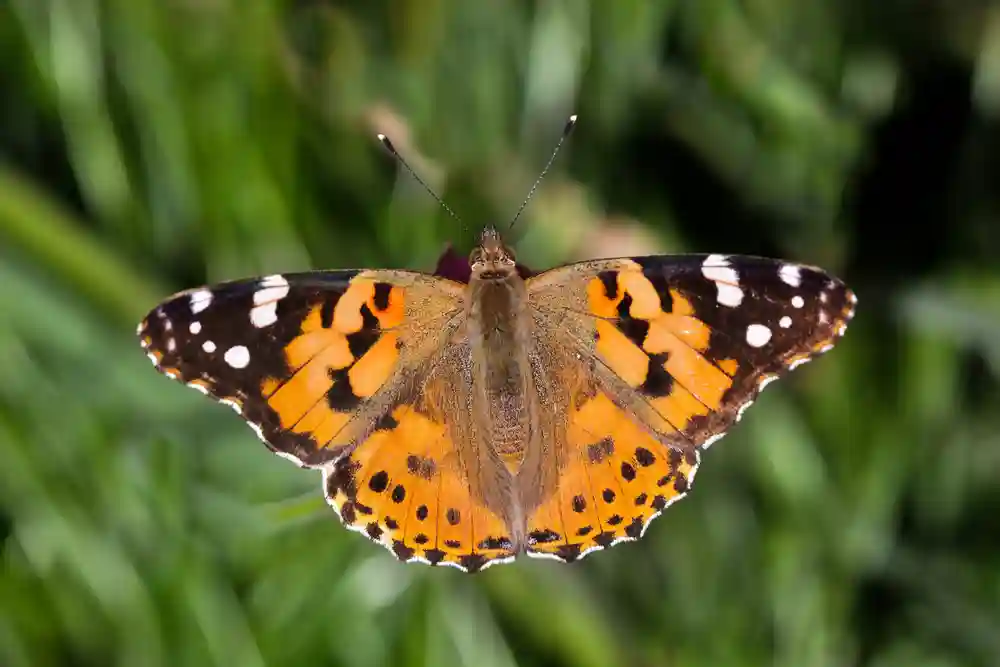
 Hypolimnas bolinaBlue Moon (Hypolimnas bolina)The blue moon, or great eggfly, is a black tropical butterfly whose white wing patches burn electric blue when the light strikes them at the right angVanessa carduiPainted Lady (Vanessa cardui)No other butterfly lives on so much of the planet.
Show all 61 other brush-footed species names
- Angled Castor (Ariadne ariadne)
- Autumn Leaf (Doleschallia bisaltide)
- Baron (Euthalia aconthea)
- Black Prince (Rohana parisatis)
- Black Rajah (Charaxes solon)
- Blue Admiral (Kaniska canace)
- Blue Tiger (Tirumala limniace)
- Brown King Crow (Euploea klugii)
- Ceylon Blue Glassy Tiger (Ideopsis similis)
- Ceylon Blue Oakleaf (Kallima philarchus) endemic
- Ceylon Forester (Lethe dynsate) endemic
- Ceylon Palmfly (Elymnias singhala) endemic
- Ceylon Tiger (Parantica taprobana) endemic
- Ceylon Tree Nymph (Idea iasonia)
- Chestnut-streaked Sailer (Neptis jumbah)
- Chocolate Pansy (Junonia iphita)
- Cingalese Bushbrown (Mycalesis rama) endemic
- Clipper (Parthenos sylvia)
- Club Beak (Libythea myrrha)
- Commander (Moduza procris)
- Common Castor (Ariadne merione)
- Common Crow (Euploea core)
- Common Cruiser (Vindula erota)
- Common Evening Brown (Melanitis leda)
- Common Lascar (Pantoporia hordonia)
- Common Nawab (Polyura athamas)
- Common Palmfly (Elymnias hypermnestra)
- Common Sailer (Neptis hylas)
- Common Treebrown (Lethe rohria)
- Danaid Eggfly (Hypolimnas misippus)
- Dark Blue Tiger (Tirumala septentrionis)
- Darkbrand Bushbrown (Mycalesis mineus)
- Dark Evening Brown (Melanitis phedima)
- Dingy Bush-brown (Mycalesis perseus)
- Double-branded Crow (Euploea sylvester)
- Dusky Bush-brown (Orsotriaena medus)
- European Nettle-tree Butterfly (Libythea celtis)
- Gaudy Baron (Euthalia lubentina)
- Glad-eye Bushbrown (Mycalesis patnia)
- Glassy Tiger (Parantica aglea)
- Gray Pansy (Junonia atlites)
- Great Crow (Euploea phaenareta)
- Indian Fritillary (Argynnis hyperbius)
- Indian Red Admiral (Vanessa indica)
- Jewel Four-ring (Ypthima avanta)
- Lemon Pansy (Junonia lemonias)
- Long-brand Bushbrown (Mycalesis visala)
- Peacock Pansy (Junonia almana)
- Plain Tiger (Danaus chrysippus)
- Red-spot Duke (Dophla evelina)
- Rustic (Cupha erymanthis)
- Sinhalese Five-ring (Ypthima singala) endemic
- Small Leopard (Phalanta alcippe)
- Southern Duffer (Discophora lepida)
- Spotted Joker (Byblia ilithyia)
- Sri Lanka Treebrown (Lethe daretis) endemic
- Tamil Lacewing (Cethosia nietneri)
- Tamil Treebrown (Lethe drypetis)
- Tawny Coster (Acraea terpsicore)
- White Four-ring (Ypthima ceylonica)
- Yellow Pansy (Junonia hierta)
Gossamer-Winged (Lycaenidae)
Show all 52 gossamer-winged species names
- Acacia Blue (Surendra vivarna)
- Banded Blue Pierrot (Discolampa ethion)
- Bold Line-blue (Nacaduba pactolus)
- Bright Babul Blue (Azanus ubaldus)
- Centaur Oakblue (Arhopala centaurus)
- Ceylon Cereleun (Jamides coruscans) endemic
- Ceylon Hedge Blue (Udara lanka) endemic
- Ceylon Indigo Royal (Tajuria arida) endemic
- Clouded Silverline (Cigaritis nubilus) endemic
- Common Guava Blue (Virachola isocrates)
- Common Imperial (Cheritra freja)
- Common Onyx (Horaga onyx)
- Common Pierrot (Castalius rosimon)
- Common Silverline (Cigaritis vulcanus)
- Common Tinsel (Catapaecilma major)
- Dark Cornelian (Deudorix epijarbas)
- Dark Grass Blue (Zizeeria karsandra)
- Dingy Lineblue (Petrelaea dana)
- Forget-me-not (Catochrysops strabo)
- Gram Blue (Euchrysops cnejus)
- Grass Jewel (Freyeria trochylus)
- Green's Silverline (Cigaritis greeni) endemic
- Indian Cupid (Cupido lacturnus)
- Indian Sunbeam (Curetis thetis)
- King Cerulean (Jamides bochus)
- Lesser Grass-blue (Zizina otis)
- Lime Blue (Chilades lajus)
- Long-tailed Blue (Lampides boeticus)
- Long-tailed Line-blue (Prosotas nora)
- Malabar Flash (Rapala lankana)
- Malayan (Megisba malaya)
- Monkey Puzzle (Rathinda amor)
- Nilgiri Tit (Hypolycaena nilgirica)
- Pale Ceylon Lineblue (Nacaduba sinhala) endemic
- Plain Hedge Blue (Celastrina lavendularis)
- Plains Blue Royal (Tajuria jehana)
- Plains Cupid (Luthrodes pandava)
- Plumbago Blue (Leptotes plinius)
- Pointed Ciliate Blue (Anthene lycaenina)
- Pointed Lineblue (Ionolyce helicon)
- Purple Leaf Blue (Amblypodia anita)
- Quaker (Neopithecops zalmora)
- Red Pierrot (Talicada nyseus)
- Redspot (Zesius chrysomallus)
- Silverstreak Blue (Iraota timoleon)
- Singalese Hedge Blue (Udara singalensis) endemic
- Striped Pierrot (Tarucus nara)
- Sword-tailed Flash (Bindahara phocides)
- White Hedge Blue (Udara akasa)
- White Royal (Pratapa deva)
- Woodhouse's Four Lineblue (Nacaduba ollyetti) endemic
- Yamfly (Loxura atymnus)
Whites and Sulphurs (Pieridae)
Show all 27 whites and sulphurs species names
- Black-spotted White (Leptosia nina)
- Chocolate Albatross (Appias lyncida)
- Common Grass Yellow (Eurema hecabe)
- Common Gull (Cepora nerissa)
- Common Jezebel (Delias eucharis)
- Crimsontip (Colotis danae)
- Dark Wanderer (Pareronia ceylanica)
- Great Orange Tip (Hebomoia glaucippe)
- Large Salmon Arab (Colotis fausta)
- Lemon Migrant (Catopsilia pomona)
- Lesser Gull (Cepora nadina)
- Lined Grass-yellow (Eurema laeta)
- No-brand Grass-yellow (Eurema brigitta)
- Orange Migrant (Catopsilia scylla)
- Painted Sawtooth (Prioneris sita)
- Plain Puffin (Appias indra)
- Small Orangetip (Colotis etrida)
- Small Salmon Arab (Colotis amata)
- Sri Lankan Lesser Albatross (Appias galene) endemic
- Striped Albatross (Appias libythea)
- Sulphur Orange Tip (Colotis aurora)
- Three-spot Grass Yellow (Eurema blanda)
- White Albatross (Appias albina)
- White Migrant (Catopsilia pyranthe)
- White Orangetip (Ixias marianne)
- Yellow Albatross (Appias paulina)
- Yellow Orange Tip (Ixias pyrene)
Metalmark (Riodinidae)
- Plum Judy (Abisara echerius)
Swallowtail (Papilionidae)
Show all 15 swallowtail species names
- Blue Mormon (Papilio polymnestor)
- Blue Triangle (Graphium sarpedon)
- Ceylon Rose (Pachliopta jophon) endemic
- Chequered Swallowtail (Papilio demoleus)
- Common Banded Peacock (Papilio crino)
- Common Jay (Graphium doson)
- Common Mime (Papilio clytia)
- Common Mormon (Papilio polytes)
- Common Rose (Pachliopta aristolochiae)
- Crimson Rose (Pachliopta hector)
- Five-bar Swallowtail (Graphium antiphates)
- Green-spotted Triangle (Graphium agamemnon)
- Red Helen (Papilio helenus)
- Spot Swordtail (Graphium nomius)
- Sri Lankan Birdwing (Troides darsius) endemic
Skipper (Hesperiidae)
Show all 38 skipper species names
- Banded Demon (Notocrypta paralysos)
- Banded Redeye (Gangara lebadea)
- Black Angle (Tapena thwaitesi)
- Blank Swift (Caltoris kumara)
- Branded Orange Awlet (Bibasis oedipodea)
- Ceylon Dartlet (Oriens goloides)
- Chestnut Bob (Iambrix salsala)
- Chinese Dart (Potanthus confucius)
- Common Awl (Hasora badra)
- Common Banded Awl (Hasora chromus)
- Common Bush Hopper (Ampittia dioscorides)
- Common Grass Dart (Taractrocera maevius)
- Common Redeye (Matapa aria)
- Common Small Flat (Sarangesa dasahara)
- Conjoined Swift (Pelopidas conjuncta)
- Decorated Ace (Thoressa decorata)
- Giant Redeye (Gangara thyrsis)
- Grass Demon (Udaspes folus)
- Hedge-hopper (Baracus vittatus)
- Indian Ace (Halpe homolea)
- Indian Awlking (Choaspes benjaminii)
- Indian Dart (Potanthus pseudomaesa)
- Indian Grizzled Skipper (Spialia galba)
- Indian Palm Bob (Suastus gremius)
- Marbled Skipper (Gomalia elma)
- Orangetail Awl (Bibasis sena)
- Pale Small-branded Swift (Pelopidas thrax)
- Pallid Dart (Potanthus pallida)
- Philippine Swift (Caltoris philippina)
- Pied Flat (Tagiades japetus)
- Restricted Demon (Notocrypta curvifascia)
- Rice Swift (Borbo cinnara)
- Small Branded Swift (Pelopidas mathias)
- Small Palm Bob (Suastus minuta)
- Tree Flitter (Hyarotis adrastus)
- Tricolour Pied Flat (Coladenia indrani)
- Water Snow Flat (Tagiades litigiosa)
- White Banded Awl (Hasora taminatus)
How to identify a butterfly in Sri Lanka
Start with the family. Large black butterflies with red bodies and white or crimson hindwing patches are the roses; large black butterflies with yellow or golden hindwings are the birdwing or the Common Mormon's mimetic female. Slow, floppy black-and-white flyers are the Tree Nymph and its imitators, and orange-and-black butterflies with black-veined wings are tigers, which the Danaid Eggfly and the female Common Mormon copy. Brown butterflies with rows of eyespots along the forest floor are bushbrowns and evening browns; small, bright, low-flying butterflies with tails are lineblues and royals; and the small brown rockets around grass and palms are skippers.
Season and zone narrow the list further. A tiger above 1,500 metres is likely the Ceylon Tiger; a pansy on a dry-zone track in April is one of five species that can be told apart by the colour of the upperside; and a butterfly with a fig-leaf silhouette that vanishes on a twig is one of the oakleafs. Because so many Sri Lankan populations are endemic subspecies, local guides are worth more than mainland ones.
Frequently asked questions about Sri Lankan butterflies
How many butterfly species are found in Sri Lanka?
About 245 butterfly species have been recorded in Sri Lanka, of which roughly 26 to 31, depending on the classification used, are endemic and found nowhere else. Many more are endemic subspecies. The brush-footed butterflies are the largest family, followed by the blues and hairstreaks, the whites and sulphurs, the swallowtails and the skippers.
What is the national butterfly of Sri Lanka?
The Sri Lankan Birdwing, Troides darsius, an endemic swallowtail and the largest butterfly on the island, with a black-and-gold wingspan approaching 17 centimetres in the female. It breeds on Aristolochia vines in forests and large gardens across the wet and intermediate zones and is protected under Sri Lankan law.
Are there butterfly species unique to Sri Lanka?
Yes. Around 26 to 31 species are endemic, including the Sri Lankan Birdwing, Ceylon Rose, Ceylon Tree Nymph, Ceylon Tiger, Ceylon Blue Oakleaf, Ceylon Palmfly, Ceylon Forester, Cingalese Bushbrown, Sri Lankan Lesser Albatross and Ceylon Cerulean. Most are forest butterflies of the wet zone and the central highlands, which is why forest loss threatens them.
What are some examples of endemic butterflies in Sri Lanka?
Among the brush-foots, the Ceylon Blue Oakleaf (Kallima philarchus), Ceylon Forester (Lethe dynsate), Ceylon Palmfly (Elymnias singhala), Ceylon Tiger (Parantica taprobana), Ceylon Tree Nymph (Idea iasonia) and Cingalese Bushbrown (Mycalesis rama). Among the other families, the Sri Lankan Birdwing, Ceylon Rose, Sri Lankan Lesser Albatross, Ceylon Cerulean and Ceylon Hedge Blue are also found only on the island.
Which butterfly family is most common in Sri Lanka?
The brush-footed butterflies, Nymphalidae, with more than sixty species on the island, including the tigers, crows, pansies, bushbrowns, evening browns, barons and oakleafs. Their front legs are reduced to small brush-like stumps, so they stand on four legs. The Common Leopard, Blue Pansy, Common Tiger and Great Eggfly are the ones most often seen.
Is the Ceylon Tiger butterfly endemic to Sri Lanka?
Yes. The Ceylon Tiger, Parantica taprobana, lives only in Sri Lanka, mainly in the montane forests of the central highlands above about 1,000 metres, where it replaces the lowland Glassy and Blue Tigers. It is a dark brown-and-white milkweed butterfly that is common around Nuwara Eliya, Horton Plains and the Knuckles Range.
What is the scientific name of the Ceylon Blue Oakleaf?
Kallima philarchus. It is an endemic brush-footed butterfly of Sri Lanka's wet-zone and hill forests whose closed wings mimic a dead leaf so exactly, down to the midrib and blemishes, that it disappears when it settles on a twig. The upperside is deep blue and black with an orange band; its Indian relative is the Orange Oakleaf.
When is the best time to see butterflies in Sri Lanka?
March to May, after the north-east monsoon, when numbers peak across the island and the great migration of emigrants, albatrosses, tigers and crows is under way. October and November, after the south-west monsoon, give a second peak, especially in the dry zone. Butterflies fly all year, but the wet-zone forests are quietest at the height of the rains.
What is the butterfly migration in Sri Lanka?
A mass movement of butterflies, mostly Lemon and Mottled Emigrants, Common and Lesser Albatrosses, Blue and Dark Blue Tigers and Common Crows, that flows across the island for weeks between about February and April. Folklore says they fly to Adam's Peak, called Samanalakanda or Butterfly Mountain; in reality they move from the drying dry zone towards the wet zone.
Where is the best place to see butterflies in Sri Lanka?
Sinharaja Forest Reserve, the UNESCO-listed rainforest in the south-west, is the best single site, with the Sri Lankan Birdwing, Ceylon Tree Nymph, Ceylon Rose and Ceylon Blue Oakleaf. Horton Plains and the Knuckles Range add the highland species such as the Ceylon Tiger, and the dry-zone parks such as Wilpattu and Yala are best after the rains.
Published November 30, 2023 · Last updated September 21, 2026