
Green Dragontail (Lamproptera Meges)
Half the wing is glass, the tails are longer than the body, and the flight is a blurred hover over wet sand. The green dragontail is the swallowtail that most people first mistake for a dragonfly. It is one of the two smallest members of its family in the world, it lives beside forest streams from northeast India to Sulawesi, and it feeds on a single obscure group of climbing plants.
 By

In this guide
Description and identification
The green dragontail belongs to Lamproptera, a genus of just two or three species that sits in the tribe Leptocircini of the swallowtail family, alongside the kite swallowtails and the long-tailed scarce swallowtail of Europe. Dragontails are the smallest swallowtails in the world, and they look nothing like the large, broad-winged Papilio that most people picture when they hear the family name.
Adult butterfly
- Wingspan: 1.6–2.2 in (40–55 mm), tails excluded. Body length is only about 0.8 in (20 mm).
- Wing shape: the forewing is narrow and pointed and the hindwing is small and produced into an extraordinarily long, slender tail. Each tail is white-tipped, blackish along its length and longer than the hindwing that carries it, so the butterfly looks two or three times its real size in flight.
- Transparent panel: the outer half of the forewing and much of the hindwing are free of scales, leaving a clear glass-like window through which foliage is visible. This is the feature that fools people into calling it a dragonfly.
- Colour: the scaled parts are velvety black. A narrow band of metallic green runs obliquely across both wings, cutting through the transparent panel; depending on the angle of the light and on the subspecies, the band flashes from grass green to blue-green.
- Underside: a slightly duller repeat of the upperside, with the green band visible from below and the transparent window equally clear.
- Sexes: very similar. Both males and females carry the green band, and there is no obvious sex mark on the wings. Males average marginally smaller with a slimmer abdomen, and are the sex almost always seen at damp sand. Sex is usually judged from behaviour rather than from pattern.
About ten subspecies are recognised across the range. They differ chiefly in the width of the green band and in how far the transparent area extends, so that an individual from northeast India and one from Sulawesi can look noticeably different while remaining the same species.
How to identify a green dragontail in the field
Three things settle it at once. First the tails: extremely long, thin and white-tipped, unlike any other small butterfly in Asia. Second the wings: a large, genuinely see-through panel with a green diagonal band across it. Third the flight and the place: a fast, whirring, dragonfly-like hover, almost always within a few metres of a stream, seepage or waterfall inside forest. The only serious confusion is with its own close relative, the white dragontail Lamproptera curius, in which the band is white instead of green.
Not a dragonfly. Dragonflies hold their wings flat and beat all four independently; the dragontail beats its forewings and hindwings together and settles with the wings closed above the back. If the insect has a coiled proboscis and clubbed antennae, it is the butterfly.

Life cycle: egg, caterpillar, chrysalis and adult

Breeding is continuous where conditions stay warm and wet, with generations overlapping through the year, and it slows in the dry season. The entire cycle is tied to a single group of forest climbers, so the immature stages are found only where those vines grow.
Eggs
The female flies slowly along the edge of a stream, searching the vines that trail over the bank, and lays her eggs one at a time on the soft new leaves and shoot tips of Illigera. Each egg is a smooth, almost spherical bead a little under a millimetre across, pale translucent green when fresh and darkening as the embryo develops. There is no ribbing or sculpture on the surface. Hatching takes roughly three to five days in the warm lowlands.
Caterpillar
The young larva eats its eggshell before starting on the leaf, and rests along the midrib between meals. The full-grown caterpillar is a rich dark green scattered with small black spots and short paired tubercles along the back, the body tapering slightly towards the rear. Held still against a green leaf it is genuinely difficult to see. Like every swallowtail larva it carries an osmeterium, a fleshy forked organ hidden behind the head that is shot out when the caterpillar is prodded and gives off a sharp, unpleasant smell that repels ants and small wasps. The caterpillar passes through five instars in roughly two to three weeks.
Chrysalis
When it is ready to pupate the larva spins a silk pad on the upper surface of a leaf, sometimes on a stem, and attaches itself by the hooked cremaster at the tip of the abdomen. It then spins a fine silk girdle over its back, so that the chrysalis is held upright against the surface rather than hanging free, the arrangement used by all swallowtails. The pupa is short, angular and green or straw-brown depending on where it is formed, and it looks convincingly like a small broken leaf or a bud. It lasts about two weeks.
Adult butterfly
The adult emerges in the morning, expands the long tails carefully and is flying within a couple of hours. Dragontails are short-lived: an adult is generally on the wing for only one to two weeks, which is brief even by butterfly standards, as our guide to how long butterflies live explains. They compensate by being active from early morning to mid-afternoon almost every day of that short life.
Where the green dragontail lives
The green dragontail is a butterfly of tropical and subtropical Asia. Its range begins in northeastern India, in Assam and the states east of it, and runs through Myanmar, Thailand, Laos, Cambodia and Vietnam into southern China and Hainan. Southward it continues through Peninsular Malaysia, Brunei and East Malaysia to Sumatra, Java, Borneo, Sulawesi and parts of the Philippines. Around ten subspecies occupy different parts of that archipelago.
It is far more specific about habitat than about geography. The green dragontail lives in primary and good secondary tropical rainforest, and within that forest it stays beside running water: stream banks, rocky riverbeds, seepages, sandbanks and the spray zone around small waterfalls, usually below about 4,900 ft (1,500 m). It needs the wet sand for minerals and the vines along the bank for its caterpillars, and it is rarely found more than a short distance from both. Clear a strip of streamside forest and the butterfly disappears from it, which is why it has become scarce in heavily logged country. In Peninsular Malaysia the species is treated as vulnerable and receives legal protection.
Other swallowtails share the same forest without sharing the streambed niche: the huge, iridescent Ulysses swallowtail of the eastern islands, and the variable, mimic-rich great mormon of gardens and forest edge throughout the region.

Host plants and diet
Caterpillar host plants. Dragontail caterpillars feed on climbing plants of the genus Illigera, in the small tropical family Hernandiaceae. Illigera burmanica, I. celebica, I. appendiculata and their relatives are the recorded host plants, and no other plant family is reliably known to support the species. Older accounts sometimes add Zanthoxylum, the prickly ash used by many true Papilio swallowtails, but that belongs to the citrus family Rutaceae and is not a dragontail food plant; the confusion appears to come from lumping all swallowtails together. The narrowness of this diet matters: Illigera is an uncommon forest liana, and a population of dragontails cannot exist without it.
Adult diet. Adults take nectar from small forest-edge flowers, feeding while hovering rather than perching, with the wings still beating and the tails streaming behind. Far more conspicuous is their mud-puddling. Males gather on wet sand, damp rock and mineral-rich seepages at the water's edge, sometimes several at a time, and pump water through the gut for hours to extract sodium and other salts. The minerals are passed to the female in the sperm package at mating and end up in her eggs, so a good sandbank is a genuine resource rather than a curiosity. Dragontails will also visit animal droppings and damp ash for the same reason.
Behavior: flight, puddling and courtship
Flight. The wings are small relative to the body, so the dragontail must beat them extremely fast, and the result is a whirring blur that looks and sounds nothing like a butterfly. It can hover in one spot, shift sideways, and reverse, and it feeds and drinks without ever fully settling. Even when it lands on sand the wings usually keep fanning. The long tails trail behind and act as a stabiliser and rudder, damping the yaw that such rapid wingbeats would otherwise produce and helping the insect hold position in the moving air beside a waterfall.
Daily routine. Dragontails are creatures of the morning. They become active soon after the sun reaches the streambed, puddle heavily through late morning, patrol and feed in the early afternoon, and are largely finished by mid-afternoon. In dull or rainy weather they stay hidden in the understorey. They are strongly territorial about good drinking spots, and a male will chase off another that lands too close before returning to the same patch of sand.
Defence. The species has no toxins. Its protection is speed, unpredictability and disguise: the transparent wing panels break up the outline against dappled forest light, the black-and-green pattern reads as nothing in particular, and the long white-tipped tails appear to draw the strikes of birds and lizards away from the body. Dragontails with one or both tails bitten off are common, and they fly perfectly well without them.
Courtship. Males search for females along the same streams they drink at, flying fast a metre or so above the water. Courtship is brief and aerial, with the male hovering beside and beneath the female before the pair settles on vegetation to mate. The general sequence is covered on our page about how butterflies mate and reproduce. Females then spend much of their short lives working the vines along the bank, laying one egg at a time.

Similar butterflies and how to tell them apart
| Species | Looks like | How to separate it from the green dragontail |
|---|---|---|
| White dragontail, Lamproptera curius | Essentially identical in shape, size, flight and habitat | The oblique band across the wings is white or pale grey with no metallic green; the two often puddle on the same sandbank, so the band colour is the only field mark needed |
| Scarce swallowtail, Iphiclides podalirius | Long-tailed relative in the same tribe | Much larger, pale cream with bold black tiger stripes, no transparent panel, and a European and West Asian species that never overlaps in range |
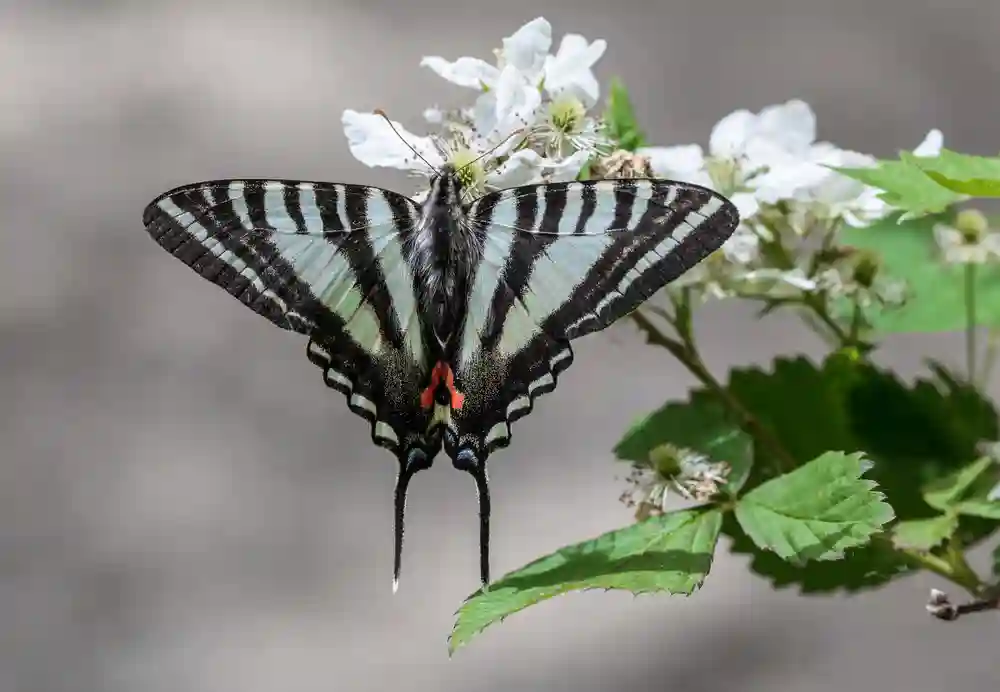
| Zebra swallowtail, Protographium marcellus | Narrow wings and very long tails | Larger, boldly striped black and white with red hindwing spots, fully scaled wings, and confined to eastern North America |
| Ulysses swallowtail, Papilio ulysses | Another blue-green Asian swallowtail | Far larger, with broad wings, brilliant electric blue upperside, short spatulate tails and no transparent area at all |
| Clearwing damselflies and small dragonflies | The commonest real-world confusion | Four wings beating independently, wings held flat or folded vertically at rest, bristle-like antennae, and biting jaws instead of a coiled proboscis |
Quick facts
| Scientific name | Lamproptera meges (Zinken, 1831) |
|---|---|
| Family | Papilionidae (swallowtails), tribe Leptocircini |
| Wingspan | 1.6–2.2 in (40–55 mm), excluding the tails |
| Distribution | Northeastern India, Myanmar, Thailand, Laos, Cambodia, Vietnam, southern China, Peninsular and East Malaysia, Brunei, Indonesia and the Philippines |
| Habitat | Tropical and subtropical rainforest beside streams, rivers and waterfalls, up to about 4,900 ft |
| Host plants | Climbing Illigera species (Hernandiaceae), including I. burmanica and I. celebica |
| Adult food | Nectar taken on the wing; heavy mud-puddling on damp sand and seepages for salts |
| Lifespan of adults | About one to two weeks |
| Broods | Continuous in the wet tropics, reduced in the dry season |
| Flight | Rapid whirring wingbeats with true hovering; feeds without settling |
| Subspecies | About 10 described |
| Conservation status | Not globally assessed as threatened, but dependent on intact streamside forest; listed as vulnerable and legally protected in Peninsular Malaysia |
Did you know?
- The dragontails are the smallest swallowtails on Earth. A green dragontail's body is about the size of a house fly's, and almost everything that makes it look bigger is tail.
- The clear windows are not holes. The wing membrane is complete; it simply grows without the covering scales that make the rest of the wing black, and the few scales that remain there are hair-like and widely spaced.
- The tails are disposable. Birds and lizards strike at the long white tips, well behind the body, and dragontails missing one or both tails are a common sight at any good puddling site.
- Its whole existence depends on a plant almost nobody has heard of. Illigera is an inconspicuous forest liana, and where the vine is cleared the butterfly vanishes even if the rest of the forest is left standing.
- Slow-motion film of dragontails feeding, most famously by the Japanese nature photographer Kazuo Unno, revealed that the insect hovers throughout a meal and never puts its full weight on a flower.
- Puddling is a male occupation. Almost every dragontail found sitting on wet sand is a male collecting sodium, most of which he will hand to a female as a nuptial gift.
In summary
The green dragontail is a tiny black swallowtail with a transparent panel across both wings, a metallic green diagonal band and a pair of white-tipped tails longer than the hindwings themselves. It lives beside forest streams from northeast India and southern China through mainland Southeast Asia to Malaysia, Indonesia and the Philippines, where its dark green, black-spotted caterpillar eats only climbing Illigera vines and its girdled chrysalis sits upright on a leaf. Adults live a week or two, hover like dragonflies while they feed, and crowd onto damp sand for salts. If the band is green it is this species; if it is white, you are looking at the white dragontail instead.
Green Dragontail butterfly pictures


Frequently asked questions about the green dragontail butterfly
What does a Green Dragontail caterpillar look like?
It is a dark green caterpillar scattered with small black spots, with short paired tubercles along the back and a body that tapers slightly towards the rear. The colour is pure camouflage against the leaves of its Illigera food plant. Like all swallowtail larvae it can shoot out a forked, foul-smelling osmeterium behind the head when it is threatened.
How can you tell the difference between a male and female Green Dragontail?
It is difficult, because both sexes carry the same green band and the same transparent wing panels and there is no wing sex mark. Males average slightly smaller with a slimmer abdomen and are the sex you find drinking on wet sand, while females spend their time along streamside vines laying eggs. Behaviour separates them more reliably than appearance.
What is the average wingspan of a Green Dragontail butterfly?
The wingspan is about 40 to 55 millimetres, or 1.6 to 2.2 inches, measured without the tails, and the body is only around 20 millimetres long. That makes the dragontails the smallest swallowtails in the world. The long white-tipped tails add greatly to the apparent size of the insect in flight.
Where is the Green Dragontail butterfly found?
It occurs from northeastern India and Myanmar through Thailand, Laos, Cambodia, Vietnam and southern China, and south through Peninsular and East Malaysia, Brunei, Sumatra, Java, Borneo, Sulawesi and the Philippines. About ten subspecies are recognised. Within that range it is restricted to streams, rivers and waterfalls inside tropical and subtropical rainforest.
What are the colors of an adult Green Dragontail?
The scaled parts of the wings are velvety black, crossed by a narrow oblique band of metallic green that can flash blue-green depending on the light. Between and around those markings much of the wing is transparent, with no scales at all. The long hindwing tails are blackish with clean white tips.
Why does the Green Dragontail have transparent wings?
The clear panels are areas of normal wing membrane that develop without covering scales. Against the broken light of a forest streambed they make the butterfly's outline hard to resolve, so a bird sees fragments of black and green rather than an insect. Transparency also saves weight on a butterfly that relies on very fast wingbeats.
How does the Green Dragontail chrysalis attach to a leaf?
The caterpillar spins a silk pad on the upper surface of a leaf or stem and hooks into it with the cremaster at the tip of its abdomen, then spins a fine silk girdle over its back. The girdle holds the chrysalis upright against the surface rather than hanging, the standard arrangement for swallowtails, and it remains there for about two weeks.
What does the Green Dragontail eat?
Caterpillars eat only climbing Illigera vines of the family Hernandiaceae, such as Illigera burmanica and I. celebica. Adults sip nectar from small forest flowers while hovering, and males spend hours mud-puddling on damp sand and seepages to take up sodium, which is later transferred to the female during mating.
Is the Green Dragontail a butterfly or a dragonfly?
It is a butterfly, despite the name and the impression it gives. A dragonfly beats four wings independently, rests with them spread flat, has bristle-like antennae and chews its prey. The dragontail beats forewing and hindwing together, closes its wings above its back at rest, has clubbed antennae and drinks through a coiled proboscis.
Is the Green Dragontail endangered?
It has not been assessed as globally threatened, but it depends completely on undisturbed streamside rainforest and on an uncommon climbing vine, so it disappears quickly where forest along watercourses is logged. In Peninsular Malaysia it is treated as vulnerable and is legally protected. Habitat protection along forest streams is the practical conservation measure.
Other butterflies in the Swallowtail family
All Swallowtail (Papilionidae) → Swallowtail (Papilionidae)Ulysses (Papilio Ulysses)
 Swallowtail (Papilionidae)Scarce Swallowtail (Iphiclides podalirius)
 Swallowtail (Papilionidae)Zebra Swallowtail (Protographium marcellus)
 Swallowtail (Papilionidae)Great Mormon (Papilio memnon)
 Swallowtail (Papilionidae)Common Yellow Swallowtail (Papilio machaon)
 Brush-Footed (Nymphalidae)Paper Kite (Idea leuconoe)
Keep exploring
More swallowtail butterflies
- Giant Swallowtail (Papilio cresphontes)
- Apollo (Parnassius apollo)
- Giant Blue Swallowtail (Papilio zalmoxis)
- Common Green Birdwing (Ornithoptera priamus)
- Canadian Tiger Swallowtail (Papilio canadensis)
Butterfly guides