
Butterflies in Australia
Australia has more than 400 butterfly species, a large share of them found nowhere else, spread from the rainforests of tropical Queensland to the alpine meadows of the Snowy Mountains and Tasmania. The country's celebrities are the electric-blue Ulysses, the Cairns Birdwing, the largest butterfly on the continent, and the Australian Painted Lady, while the most abundant butterfly is the tiny Common Grass-blue on every lawn. Australia has no official national butterfly, and about a dozen species, among them the Richmond Birdwing and the Bulloak Jewel, are legally protected as threatened.

On this page
- Butterflies found in Australia
- Butterflies of Australia at a glance
- Signature Australian butterflies
- The Australian butterfly calendar
- Where to see butterflies in Australia
- Host plants and butterfly gardening in Australia
- Rare and threatened butterflies in Australia
- How to identify butterflies in Australia
- Frequently asked questions
Butterflies of Australia at a glance
Australia is a continent of extremes for butterflies. The Wet Tropics of north Queensland hold rainforest species shared with New Guinea, the eucalypt woodlands of the east coast have their own browns, azures and skippers, and the mountains of the south-east and Tasmania carry xenicas that fly for a few weeks in summer. More than 400 species have been recorded, and because the continent has been isolated for so long, a large share of them occur nowhere else.
Six families are represented. The gossamer-winged butterflies are the largest group, with roughly 140 blues, coppers, hairstreaks, azures and jewels, many of them raised by ants. The skippers come next, dominated by the ochres and grass-skippers of the subfamily Trapezitinae, which is almost entirely Australian. The brush-footed butterflies supply the browns, crows, emperors and eggflies, the whites and yellows include the jezebels and migrants, the swallowtails are few but spectacular, and a single metalmark, the Harlequin Metalmark of Cape York, represents the Riodinidae. Australia has no native fritillaries apart from the near-extinct Australian Fritillary; their place is taken by the endemic browns of the genera Heteronympha, Geitoneura and Oreixenica.
Signature Australian butterflies
The Ulysses is the butterfly most visitors want to see. Its upperside is a brilliant metallic blue that flashes on and off in flight, while the underside is dull brown, so a resting Ulysses simply vanishes. It lives in the rainforests between Cooktown and Mackay, breeds on the pink-flowered doughwood Melicope elleryana, and has become the unofficial emblem of tropical North Queensland.

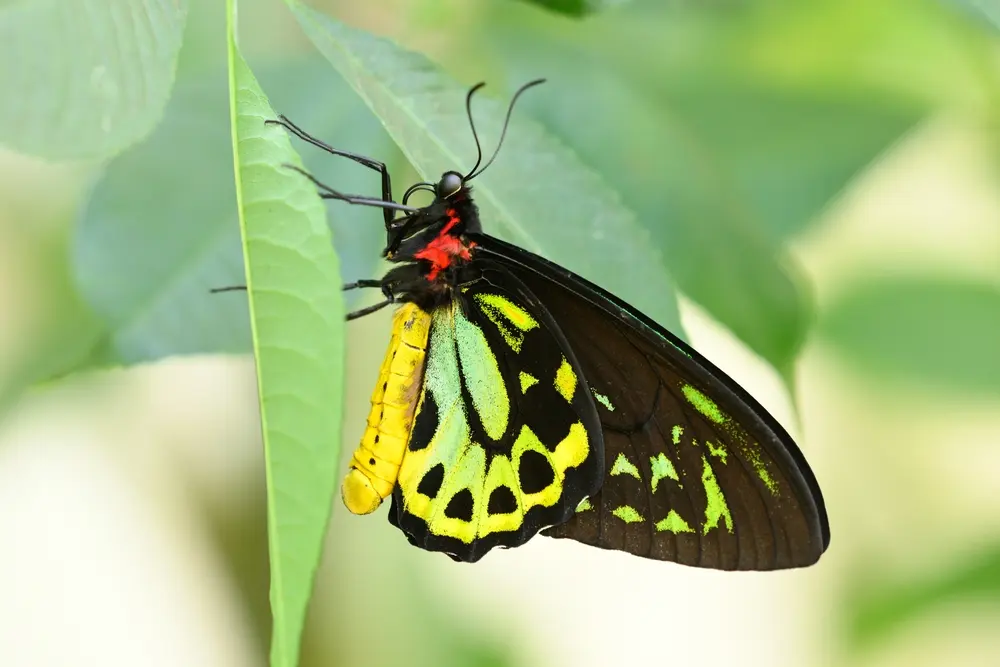
The Cairns Birdwing (Ornithoptera euphorion) is the largest butterfly native to Australia; females can span about 15 cm and are black and cream, while the smaller males glow green and gold. It is confined to the Wet Tropics and lays only on native Pararistolochia vines. The Common Green Birdwing, listed here as the New Guinea Birdwing, replaces it on Cape York, and the threatened Richmond Birdwing holds on in rainforest remnants of south-east Queensland and northern New South Wales.
Along the east coast the Orchard Swallowtail is the big black-and-white butterfly of suburban gardens, its young caterpillars disguised as bird droppings on citrus trees. The Varied Eggfly, known elsewhere as the Blue Moon, is common across the north and east, the male jet-black with violet-ringed white spots, the female endlessly variable. The Common Crow, now treated as Euploea corinna rather than the Asian E. core, gathers in shaded gullies through the northern dry season.

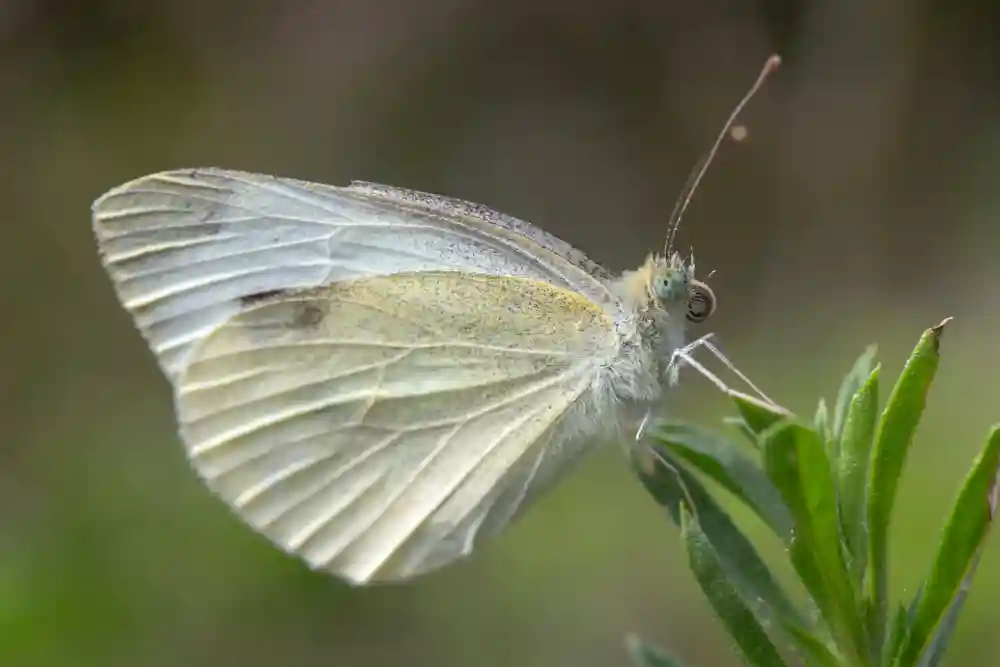
The Monarch, called the Wanderer in Australia, is not native: it appeared in the 1870s once introduced milkweeds gave it a food plant, and now forms winter clusters near Sydney and Adelaide. The Cabbage White, first found in Victoria in 1939, is the commonest butterfly in vegetable gardens from Perth to Hobart. The two Christmas Island swallowtails on the list, including the Great Mormon, occur only on that Indian Ocean territory.
The Australian butterfly calendar
Because the country spans the tropics and the temperate south, there is no single butterfly season. In north Queensland butterflies fly all year, but numbers surge during and just after the wet season, from December to April, when birdwings, Ulysses and Blue Triangles are most abundant. In the dry season Common Crows hang in dense aggregations in shaded creek beds and the Evening Brown switches to a plainer dry-season form.
In the south the year runs from September to April. Spring is the migration season: Caper Whites stream out of the inland in October and November and can fill Sydney and Melbourne streets for a few days, and the Australian Painted Lady moves south in the same months, breeding on everlastings and cudweeds as it goes. Our guide to butterfly migration explains how these movements are driven by rain in the interior rather than by cold. December and January are the peak for the browns and skippers of the eucalypt woodlands, and the alpine xenicas fly only in January and February.
The Common Brown has one of the oddest calendars of any butterfly: males emerge in spring and die within weeks, while the females spend the dry summer dormant in the shade and lay on grasses only when autumn rain arrives. Winter is quiet but never empty: Common Grass-blues fly on any mild day, and the Monarch clusters wait out the cold much as their relatives do in Mexico, a habit described in where butterflies go in the winter.
Where to see butterflies in Australia
The richest butterfly country is the Wet Tropics between Townsville and Cooktown, where a single rainforest walk can produce birdwings, Ulysses, triangles and a dozen blues.
- Australian Butterfly Sanctuary, Kuranda — the largest butterfly flight aviary in the country, open since 1987, with free-flying Ulysses and Cairns Birdwings outside Cairns.
- Daintree and the Atherton Tablelands — wild Ulysses and birdwings along the creeks, best from December to May.
- Lamington National Park and Tamborine Mountain — strongholds of the Richmond Birdwing in south-east Queensland.
- Kosciuszko National Park — alpine xenicas and mountain skippers on the summer meadows above 1,500 m.
- Tasmania's Central Plateau — the endemic Ptunarra Brown on tussock grassland in March and April.
The tropical species continue north into Papua New Guinea, while New Zealand has only a short list of its own plus a few Australian species that crossed the Tasman.
Host plants and butterfly gardening in Australia
Australian butterflies are tied closely to native plants, so a garden built on local species outperforms one built on exotic nectar flowers. The most useful caterpillar host plants are:
- Citrus and native finger lime — the Orchard Swallowtail and, in the north, the Fuscus and Ambrax Swallowtails.
- Pink-flowered doughwood (Melicope elleryana) — the only food of the Ulysses.
- Birdwing vine (Pararistolochia praevenosa) — the Richmond Birdwing. Never plant Dutchman's pipe, which attracts the females but poisons their caterpillars.
- Wattles — the Imperial Hairstreak, whose gregarious caterpillars are guarded by ants, and the Wattle Blue.
- Native grasses and sedges — the browns, xenicas and most ochres and grass-skippers; an unmown tussock patch does more than any flower bed.
- Senna and native capers — the Lemon Migrant and the Caper White.
Milkweeds feed the Monarch but are introduced weeds in much of the country. For nectar, native daisies, grevilleas, bottlebrushes, Buddleja, pentas and salvias keep adults visiting from spring to autumn.
Rare and threatened butterflies in Australia
Australia's most threatened butterflies are habitat specialists tied to one plant, one ant or one patch of ground. The Richmond Birdwing declined for most of the twentieth century as lowland rainforest was cleared and its vine was replaced by the poisonous Dutchman's pipe; a community planting program begun in the 1990s has restored it to parts of its range, and it remains listed as vulnerable in Queensland. The Bulloak Jewel survives on a handful of bulloak stands in southern Queensland where its caterpillars live with a single ant species, and the Bathurst Copper, listed here as the Purple Copper, is confined to cold hillsides above 900 m in central New South Wales.
Other names on the national threatened list include the Golden-rayed Blue of Victoria's Wimmera, Illidge's Ant-blue, reared inside ant nests in grey mangroves, the Ptunarra Brown of Tasmania, and the Australian Fritillary, which bred on violets in coastal swamps and has not been reliably seen since the early 2000s. Land clearing, grazing, changed fire regimes and invasive weeds are the recurring causes.
Butterflies found in Australia
380 species listed for Australia, grouped by family. Linked names have a full profile on this site with pictures of every life stage.
Brush-Footed (Nymphalidae)
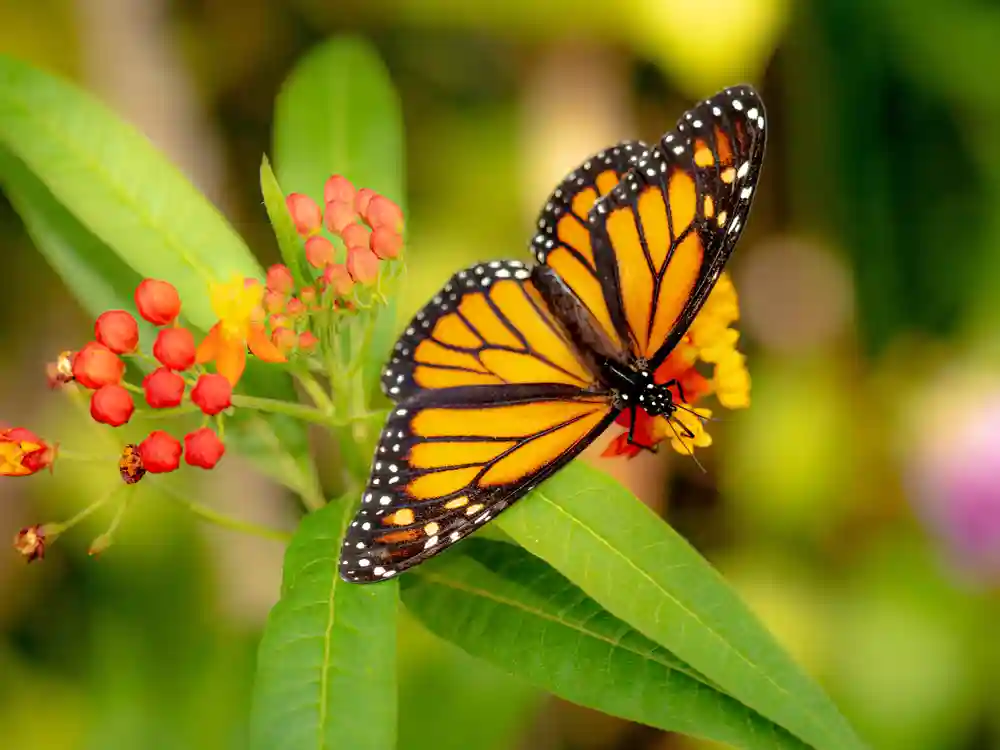 Danaus plexippusMonarch (Danaus plexippus)The monarch is a large orange butterfly with black-outlined wing veins and a black, white-spotted border, found across North America and now on severa
 Hypolimnas bolinaBlue Moon (Hypolimnas bolina)The blue moon, or great eggfly, is a black tropical butterfly whose white wing patches burn electric blue when the light strikes them at the right ang
Show all 46 other brush-footed species names
- Australian Painted Lady (Vanessa kershawi)
- Banded Evening Brown (Melanitis amabilis)
- Banks' Brown (Heteronympha banksii)
- Cedar Bush-brown (Mycalesis sirius)
- Christmas Emperor (Polyura andrewsi)
- Common Crow (Euploea core)
- Dingy Bush-brown (Mycalesis perseus)
- Dusky Bush-brown (Orsotriaena medus)
- Dusky Knight (Ypthima arctoa)
- Evening Brown (Melanitis leda)
- Marbled Xenica (Geitoneura klugii)
- Orange Bush-brown (Mycalesis terminus)
- Orange Emperor (Charaxes latona)
- Palmfly (Elymnias agondas)
- Australian Lurcher Butterfly (Yoma Sabina)
- Papuan Evening Brown (Melanitis constantia)
- Pearl Owl (Taenaris artemis)
- Ringed Xenica (Geitoneura acantha)
- Silky Owl (Taenaris catops)
- Tailed Emperor (Polyura sempronius)
- Tasmanian Xenica (Nesoxenica leprea)
- Apaturina erminea papuana
- Apaturina erminea
- Argynnina cyrila
- Argynnina hobartia
- Geitoneura minyas
- Oreixenica correae
- Oreixenica kershawi
- Oreixenica lathoniella
- Oreixenica latialis
- Oreixenica orichora
- Oreixenica ptunarra
- Heteronympha cordace
- Heteronympha merope
- Heteronympha mirifica
- Heteronympha paradelpha
- Heteronympha penelope
- Heteronympha solandri
- Polyura pyrrhus sempronius
- Hypocysta adiante
- Hypocysta euphemia
- Hypocysta irius
- Hypocysta metirius
- Hypocysta pseudirius
- Tisiphone abeona
- Tisiphone helena
Gossamer-Winged (Lycaenidae)
Show all 149 gossamer-winged species names
- Amethyst Hairstreak (Jalmenus icilius)
- Amethyst Jewel (Hypochrysops elgneri)
- Apollo Jewel (Hypochrysops apollo)
- Arid Bronze Azure (Ogyris subterrestris)
- Azure Moonbeam (Philiris azule)
- Bicolour Moonbeam (Philiris fulgens)
- Bitter-bush Blue (Theclinesthes albocincta)
- Black Ant-blue (Acrodipsas hirtipes)
- Black-spotted Flash (Hypolycaena phorbas)
- Black-veined Ant-blue (Acrodipsas arcana)
- Blotched Dusky-blue (Candalides acasta)
- Blue Moonbeam (Philiris nitens)
- Bold Line-blue (Nacaduba pactolus)
- Bright Copper (Paralucia aurifera)
- Bright Cornelian (Deudorix diovis)
- Bright Forest-blue (Pseudodipsas cephenes)
- Bright Oak-blue (Arhopala madytus)
- Bright Purple Azure (Ogyris barnardi)
- Broad-margined Azure (Ogyris olane)
- Bronze Ant-blue (Acrodipsas brisbanensis)
- Bronze Line-blue (Ionolyce helicon)
- Brown Ant-blue (Acrodipsas mortoni)
- Bulloak Jewel (Hypochrysops piceata)
- Chequered Copper (Lucia limbaria)
- Cobalt Pea-blue (Catochrysops amasea)
- Common Grass-blue (Zizina labradus)
- Common Pencil-blue (Candalides absimilis)
- Copper Ant-blue (Acrodipsas cuprea)
- Copper Jewel (Hypochrysops apelles)
- Copper Pencil-blue (Candalides cyprotus)
- Coral Jewel (Hypochrysops miskini)
- Cyane Jewel (Hypochrysops cyane)
- Cycad Blue (Theclinesthes onycha)
- Dainty Grass-blue (Zizula hylax)
- Dark Ciliate-blue (Anthene seltuttus)
- Dark Cornelian (Deudorix epijarbas)
- Dark Forest-blue (Pseudodipsas eone)
- Dark Green-banded Blue (Nothodanis schaeffera)
- Dark Opal (Nesolycaena medicia)
- Dark Pencil-blue (Candalides consimilis)
- Dark Purple Azure (Ogyris abrota)
- Decima Ant-blue (Acrodipsas decima)
- Delicate Blue (Udara tenella)
- Devil's Blue (Neopithecops lucifer)
- Dull Heath-blue (Neolucia mathewi)
- Emerald Hairstreak (Jalmenus daemeli)
- Fiery Copper (Paralucia pyrodiscus)
- Fiery Jewel (Hypochrysops ignita)
- Fringed Heath-blue (Neolucia agricola)
- Glistening Line-blue (Sahulana scintillata)
- Golden Ant-blue (Acrodipsas aurata)
- Golden Azure (Ogyris ianthis)
- Golden-rayed Blue (Candalides noelkeri)
- Gracile Line-blue (Prosotas gracilis)
- Green-banded Jewel (Hypochrysops theon)
- Green-banded Line-blue (Nacaduba cyanea)
- Grey Ant-blue (Acrodipsas melania)
- Hairy Line-blue (Erysichton lineata)
- Imperial Hairstreak (Jalmenus evagoras)
- Indigo Flash (Rapala varuna)
- Inland Hairstreak (Jalmenus aridus)
- Jewelled Grass-blue (Freyeria putli)
- Kimberley Spotted Opal (Nesolycaena caesia)
- King Cerulean (Jamides bochus)
- Large Bronze Azure (Ogyris idmo)
- Large Green-banded Blue (Danis danis)
- Large Moonbeam (Philiris diana)
- Large Purple Line-blue (Nacaduba berenice)
- Lesser Grass-blue (Zizina otis)
- Long-tailed Line-blue (Prosotas nora)
- Long-tailed Pea-blue (Lampides boeticus)
- Macqueen's Hairstreak (Jalmenus pseudictinus)
- Mangrove Jewel (Hypochrysops epicurus)
- Mangrove or Illidge's Ant-blue (Acrodipsas illidgei)
- Marbled Line-blue (Erysichton palmyra)
- Mauve Line-blue (Petrelaea tombugensis)
- Montane Heath-blue (Neolucia hobartensis)
- Moonlight Jewel (Hypochrysops delicia)
- Moth Butterfly (Liphyra brassolis)
- Narcissus Jewel (Hypochrysops narcissus)
- Northern Hairstreak (Jalmenus eichhorni)
- Northern Pencil-blue (Candalides gilberti)
- Northern Purple Azure (Ogyris zosine)
- Orange-lobed Flash (Deudorix epirus)
- Orange-tipped Azure (Ogyris iphis)
- Orange-tipped Pea-blue (Everes lacturnus)
- Orchid Flash (Hypolycaena danis)
- Pale Cerulean (Jamides cyta)
- Pale Ciliate-blue (Anthene lycaenoides)
- Pale Pea-blue (Catochrysops panormus)
- Papuan Cerulean (Jamides nemophila)
- Papuan Line-blue (Catopyrops ancyra)
- Paradise Jewel (Hypochrysops hippuris)
- Peacock Jewel (Hypochrysops pythias)
- Pied Blue (Pithecops dionisius)
- Plumbago Blue (Leptotes plinius)
- Princess Flash (Deudorix smilis)
- Purple Cerulean (Jamides phaseli)
- Purple Line-blue (Prosotas dubiosa)
- Purple Moonbeam (Philiris innotatus)
- Purple Copper (Paralucia spinifera)
- Rayed Blue (Candalides heathi)
- Royal Jewel (Hypochrysops polycletus)
- Saltbush Blue (Theclinesthes serpentata)
- Samphire Blue (Theclinesthes sulpitius)
- Sapphire Azure (Ogyris aenone)
- Sapphire Moonbeam (Philiris sappheira)
- Satin Azure (Ogyris amaryllis)
- Satin Opal (Nesolycaena albosericea)
- Shining Cerulean (Jamides amarauge)
- Shining Oak-blue (Arhopala micale)
- Shining Pencil-blue (Candalides helenita)
- Short-tailed Line-blue (Prosotas felderi)
- Silky Azure (Ogyris oroetes)
- Silky Hairstreak (Pseudalmenus chlorinda)
- Silky Jewel (Hypochrysops digglesii)
- Small Ant-blue (Acrodipsas myrmecophila)
- Small Bronze Azure (Ogyris otanes)
- Small Dusky-blue (Candalides erinus)
- Small Green-banded Blue (Psychonotis caelius)
- Small Pied Blue (Megisba strongyle)
- Southern Purple Azure (Ogyris genoveva)
- Speckled Line-blue (Catopyrops florinda)
- Splendid Jewel (Hypochrysops cleon)
- Spotted Dusky-blue (Candalides delospila)
- Spotted Grass-blue (Zizeeria karsandra)
- Spotted Opal (Nesolycaena urumelia)
- Spotted Pea-blue (Euchrysops cnejus)
- Stencilled Hairstreak (Jalmenus ictinus)
- Sword-tailed Flash (Bindahara phocides)
- Trident Pencil-blue (Candalides margarita)
- Turquoise Hairstreak (Jalmenus clementi)
- Western Jewel (Hypochrysops halyaetus)
- Twin Dusky-blue (Candalides geminus)
- Two-spotted Line-blue (Nacaduba biocellata)
- Varied Dusky-blue (Candalides hyacinthina)
- Varied Hairstreak (Jalmenus inous)
- Violet Line-blue (Nacaduba calauria)
- Waterhouse's Hairstreak (Jalmenus lithochroa)
- Wattle Blue (Theclinesthes miskini)
- Western Bitter-bush Blue (Theclinesthes hesperia)
- White-banded Cerulean (Jamides aleuas)
- White-banded Line-blue (Nacaduba kurava)
- White-margined Moonbeam (Philiris ziska)
- White Oak-blue (Arhopala wildei)
- White-spotted Flash (Deudorix democles)
- Yellow Jewel (Hypochrysops byzos)
- Yellow-spotted Blue (Candalides xanthospilos)
- Purple Oak-blue (Arhopala eupolis)
Whites and Sulphurs (Pieridae)
Show all 36 other whites and sulphurs species names
- Black Jezebel (Delias nigrina)
- Black-spotted White (Leptosia nina)
- Blue Albatross (Appias celestina)
- Broad-margined Grass-yellow (Eurema puella)
- Caper Gull (Cepora perimale)
- Caper White (Belenois java)
- Cape York Pearl-white (Elodina claudia)
- Delicate Pearl-white (Elodina perdita)
- Glistening Pearl-white (Elodina queenslandica)
- Golden Jezebel (Delias aruna)
- Grey Albatross (Appias melania)
- Imperial Jezebel (Delias harpalyce)
- Large Grass-yellow (Eurema hecabe)
- Lemon Migrant (Catopsilia pomona)
- Lined Grass-yellow (Eurema laeta)
- Narrow-winged Pearl-white (Elodina padusa)
- No-brand Grass-yellow (Eurema brigitta)
- Orange Albatross (Appias ada)
- Orange Migrant (Catopsilia scylla)
- Pink grass-yellow (Eurema herla)
- Red-banded Jezebel (Delias mysis)
- Scalloped Grass-yellow (Eurema alitha)
- Scarlet Jezebel (Delias argenthona)
- Small Grass-yellow (Eurema smilax)
- Small Pearl-white (Elodina walkeri)
- Southern Pearl-white (Elodina angulipennis)
- Spotted Jezebel (Delias aganippe)
- Striated Pearl-white (Elodina parthia)
- Striped Albatross (Appias olferna)
- Three-spot Grass Yellow (Eurema blanda)
- White Migrant (Catopsilia pyranthe)
- White Albatross (Appias albina)
- Yellow Albatross (Appias paulina)
- Yellow-banded Jezebel (Delias ennia)
- Yellow Migrant (Catopsilia gorgophone)
- Yellow-spotted Jezebel (Delias nysa)
Metalmark (Riodinidae)
- Harlequin Metalmark (Praetaxila segecia)
Swallowtail (Papilionidae)
 Papilio memnonGreat Mormon (Papilio memnon)One of the largest swallowtails in Asia, the great Mormon is really several butterflies in one.Ornithoptera priamusCommon Green Birdwing (Ornithoptera priamus)One of the giants of the butterfly world, the common green birdwing sails above the rainforest canopy of New Guinea, the Solomons and tropical AustralPapilio aegeusLarge Citrus (Papilio aegeus)One of Australia's largest butterflies, and a swallowtail with no tails at all.Papilio UlyssesUlysses (Papilio Ulysses)A large tropical swallowtail whose upper wings burn electric blue in sunlight and switch off completely the moment it lands, the Ulysses is the signat
Show all 16 other swallowtail species names
- Ambrax Swallowtail (Papilio ambrax)
- Blue Triangle (Graphium sarpedon)
- Cairns Birdwing (Ornithoptera euphorion)
- Chequered Swallowtail (Papilio demoleus)
- Clearwing Swallowtail (Cressida cressida)
- Dainty Swallowtail (Papilio anactus)
- Five-barred Swordtail (Graphium aristeus)
- Four-barred Swordtail (Protographium leosthenes)
- Fuscus Swallowtail (Papilio fuscus)
- Green-spotted Triangle (Graphium agamemnon)
- Green Triangle (Graphium macfarlanei)
- Macleay's Swordtail (Graphium macleayanus)
- Norfolk Swallowtail (Papilio amynthor)
- Pale Triangle (Graphium eurypylus)
- Red-bodied Swallowtail (Pachliopta polydorus)
- Richmond Birdwing (Ornithoptera richmondia)
Skipper (Hesperiidae)
Show all 125 skipper species names
- Banded Dusk-flat (Chaetocneme critomedia)
- Barred Skipper (Dispar compacta)
- Black-ringed Ochre (Trapezites petalia)
- Blue-flash Skipper (Rachelia extrusus)
- Broad-banded Awl (Hasora hurama)
- Bronze Flat (Netrocoryne repanda)
- Bronze Ochre (Trapezites macqueeni)
- Brown Ochre (Trapezites iacchus)
- Chequered Grass-skipper (Anisynta tillyardi)
- Common Banded Awl (Hasora chromus)
- Eastern Dusk-flat (Chaetocneme beata)
- Greater Peacock Awl (Allora major)
- Green Awl (Hasora discolor)
- Heath Ochre (Trapezites phigalia)
- Large Banded Awl (Hasora khoda)
- Laterite Ochre (Trapezites waterhouse)
- Montane Grass-skipper (Anisynta monticolae)
- Montane Ochre (Trapezites phigalioides)
- Mottled Grass-skipper (Anisynta cynone)
- Narrow-winged Awl (Badamia exclamationis)
- Doubleday's Skipper (Toxidia doubledayi)
- Northern Silver Ochre (Trapezites maheta)
- Orange Ochre (Trapezites eliena)
- Ornate Dusk-flat (Chaetocneme denitza)
- Ornate Ochre (Trapezites genevieveae)
- Papuan Snow Flat (Tagiades nestus)
- Peacock Awl (Allora doleschallii)
- Pied Flat (Tagiades japetus)
- Purple Dusk-flat (Chaetocneme porphyropis)
- Regent Skipper (Euschemon rafflesia)
- Rice Swift (Borbo cinnara)
- Sandstone Ochre (Trapezites taori)
- Sciron Ochre (Trapezites sciron)
- Silver-spotted Ochre (Trapezites argenteoornatus)
- Silver-studded Ochre (Trapezites iacchoides)
- Small Orange Ochre (Trapezites heteromacula)
- Southern Silver Ochre (Trapezites praxedus)
- Speckled Ochre (Trapezites atkinsi)
- Splendid Ochre (Trapezites symmomus)
- Two-brand Grass-skipper (Anisynta dominula)
- Two-spotted Grass-skipper (Pasma tasmanicus)
- Wedge Grass-skipper (Anisynta sphenosema)
- Western Flat (Exometoeca nycteris)
- White-veined Sand-skipper (Anisynta albovenata)
- Yellow Ochre (Trapezites lutea)
- Cephrenes augiades
- Cephrenes trichopepla
- Anisyntoides argenteoornatus
- Antipodia atralba
- Antipodia chaostola
- Antipodia dactyliota
- Arrhenes dschilus
- Arrhenes marnas
- Borbo impar
- Hesperilla chrysotricha
- Hesperilla crypsargyra
- Hesperilla crypsigramma
- Hesperilla donnysa
- Hesperilla flavescens
- Hesperilla furva
- Hesperilla idothea
- Hesperilla malindeva
- Hesperilla mastersi
- Hesperilla ornata
- Hesperilla picta
- Hesperilla sarnia
- Hesperilla sexguttata
- Ocybadistes ardea
- Ocybadistes flavovittata
- Ocybadistes hypomeloma
- Ocybadistes knightorum
- Ocybadistes walkeri
- Croitana aestiva
- Croitana arenaria
- Croitana croites
- Herimosa albovenata
- Mesodina aeluropis
- Mesodina cyanophracta
- Mesodina gracillima
- Mesodina halyzia
- Mesodina hayi
- Mimene atropatene
- Motasingha dirphia
- Motasingha trimaculata
- Neohesperilla croceus
- Neohesperilla senta
- Neohesperilla xanthomera
- Neohesperilla xiphiphora
- Notocrypta waigensis
- Sabera caesina
- Sabera dobboe
- Sabera fuliginosa
- Oreisplanus munionga
- Oreisplanus perornata
- Parnara amalia
- Parnara bada
- Pelopidas agna
- Pelopidas lyelli
- Proeidosa polysema
- Pseudoborbo bevani
- Taractrocera anisomorpha
- Taractrocera dolon
- Taractrocera ilia
- Taractrocera ina
- Taractrocera papyria
- Signeta flammeata
- Signeta tymbophora
- Suniana lascivia
- Suniana sunias
- Toxidia andersoni
- Toxidia inornatus
- Toxidia melania
- Toxidia parvulus
- Toxidia peron
- Toxidia rietmanni
- Toxidia thyrrhus
- Telicota ancilla
- Telicota anisodesma
- Telicota augias
- Telicota brachydesma
- Telicota colon
- Telicota eurotas
- Telicota eurychlora
- Telicota mesoptis
- Telicota ohara
How to identify butterflies in Australia
Start with size and family. Anything with a wingspan above 10 cm in the east is a swallowtail or birdwing: black and white with a red hindwing spot is the Orchard Swallowtail, green-and-black in the tropics is a birdwing, and electric blue is the Ulysses. Medium-sized brown butterflies with eyespots on grass and in woodland are the browns and xenicas, told apart by the placement of the eyespots and by region. Orange-and-black butterflies are usually the Australian Painted Lady, told from the rare true Painted Lady by the blue-centred spots on its hindwing, or the Monarch and its mimic the Lesser Wanderer.
The hard groups are the blues, where the underside pattern matters more than the colour on top, and the skippers, best identified by the underside markings and their host sedges. Australia's fauna stands on its own among the countries under Butterflies of the World, so a European or North American field guide is of little help here.
Frequently asked questions about Australian butterflies
How many species of butterfly are found in Australia?
More than 400 butterfly species have been recorded in Australia, and the total rises past 430 when the Torres Strait islands and the offshore territories are included. A large proportion occur nowhere else, particularly the browns, azures, jewels, ant-blues and ochres, while a few, such as the Monarch and the Cabbage White, arrived within the last 150 years.
What is the largest butterfly in Australia?
The Cairns Birdwing (Ornithoptera euphorion) is the largest butterfly native to Australia. Females are black and cream with a wingspan of up to about 15 cm; males are smaller and brilliant green and gold. It lives only in the rainforests of north-east Queensland, between Cooktown and Mackay, where its caterpillars feed on native Pararistolochia vines.
Does Australia have a national butterfly?
No, Australia has never officially designated a national butterfly, and no state has an official butterfly emblem either. The Ulysses (Papilio ulysses) is used informally as the emblem of tropical North Queensland and appears in tourism branding for Cairns, while the Richmond Birdwing has become the flagship species for rainforest conservation in south-east Queensland.
Where is the best place to see butterflies in Australia?
The Wet Tropics of north Queensland, between Townsville and Cooktown, hold the most species. The Australian Butterfly Sanctuary at Kuranda near Cairns is the largest butterfly flight aviary in the country and shows Ulysses and Cairns Birdwings at close range, while the Daintree, the Atherton Tablelands and Lamington National Park are the best wild sites.
What are the most common butterflies in Australia?
The Common Grass-blue is the most abundant Australian butterfly, flying low over lawns and clover in every state. In gardens the Cabbage White, Orchard Swallowtail, Australian Painted Lady, Common Brown, Varied Eggfly and Monarch are the species people notice most, and in the north the Common Crow, Lemon Migrant and Evening Brown are everywhere.
Is the Monarch butterfly native to Australia?
No. The Monarch, known in Australia as the Wanderer, arrived from the Americas in the 1870s, once introduced milkweeds gave its caterpillars something to eat. It is now established along the east coast, in South Australia and around Perth, and forms winter clusters in sheltered gullies near Sydney and Adelaide, just as it does at its overwintering sites in Mexico and California.
Which family of butterflies is most diverse in Australia?
The gossamer-winged butterflies (Lycaenidae) are the most diverse family in Australia, with roughly 140 species of blues, coppers, hairstreaks, azures and jewels, many of them tended by ants. The skippers come second with about 120 species, most of them ochres and grass-skippers found nowhere else, followed by the brush-footed butterflies.
Are there butterflies found only in Australia?
Yes. A large share of Australian butterflies are endemic, including almost all the browns and xenicas, such as the Common Brown, Ringed Xenica and Ptunarra Brown, the azures and jewels of the genera Ogyris and Hypochrysops, the ant-blues, the Regent Skipper and most of the ochres. The Cairns Birdwing and Richmond Birdwing are endemic swallowtails.
When do butterflies migrate in Australia?
The main migrations happen in spring, from September to November. Caper Whites and Australian Painted Ladies breed in the inland after good rain and then stream south and east, sometimes filling city streets for a few days. The Lemon Migrant and Blue Tiger move along the Queensland coast, and Monarchs gather at coastal winter clusters between May and August.
Which Australian butterflies are endangered?
Species protected under national or state law include the Richmond Birdwing, Bulloak Jewel, Bathurst (Purple) Copper, Golden-rayed Blue, Illidge's Ant-blue, Ptunarra Brown and the Australian Fritillary, which may already be extinct. Most are specialists dependent on one host plant or one ant species, and habitat clearing, weeds and changed fire regimes are the main threats.
Published October 30, 2023 · Last updated September 21, 2026