
Types of Butterflies in Alaska

There are about 75-80 species of butterflies found in Alaska. Among them, about 35-40 species live in Anchorage and the nearby Chugach Mountains. Most butterflies go through their life cycles in warmer climates. Some species flutter over entire North America, and some unique species, e.g., Phoebus Parnassian, can acclimate to cold temperatures. Alaskan butterflies can live over a year and are found everywhere, including the sea level and mountaintops.

Although Alaska does not have any state butterfly, it has officially designated Four-spot Skimmer Dragonfly as the state insect.
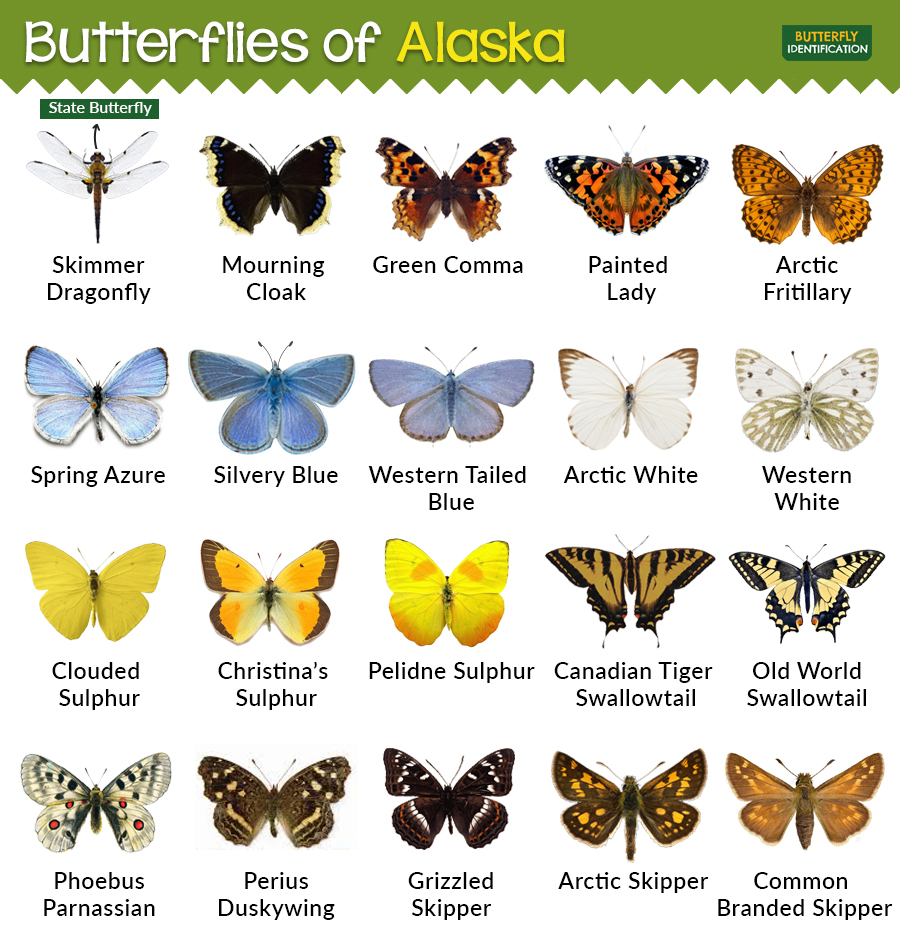
Butterflies in Alaska (AK)

Brush-Footed (Nymphalidae)

  • Milbert’s Tortoiseshell (Nymphalis milberti)
  • Mourning Cloak (Nymphalis antiopa)
  • Green Comma (Polygonia faunus)
  • Painted Lady (Vanessa cardui)
  • Arctic Fritillary (Boloria chariclea)
  • Mountain Fritillary (Boloria napaea)
  • Silver-Bordered Fritillary (Boloria selene)
  • Mormon Fritillary (Speyeria mormonia)
  • Ross’s Alpine (Erebia rossii)
  • Field Crescent (Phyciodes pratensis)

Gossamer-Winged (Lycaenidae)

  • Spring Azure (Celastrina ladon)
  • Silvery Blue (Glaucopsyche lygdamus)
  • Northern Blue (Lycaeides idas)
  • Western Tailed Blue (Cupido (Everes) amyntula)

Whites and Sulphurs (Pieridae)

  • Arctic White (Pieris angelika)
  • Western White (Pontia occidentalis)
  • Creamy Marblewing (Euchloe ausonides)
  • Palaeno Sulphur (Colias palaeno)
  • Clouded Sulphur (Colias philodice vitabunda)
  • Christina’s Sulphur (Colias christina)
  • Giant Sulphur (Colias gigantea)
  • Pelidne Sulphur (Colias pelidne)
  • Labrador Sulphur (Colias nastes)
  • Canadian Sulphur (Colias canadensis)
  • Hecla Sulphur (Colias hecla)
  • Booth’s Sulphur (Colias tyche thula)

Swallotail (Papilionidae)

Skipper (Hesperiidae)

  • Perius Duskywing (Erynnis persius)
  • Grizzled Skipper (Pyrgus centaureae)
  • Arctic Skipper (Carterocephalus palaemon)
  • Common Branded Skipper (Hesperia comma)
Frequently Asked Questions

icon

Approximately 75 to 80 butterfly species are found throughout Alaska. The Anchorage area and the nearby Chugach Mountains are home to about half of these species, with around 35 to 40 different types recorded. These insects have adapted to thrive in the state’s diverse and often cold environments.

icon

The most common butterfly families in Alaska include Brush-Footed (Nymphalidae), Gossamer-Winged (Lycaenidae), and Whites and Sulphurs (Pieridae). Other prominent families are Swallowtails (Papilionidae) and Skippers (Hesperiidae). Each family contains multiple species adapted to the region’s unique climate, like the Arctic Fritillary and Canadian Tiger Swallowtail.

icon

No, Alaska does not have an official state butterfly. While the state is home to many butterfly species, it has not designated one for this honor. Instead, Alaska officially recognized the Four-spot Skimmer Dragonfly as its state insect, a different type of flying insect found in the region.

icon

Alaskan butterflies survive cold winters through life cycles adapted to the climate, allowing them to live for over a year. Species like the Phoebus Parnassian are particularly acclimated to cold temperatures. They typically overwinter in a dormant stage, such as an egg, larva, or chrysalis, to endure freezing conditions.

icon

The Phoebus Parnassian (Parnassius phoebus) is a unique butterfly species in Alaska known for its ability to acclimate to cold temperatures. This species, along with the Eversmann’s Parnassian, belongs to the Swallowtail family and is well-adapted to the state’s challenging alpine and arctic environments, making it distinctive.

icon

Butterflies in Alaska can be found in a wide variety of habitats across the state. Their range extends from sea level coastal areas all the way up to mountaintops. This demonstrates their remarkable adaptability to the different elevations and environmental conditions present in the vast Alaskan wilderness.

icon

Butterflies in Alaska can live for over a year, a lifespan adapted to the region’s short summers and long winters. This extended life cycle allows them to complete their development through the different seasons. Many species overwinter in a dormant stage before emerging as adults in the warmer months.