
Types of Butterflies in South Carolina
This south-eastern U.S. state is home to approximately 165 species of butterflies, of which some are native species while others are migratory like the monarch and cloudless sulphur. The butterfly hotspots in the state include the Pinckney Island National Wildlife Refuge, Calibogue Sound beach, Mackay Creek, and Port Royal Sound. As temperature rises in spring, many plants flourish and butterfly activities increase.
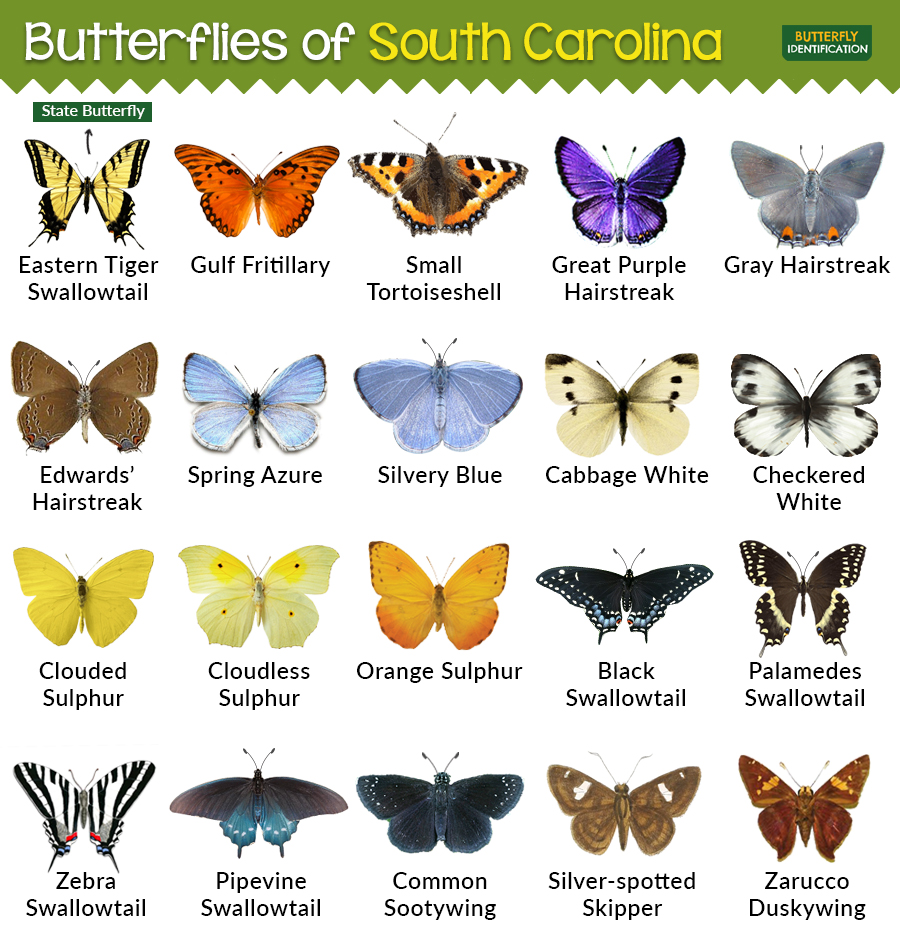
The Eastern Tiger Swallowtail (Papilio glaucus), characterized by yellow and black markings and a wingspan of 5 inches, has been designated as the state butterfly of South Carolina.
Brush-Footed (Nymphalidae)
- Gulf Fritillary (Agraulis vanillae)
- Queen (Danaus gilippus)
- Small Tortoiseshell (Aglais urticae)
Gossamer-Winged (Lycaenidae)
- Harvester (Feniseca tarquinius)
- Harvester (Feniseca tarquinius)
- Gray Copper (Lycaena dione)
- Gray Copper (Lycaena dione)
- Bronze Copper (Lycaena hyllus)
- Ruddy Copper (Lycaena rubidus)
- Purplish Copper (Lycaena helloides)
- Great Purple Hairstreak (Atlides halesus)
- Coral Hairstreak (Satyrium titus)
- Edwards’ Hairstreak (Satyrium edwardsii)
- White-M Hairstreak (Parrhasius m-album)
- Gray Hairstreak (Strymon melinus)
- Striped Hairstreak (Satyrium liparops)
- King’s Hairstreak (Satyrium kingi)
- Oak Hairstreak (Satyrium favonius)
- Red-banded Hairstreak (Calycopis cecrops)
- Banded Hairstreak (Satyrium calanus)
- Olive (Juniper) Hairstreak (Callophrys gryneus)
- Brown Elfin (Callophrys augustinus)
- Frosted Elfin (Callophrys irus)
- Henry’s Elfin (Callophrys henrici)
- Eastern Pine Elfin (Callophrys niphon)
- Spring Azure (Celastrina ladon)
- Summer Azure (Celastrina neglecta)
- Eastern Tailed-Blue (Cupido comyntas)
- Cassius Blue (Leptotes cassius)
- Eastern Pygmy-Blue (Brephidium exilis)
- Appalachian Azure (Celastrina neglectamajor)
- Holly Azure (Celastrina idella)
- Silvery Blue (Glaucopsyche lygdamus)
- Ceraunus Blue (Hemiargus ceraunus)
White and Sulphurs (Pieridae)
- Cabbage White (Pieris rapae)
- Checkered White (Pontia protodice)
- Falcate Orangetip (Anthocharis midea)
- West Virginia White (Pieris virginiensis)
- Great Southern White (Ascia monuste)
- Clouded Sulphur (Colias philodice)
- Orange Sulphur (Colias eurytheme)
- Southern Dogface (Colias cesonia)
- Dainty Sulphur (Nathalis iole)
- Little Yellow (Pyrisitia lisa)
- Cloudless Sulphur (Phoebis sennae)
- Sleepy Orange (Eurema nicippe)
- Little Yellow (Pyrisitia lisa)
Swallowtail (Papilionidae)
- Black Swallowtail (Papilio polyxenes)
- Eastern Tiger Swallowtail (Papilio glaucus)
- Giant Swallowtail (Papilio cresphontes)
- Palamedes Swallowtail (Papilio palamedes)
- Pipevine Swallowtail (Battus philenor)
- Spicebush Swallowtail (Papilio troilus)
- Zebra Swallowtail (Eurytides marcellus)
Skipper (Hesperiidae)
- Cofaqui Giant-Skipper (Megathymus cofaqui)
- Yucca Giant-Skipper (Megathymus yuccae)
- Common Checkered-Skipper (Pyrgus communis)
- Common Sootywing (Pholisora catullus)
- Confusing Cloudywing (Thorybes confusis)
- Dreamy Duskywing (Erynnis icelus)
- Golden Banded-Skipper (Autochton cellus)
- Hayhurst’s Scallopwing (Staphylus hayhurstii)
- Hoary Edge (Achalarus lyciades)
- Horace’s Duskywing (Erynnis horatius)
- Juvenal’s Duskywing (Erynnis juvenalis)
- Long-tailed Skipper (Urbanus proteus)
- Mottled Duskywing (Erynnis martialis)
- Northern Cloudywing (Thorybes pylades)
- Silver-spotted Skipper (Epargyreus clarus)
- Sleepy Duskywing (Erynnis brizo)
- Southern Cloudywing (Thorybes bathyllus)
- Tropical Checkered-Skipper (Pyrgus oileus)
- Wild Indigo Duskywing (Erynnis baptisiae)
- Zarucco Duskywing (Erynnis zarucco)