
Butterflies in Portugal
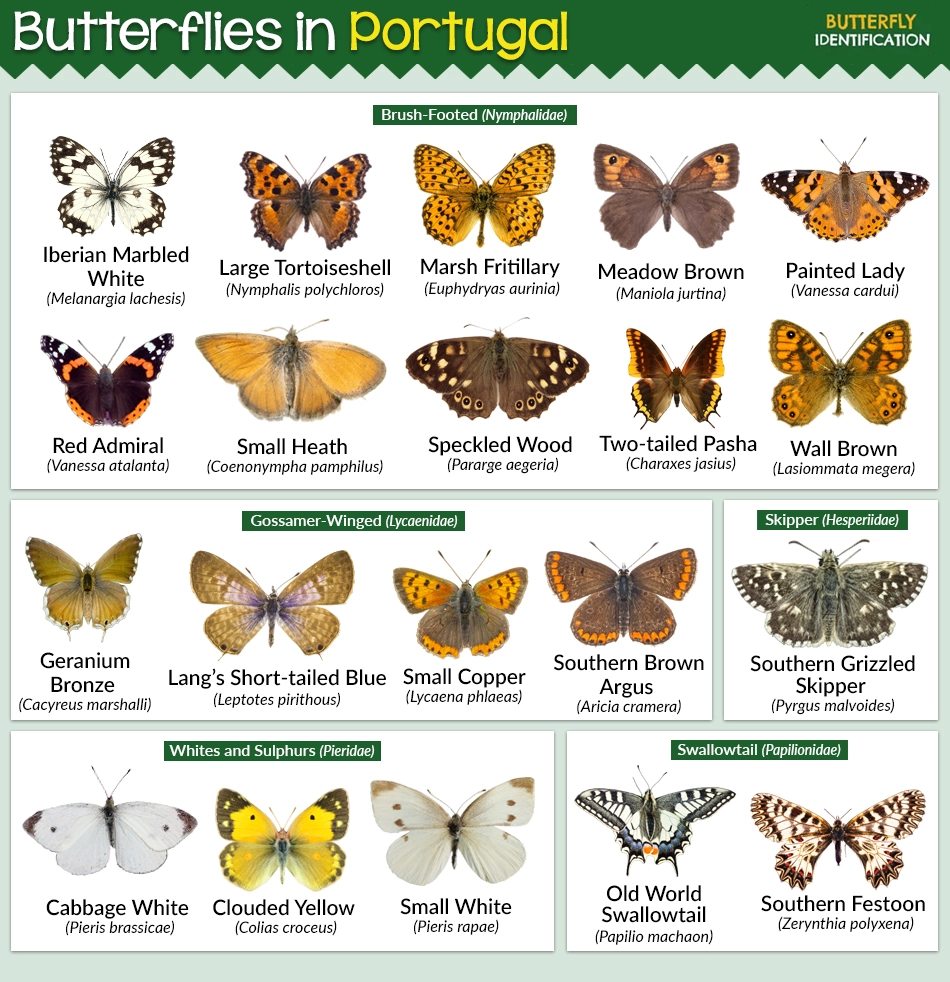
Portugal is home to several butterfly species, including the Two-tailed Pasha, the Large Tortoiseshell, and the Small White.
Butterflies in Portugal
List of Most Common Butterfly Species of Portugal
Brush-Footed (Nymphalidae)
- American Lady (Vanessa virginiensis)
- Black Satyr (Satyrus actaea)
- Cardinal (Argynnis pandora)
- Comma (Polygonia c-album)
- Dorus Ringlet (Coenonympha dorus)
- European Nettle-tree Butterfly (Libythea celtis)
- Great Banded Grayling (Brintesia circe)
- Great Eggfly (Hypolimnas bolina)
- Hedge Brown (Pyronia tithonus)
- Iberian Marbled White (Melanargia lachesis)
- Ines Blue (Melanargia ines)
- Large Tortoiseshell (Nymphalis polychloros)
- Lesser Purple Emperor (Apatura ilia)
- Lulworth Skipper (Thymelicus acteon)
- Malachite (Siproeta stelenes)
- Mallow Skipper (Carcharodus alceae)
- Marsh Fritillary (Euphydryas aurinia)
- Meadow Brown (Maniola jurtina)
- Monarch Butterfly (Danaus plexippus)
- Painted Lady (Vanessa cardui)
- Paper Kite Butterfly (Idea leuconoe)
- Peacock Butterfly (Aglais io)
- Pearly Heath (Coenonympha arcania)
- Phoebe Fritillary (Melitaea phoebe)
- Plain Tiger (Danaus chrysippus)
- Queen of Spain Fritillary (Issoria lathonia)
- Red Admiral (Vanessa atalanta)
- Red-underwing Skipper (Spialia sertorius)
- Sage Skipper (Muschampia proto)
- Scotch Argus (Hipparchia fidia)
- Silver-washed Fritillary (Argynnis paphia)
- Small Heath (Coenonympha pamphilus)
- Small Mallow (Carcharodus tripolina)
- Small Skipper (Thymelicus sylvestris)
- Southern Gatekeeper (Pyronia cecilia)
- Spanish Gatekeeper (Pyronia bathseba)
- Speckled Wood (Pararge aegeria)
- Tree Grayling (Hipparchia statilinus)
- Two-tailed Pasha (Charaxes jasius)
- Wall Brown (Lasiommata megera)
Gossamer-Winged (Lycaenidae)
- African Grass Blue (Zizeeria knysna)
- Blue-spot Hairstreak (Satyrium spini)
- Brown Hairstreak (Thecla betulae)
- European Common Blue (Polyommatus icarus)
- False Ilex Hairstreak (Satyrium esculi)
- Geranium Bronze (Cacyreus marshalli)
- Green Hairstreak (Callophrys rubi)
- Holly Blue (Celastrina argiolus)
- Lang’s Short-tailed Blue (Leptotes pirithous)
- Long-tailed Blue (Lampides boeticus)
- Lorquin’s Blue (Cupido lorquinii)
- Melanops Blue (Glaucopsyche melanops)
- Moroccan Blue (Pseudophilotes abencerragus)
- Purple-shot Copper (Lycaena alciphron)
- Silver-studded Blue (Plebejus argus)
- Small Copper (Lycaena phlaeas)
- Southern Brown Argus (Aricia cramera)
Whites and Sulphurs (Pieridae)
- Bath White (Pontia daplidice)
- Cabbage White (Pieris brassicae)
- Cleopatra (Gonepteryx cleopatra)
- Clouded Yellow (Colias croceus)
- Common Brimstone (Gonepteryx rhamni)
- Green-striped White (Euchloe belemia)
- Green-veined White (Pieris napi)
- Orange Tip (Anthocharis cardamines)
- Small White (Pieris rapae)
- Western Dappled White (Euchloe crameri)
- Wood White (Leptidea sinapis)
Swallowtail (Papilionidae)
- Old World Swallowtail (Papilio machaon)
- Spanish Festoon (Zerynthia rumina)
- Iphiclides podalirius feisthamelii
Skipper (Hesperiidae)
- Southern Grizzled Skipper (Pyrgus malvoides)
One of the best places to see butterflies in Portugal is in the southernmost district of Algarve.