
Butterflies in Spain
Most of the butterflies in Spain are common throughout the entirety of Europe. However, there are some butterflies that are unique to the country. These include the Spanish Zephyr Blue, the Spanish Brassy Ringlet, and the Zapater’s Ringlet.
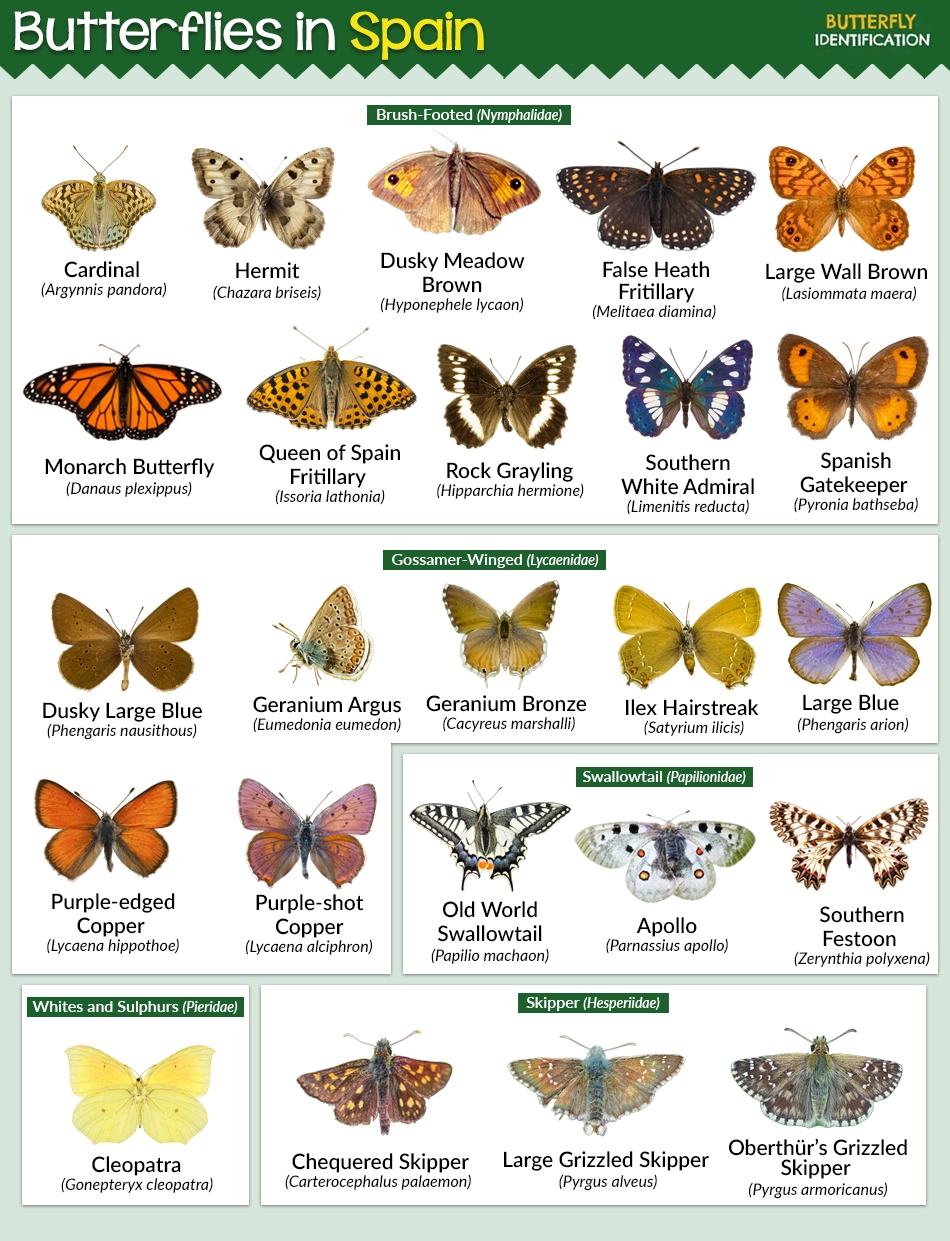
List of Different Butterfly Species of Spain
Brush-Footed (Nymphalidae)
- Black Satyr (Satyrus actaea)
- Cardinal (Argynnis pandora)
- Chestnut Heath (Coenonympha glycerion)
- Hermit (Chazara briseis)
- Dorus Ringlet (Coenonympha dorus)
- Dusky Meadow Brown (Hyponephele lycaon)
- Esper’s Marbled White (Melanargia russiae)
- European Nettle-tree Butterfly (Libythea celtis)
- False Heath Fritillary (Melitaea diamina)
- Grayling (Hipparchia semele)
- Great Banded Grayling (Brintesia circe)
- Hedge Brown (Pyronia tithonus)
- Iberian Marbled White (Melanargia lachesis)
- Ines Blue (Melanargia ines)
- Large Wall Brown (Lasiommata maera)
- Meadow Brown (Maniola jurtina)
- Monarch Butterfly (Danaus plexippus)
- Niobe Fritillary (Fabriciana niobe)
- Phoebe Fritillary (Melitaea phoebe)
- Plain Tiger (Danaus chrysippus)
- Queen of Spain Fritillary (Issoria lathonia)
- Rock Grayling (Hipparchia hermione)
- Scotch Argus (Hipparchia fidia)
- Small Heath (Coenonympha pamphilus)
- Small Skipper (Thymelicus sylvestris)
- Small Tortoiseshell (Aglais urticae)
- Soutern Hermit (Chazara prieuri)
- Southern Gatekeeper (Pyronia cecilia)
- Southern Marbled Skipper (Hyponephele lupinus)
- Southern Marbled White (Melanargia occitanica)
- Southern White Admiral (Limenitis reducta)
- Spanish Brassy Ringlet (Erebia hispania)
- Spanish Gatekeeper (Pyronia bathseba)
- Speckled Wood (Pararge aegeria)
- Tree Grayling (Hipparchia statilinus)
- Two-tailed Pasha (Charaxes jasius)
- Wall Brown (Lasiommata megera)
- Zapater’s Ringlet (Erebia zapateri)
- Hipparchia alcyone
Gossamer-Winged (Lycaenidae)
- African Grass Blue (Zizeeria knysna)
- Amanda’s Blue (Polyommatus amandus)
- Chapman’s Green Hairstreak (Callophrys avis)
- Chapman’s Blue (Polyommatus thersites)
- Dusky Large Blue (Phengaris nausithous)
- Eastern Bath White (Tarucus theophrastus)
- Escher’s Blue (Polyommatus escheri)
- European Common Blue (Polyommatus icarus)
- False Ilex Hairstreak (Satyrium esculi)
- Geranium Argus (Eumedonia eumedon)
- Geranium Bronze (Cacyreus marshalli)
- Green Hairstreak (Callophrys rubi)
- Green-underside Blue (Glaucopsyche alexis)
- Holly Blue (Celastrina argiolus)
- Ilex Hairstreak (Satyrium ilicis)
- Iolas Blue (Iolana iolas)
- Lang’s Short-tailed Blue (Leptotes pirithous)
- Large Blue (Phengaris arion)
- Long-tailed Blue (Lampides boeticus)
- Lorquin’s Blue (Cupido lorquinii)
- Melanops Blue (Glaucopsyche melanops)
- Moroccan Blue (Pseudophilotes abencerragus)
- Osiris Blue (Cupido osiris)
- Panoptes Blue (Pseudophilotes panoptes)
- Purple-edged Copper (Lycaena hippothoe)
- Purple-shot Copper (Lycaena alciphron)
- Small Copper (Lycaena phlaeas)
- Southern Brown Argus (Aricia cramera)
- Spanish Argus (Aricia morronensis)
- Spanish Zephyr Blue (Kretania hesperica)
- Agriades zullichi
Whites and Sulphurs (Pieridae)
- Bath White (Pontia daplidice)
- Berger’s Clouded Yellow (Colias alfacariensis)
- Black-veined White (Aporia crataegi)
- Cabbage White (Pieris brassicae)
- Cleopatra (Gonepteryx cleopatra)
- Clouded Yellow (Colias crocea)
- Common Brimstone (Gonepteryx rhamni)
- Green-striped White (Euchloe belemia)
- Green-veined White (Pieris napi)
- Lemon White (Euchloe charlonia)
- Orange Tip (Anthocharis cardamines)
- Portuguese Dappled White (Euchloe tagis)
- Small Orange-tip (Colotis evagore)
- Small White (Pieris rapae)
- Sooty Orange Tip (Zegris eupheme)
- Southern Small White (Pieris mannii)
- Wood White (Leptidea sinapis)
Swallowtail (Papilionidae)
- Apollo (Parnassius apollo)
- Old World Swallowtail (Papilio machaon)
- Scarce Swallowtail (Iphiclides podalirius)
- Spanish Festoon (Zerynthia rumina)
Skipper (Hesperiidae)
- Borbo Skipper (Borbo borbonica)
- Chequered Skipper (Carterocephalus palaemon)
- Cinquefoil Skipper (Pyrgus cirsii)
- Dingy Skipper (Erynnis tages)
- Dingy Swift (Gegenes nostrodamus)
- European Skipper (Thymelicus lineola)
- Large Grizzled Skipper (Pyrgus alveus)
- Lulworth Skipper (Thymelicus acteon)
- Mallow Skipper (Carcharodus alceae)
- Marbled Skipper (Carcharodus lavatherae)
- Oberthür’s Grizzled Skipper (Pyrgus armoricanus)
- Olive Skipper (Pyrgus serratulae)
- Red-underwing Skipper (Spialia sertorius)
- Rozy Grizzled Argus (Pyrgus onopordi)
- Safflower Skipper (Pyrgus carthami)
- Sage Skipper (Muschampia proto)
- Silver-spotted Skipper (Hesperia comma)
- Small Skipper (Thymelicus sylvestris)
- Southern Grizzled Skipper (Pyrgus malvoides)
- Tufted Skipper (Carcharodus floccifera)
One of the best places to see butterflies in Spain is the Valencia region in eastern Spain, where nearly 70% of all the butterflies living in the Iberian Peninsula, i.e., Portugal and Spain, can be spotted.