
Types of Butterflies in Arizona
There are five families of ‘true’ butterflies in Arizona, including Gossamer-winged Butterflies (Lycaenidae), Brush-footed Butterflies (Nymphalidae), Swallowtails (Papilionidae), Whites, Yellows, and Sulphurs (Pieridae), and Metalmarks (Riodinidae). Out of the total number of butterflies in Arizona, there are about 60 butterfly species in the city of Tucson alone.
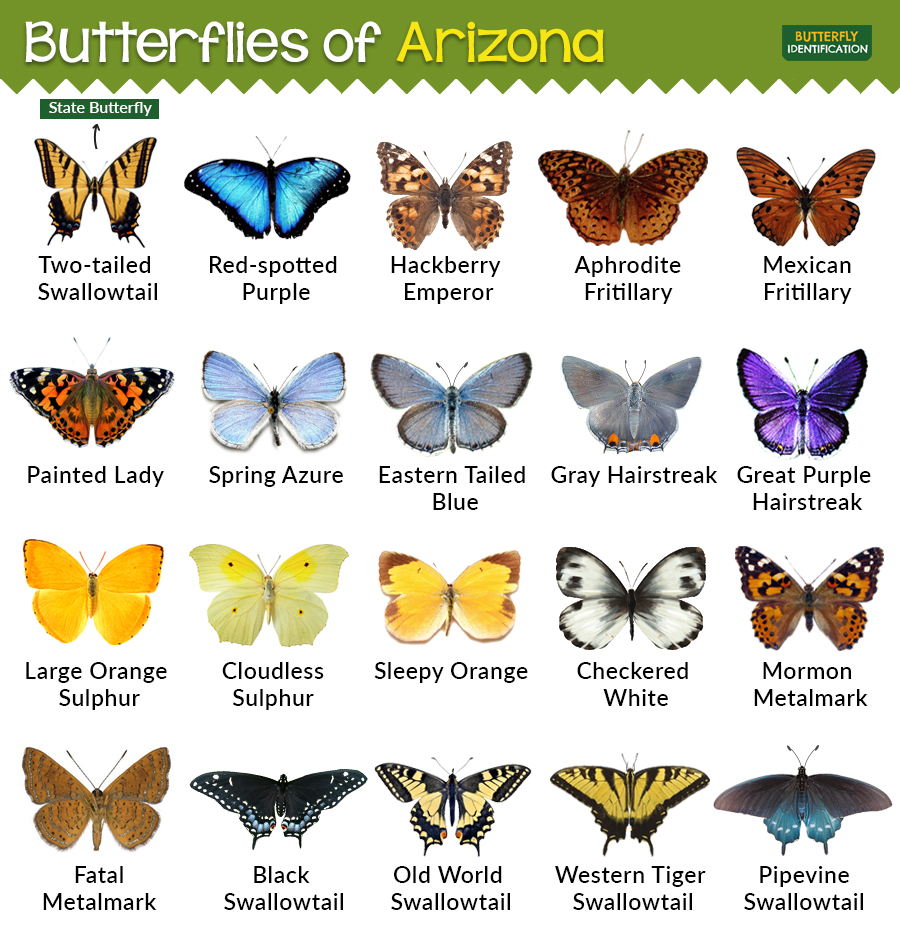
The two-tailed swallowtail butterfly (Papilio multicaudata) is Arizona’s state Butterfly. The list below gives an overview of the butterflies found in Arizona.
Brush-Footed (Nymphalidae)
- Red-spotted Purple (Limenitis arthemis)
- Viceroy (Limenitis archippus)
- Weidemeyer’s Admiral (Limenitis weidemeyerii)
- ‘Astyanax‘ Red-spotted Purple (Limenitis arthemis astyanax)
- Ruddy Daggerwing (Marpesia petreus)
- Many-banded Daggerwing (Marpesia chiron)
- Black-patched Cracker (Hamadryas atlantis)
- Blackened Bluewing (Myscelia cyananthe)
- Dusky Emperor (Asterocampa idyja)
- Empress Leilia (Asterocampa leilia)
- Hackberry Emperor (Asterocampa celtis)
- Tawny Emperor (Asterocampa clyton)
- Silver Emperor (Doxocopa laure)
- Aphrodite Fritillary (Speyeria aphrodite)
- Coronis Fritillary (Speyeria coronis)
- Mormon Fritillary (Speyeria mormonia)
- Nokomis Fritillary (Speyeria nokomis)
- Northwestern Fritillary (Speyeria hesperis)
- Mexican Fritillary (Euptoieta hegesia)
- Variegated Fritillary (Euptoieta claudia)
- Gulf Fritillary (Agraulis vanillae)
- Isabella’s Heliconian (Eueides isabella)
- Zebra Heliconian (Heliconius charithonius)
- Monarch (Danaus plexippus)
- Queen (Danaus gilippus)
- Soldier (Danaus eresimus)
- American Snout (Libytheana carinenta)
- Field Crescent (Phyciodes pulchellus)
- Graphic Crescent (Phyciodes graphica)
- Mylitta Crescent (Phyciodes mylitta)
- Northern Crescent (Phyciodes cocyta)
- Painted Crescent (Phyciodes picta)
- Pale Crescent (Phyciodes pallida)
- Pearl Crescent (Phyciodes tharos)
- Phaon Crescent (Phyciodes phaon)
- Green Comma (Polygonia faunus)
- Question Mark (Polygonia interrogationis)
- Satyr Comma (Polygonia satyrus)
- Painted Lady (Vanessa cardui)
- Red Admiral (Vanessa atalanta)
- West Coast Lady (Vanessa annabella)
- American Lady (Vanessa virginiensis)
- Red-spotted Patch (Chlosyne marina)
- Rosita Patch (Chlosyne rosita)
- Sagebrush Checkerspot (Chlosyne acastus)
- Variable Checkerspot (Euphydryas chalcedona)
- Common Buckeye (Junonia coenia)
- Dotted Checkerspot (Poladryas minuta)
- Elada Checkerspot (Texola elada)
- Mourning Cloak (Nymphalis antiopa)
- Fulvia Checkerspot (Thessalia fulvia)
- Elf (Microtia elva)
Gossamer-Winged (Lycaenidae)
- Spring Azure (Celastrina ladon)
- Lupine Blue (Aricia lupini)
- Reakirt’s Blue (Hemiargus isola)
- Western Pygmy Blue (Brephidium exilis or Brephidium exile)
- Ceraunus Blue (Hemiargus ceraunus)
- Marine Blue/Striped Blue (Leptotes marina)
- Eastern Tailed Blue (Cupido comyntas)
- Gray Hairstreak (Strymon melinus)
- Leda Ministreak (Ministrymon leda)
- Great Purple Hairstreak (Atlides halesus)
- Brown Elfin (Callophrys augustinus)
Whites and Sulphurs (Pieridae)
- Lyside Sulphur/Guayacan Sulphur (Kricogonia lyside)
- Large Orange Sulphur (Phoebis agarithe)
- Dainty Sulphur/Dwarf Yellow (Nathalis iole)
- Cloudless Sulphur (Phoebis sennae)
- Mexican Yellow (Eurema Mexicana)
- Southern Dogface (Colias cesonia)
- Sleepy Orange (Eurema nicippe)
- Desert Orangetip (Anthocharis cethura cethura)
- Checkered White (Pontia protodice)
- Spring White/California White/Colorado White (Pontia sisymbrii)
Metalmark (Riodinidae)
- Zela Metalmark (Emesis zela)
- Arizona Metalmark (Calephelis arizonensis)
- Mormon Metalmark (Apodemia mormo)
- Fatal Metalmark/Dusky Metalmark (Calephelis nemesis)
- Palmer’s Metalmark/Gray Metalmark (Apodemia palmeri)
Swallowtail (Papilionidae)
- Two-tailed Swallowtail (Papilio multicaudata)
- Anise Swallowtail (Papilio zelicaon)
- Black Swallowtail (Papilio polyxenes)
- Broad-banded Swallowtail (Papilio astyalus)
- Giant Swallowtail (Papilio cresphontes)
- Indra Swallowtail (Papilio indra)
- Old World Swallowtail (Papilio machaon)
- Ornythion Swallowtail (Papilio ornythion)
- Ruby-spotted Swallowtail (Papilio anchisiades)
- Three-tailed Swallowtail (Papilio pilumnus)
- Western Tiger Swallowtail (Papilio rutulus)
- White-dotted Cattleheart (Parides alopius)
- Pipevine Swallowtail (Battus philenor)
- Polydamas Swallowtail (Battus polydamas)