
Butterflies in Sweden
Sweden is home to several butterfly species, including the Arctic Fritillary, the Chequered Skipper, and the Reverdin’s Blue.
Butterflies in Sweden
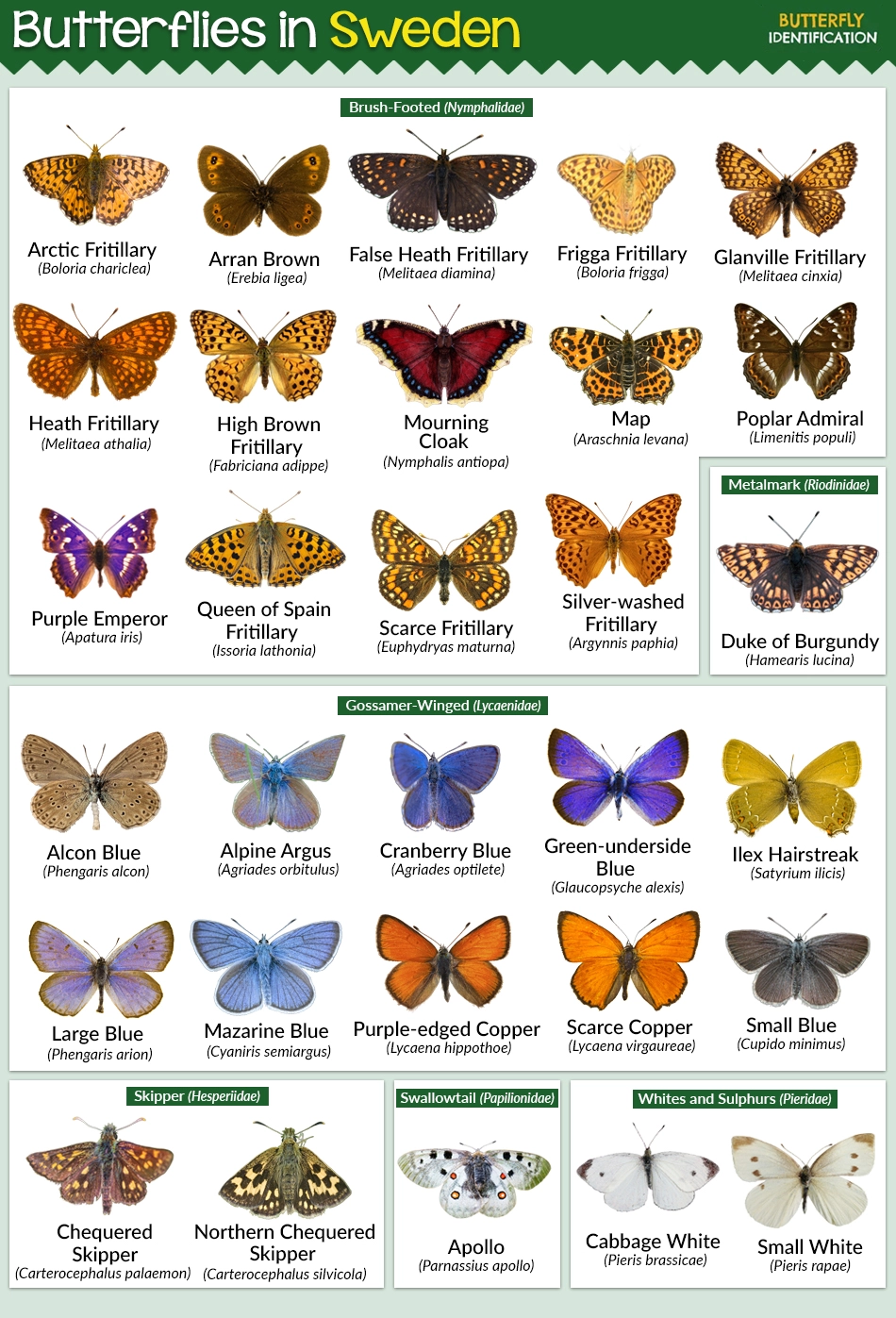
List of Different Butterfly Species of Sweden
Brush-Footed (Nymphalidae)
- Arctic Fritillary (Boloria chariclea)
- Arran Brown (Erebia ligea)
- Assmann’s Fritillary (Melitaea britomartis)
- Comma (Polygonia c-album)
- Cranberry Fritillary (Boloria aquilonaris)
- Dark Green Fritillary (Speyeria aglaja)
- Dewy Ringlet (Erebia pandrose)
- Dingy Fritillary (Boloria improba)
- Disa Alpine (Erebia disa)
- False Heath Fritillary (Melitaea diamina)
- Freija Fritillary (Boloria freija)
- Frigga Fritillary (Boloria frigga)
- Glanville Fritillary (Melitaea cinxia)
- Grayling (Hipparchia semele)
- Heath Fritillary (Melitaea athalia)
- High Brown Fritillary (Fabriciana adippe)
- Jutta Arctic (Oeneis jutta)
- Lapland Ringlet (Erebia embla)
- Large Tortoiseshell (Nymphalis polychloros)
- Large Wall Brown (Lasiommata maera)
- Lesser Marbled Fritillary (Brenthis ino)
- Map (Araschnia levana)
- Marsh Fritillary (Euphydryas aurinia)
- Meadow Brown (Maniola jurtina)
- Mourning Cloak (Nymphalis antiopa)
- Napaea Fritillary (Boloria napaea)
- Niobe Fritillary (Fabriciana niobe)
- Norse Grayling (Oeneis norna)
- Northern Wall Brown (Lasiommata petropolitana)
- Ocellate Bog Fritillary (Boloria eunomia)
- Painted Lady (Vanessa cardui)
- Pallas’ Fritillary (Argynnis laodice)
- Peacock Butterfly (Aglais io)
- Pearl-bordered Fritillary (Boloria euphrosyne)
- Pearly Heath (Coenonympha arcania)
- Polaris Fritillary (Boloria polaris)
- Poplar Admiral (Limenitis populi)
- Purple Emperor (Apatura iris)
- Queen of Spain Fritillary (Issoria lathonia)
- Red Admiral (Vanessa atalanta)
- Ringlet (Aphantopus hyperantus)
- Scarce Fritillary (Euphydryas maturna)
- Scarce Heath (Coenonympha hero)
- Silver-washed Fritillary (Argynnis paphia)
- Small Heath (Coenonympha pamphilus)
- Small Pearl-Bordered Fritillary (Boloria selene)
- Small Tortoiseshell (Aglais urticae)
- Speckled Wood (Pararge aegeria)
- Thor’s Fritillary (Boloria thore)
- Tullia’s Ringlet (Coenonympha tullia)
- Wall Brown (Lasiommata megera)
- White-veined Arctic (Oeneis bore)
- Woodland Brown (Lopinga achine)
Gossamer-Winged (Lycaenidae)
- Alcon Blue (Phengaris alcon)
- Alpine Argus (Agriades orbitulus)
- Amanda’s Blue (Polyommatus amandus)
- Black Hairstreak (Satyrium pruni)
- Brown Hairstreak (Thecla betulae)
- Cranberry Blue (Agriades optilete)
- Dorylas Blue (Polyommatus dorylas)
- European Common Blue (Polyommatus icarus)
- Geranium Argus (Eumedonia eumedon)
- Glandon Blue (Agriades glandon)
- Green Hairstreak (Callophrys rubi)
- Green-underside Blue (Glaucopsyche alexis)
- Holly Blue (Celastrina argiolus)
- Idas Blue (Plebejus idas)
- Ilex Hairstreak (Satyrium ilicis)
- Large Blue (Phengaris arion)
- Mazarine Blue (Cyaniris semiargus)
- Northern Brown Argus (Aricia artaxerxes)
- Orion Blue (Scolitantides orion)
- Purple-edged Copper (Lycaena hippothoe)
- Purple Hairstreak (Neozephyrus quercus)
- Reverdin’s Blue (Plebeius argyrognomon)
- Scarce Copper (Lycaena virgaureae)
- Silver-studded Blue (Plebejus argus)
- Silvery Argas (Aricia nicias)
- Small Blue (Cupido minimus)
- Small Copper (Lycaena phlaeas)
- Violet Copper (Lycaena helle)
- White-letter Hairstreak (Satyrium w-album)
Whites and Sulphurs (Pieridae)
- Black-veined White (Aporia crataegi)
- Cabbage White (Pieris brassicae)
- Clouded Yellow (Colias crocea)
- Common Brimstone (Gonepteryx rhamni)
- Eastern Bath White (Pontia edusa)
- Green-veined White (Pieris napi)
- Hecla Sulphur (Colias hecla)
- Labrador Sulphur (Colias nastes)
- Moorland Clouded Yellow (Colias palaeno)
- Orange Tip (Anthocharis cardamines)
- Pale Clouded Yellow (Colias hyale)
- Réal’s Wood White (Leptidea reali)
- Small White (Pieris rapae)
- Wood White (Leptidea sinapis)
Metalmark (Riodinidae)
- Duke of Burgundy (Hamearis lucina)
Swallowtail (Papilionidae)
- Apollo (Parnassius apollo)
- Clouded Apollo (Parnassius mnemosyne)
- Old World Swallowtail (Papilio machaon)
Skipper (Hesperiidae)
- Alpine Grizzled Skipper (Pyrgus andromedae)
- Chequered Skipper (Carterocephalus palaemon)
- Dingy Skipper (Erynnis tages)
- European Skipper (Thymelicus lineola)
- Grizzled Skipper (Pyrgus malvae)
- Large Chequered Skipper (Heteropterus morpheus)
- Large Grizzled Skipper (Pyrgus alveus)
- Large Skipper (Ochlodes sylvanus)
- Northern Chequered Skipper (Carterocephalus silvicola)
- Northern Grizzled Skipper (Pyrgus centaureae)
- Oberthür’s Grizzled Skipper (Pyrgus armoricanus)
- Silver-spotted Skipper (Hesperia comma)