
Butterflies in Germany
Germany is home to several butterfly species, including the Clouded Apollo, the Small Blue, and the Peacock Butterfly.
Butterflies in Germany
List of Different Butterfly Species of Germany
Brush-Footed (Nymphalidae)
- Alpine Grayling (Oeneis glacialis)
- Alpine Heath (Coenonympha gardetta)
- American Lady (Vanessa virginiensis)
- Assmann’s Fritillary (Melitaea britomartis)
- Blind Ringlet (Erebia pharte)
- Bright Eyed Ringlet (Erebia oeme)
- Cardinal (Argynnis pandora)
- Chestnut Heath (Coenonympha glycerion)
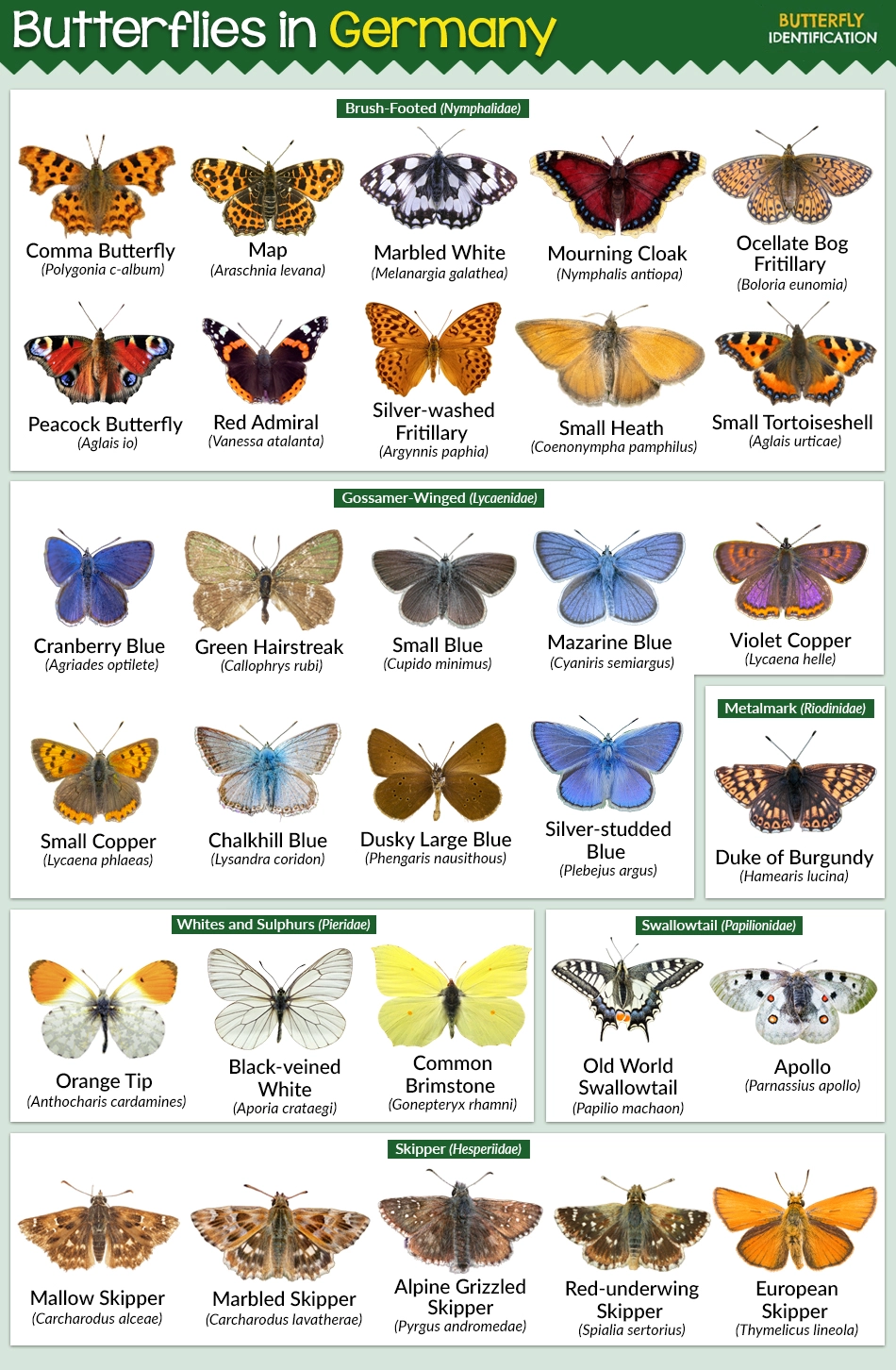
- Comma (Polygonia c-album)
- Compton Tortoiseshell (Nymphalis vaualbum)
- Cranberry Fritillary (Boloria aquilonaris)
- Cynthia’s Fritillary (Euphydryas cynthia)
- Dark Green Fritillary (Speyeria aglaja)
- Dark Rock Brown (Chazara briseis)
- Dewy Ringlet (Erebia pandrose)
- Dryad (Minois dryas)
- Dusky Meadow Brown (Hyponephele lycaon)
- Eriphyle Ringlet (Erebia eriphyle)
- European Nettle-tree Butterfly (Libythea celtis)
- False Grayling (Arethusana arethusa)
- False Heath Fritillary (Melitaea diamina)
- False Ringlet (Coenonympha oedippus)
- Glanville Fritillary (Melitaea cinxia)
- Grayling (Hipparchia semele)
- Great Banded Grayling (Brintesia circe)
- Heath Fritillary (Melitaea athalia)
- Hedge Brown (Pyronia tithonus)
- High Brown Fritillary (Fabriciana adippe)
- Large Ringlet (Erebia euryale)
- Large Tortoiseshell (Nymphalis polychloros)
- Large Wall Brown (Lasiommata maera)
- Lesser Marbled Fritillary (Brenthis ino)
- Lesser Mountain Ringlet (Erebia melampus)
- Lesser Purple Emperor (Apatura ilia)
- Map (Araschnia levana)
- Marbled Fritillary (Brenthis daphne)
- Marbled White (Melanargia galathea)
- Marsh Fritillary (Euphydryas aurinia)
- Meadow Brown (Maniola jurtina)
- Meadow Fritillary (Melitaea parthenoides)
- Meadow Ringlet (Erebia ligea)
- Monarch Butterfly (Danaus plexippus)
- Mourning Cloak (Nymphalis antiopa)
- Napaea Fritillary (Boloria napaea)
- Nickerl’s Fritillary (Melitaea aurelia)
- Niobe Fritillary (Fabriciana niobe)
- Northern Wall Brown (Lasiommata petropolitana)
- Ocellate Bog Fritillary (Boloria eunomia)
- Painted Lady (Vanessa cardui)
- Pales Fritillary (Boloria pales)
- Pallas’ Fritillary (Argynnis laodice)
- Peacock Butterfly (Aglais io)
- Pearl-bordered Fritillary (Boloria euphrosyne)
- Pearly Heath (Coenonympha arcania)
- Phoebe Fritillary (Melitaea phoebe)
- Piedmont Ringlet (Erebia meolans)
- Poplar Admiral (Limenitis populi)
- Purple Emperor (Apatura iris)
- Queen of Spain Fritillary (Issoria lathonia)
- Red Admiral (Vanessa atalanta)
- Ringlet (Aphantopus hyperantus)
- Rock Grayling (Hipparchia hermione)
- Scarce Fritillary (Euphydryas maturna)
- Scarce Heath (Coenonympha hero)
- Scotch Argus (Erebia aethiops)
- Shepherd’s Fritillary (Erebia pronoe)
- Silky Ringlet (Erebia gorge)
- Silver-washed Fritillary (Argynnis paphia)
- Small Heath (Coenonympha pamphilus)
- Small Mountain Ringlet (Erebia epiphron)
- Small Pearl-Bordered Fritillary (Boloria selene)
- Small Tortoiseshell (Aglais urticae)
- Sooty Ringlet (Erebia pluto)
- Southern White Admiral (Limenitis reducta)
- Speckled Wood (Pararge aegeria)
- Spotted Fritillary (Melitaea didyma)
- Stygian Ringlet (Erebia styx)
- Thor’s Fritillary (Boloria thore)
- Titania’s Fritillary (Boloria titania)
- Tree Grayling (Hipparchia statilinus)
- Tullia’s Ringlet (Coenonympha tullia)
- Tyndarus Ringlet (Erebia tyndarus)
- Violet Frillitary (Boloria dia)
- Wall Brown (Lasiommata megera)
- White Admiral (Limenitis camilla)
- Woodland Brown (Lopinga achine)
- Woodland Grayling (Hipparchia fagi)
- Woodland Ringlet (Erebia medusa)
- Yellow-legged Tortoiseshell (Nymphalis xanthomelas)
- Yellow-spotted Ringlet (Erebia manto)
- Euphydryas intermedia
Gossamer-Winged (Lycaenidae)
- Glandon Blue (Agriades glandon)
- Cranberry Blue (Agriades optilete)
- Alpine Argus (Agriades orbitulus)
- Brown Argus (Aricia agestis)
- Northern Brown Argus (Aricia artaxerxes)
- Geranium Bronze (Cacyreus marshalli)
- Green Hairstreak (Callophrys rubi)
- Holly Blue (Celastrina argiolus)
- Small Blue (Cupido minimus)
- Osiris Blue (Cupido osiris)
- Short-tailed Blue (Cupido argiades)
- Mazarine Blue (Cyaniris semiargus)
- Geranium Argus (Eumedonia eumedon)
- Purple Hairstreak (Favonius quercus)
- Green-underside Blue (Glaucopsyche alexis)
- Long-tailed Blue (Lampides boeticus)
- Lang’s Short-tailed Blue (Leptotes pirithous)
- Purple-shot Copper (Lycaena alciphron)
- Large Copper (Lycaena dispar)
- Violet Copper (Lycaena helle)
- Purple-edged Copper (Lycaena hippothoe)
- Small Copper (Lycaena phlaeas)
- Sooty Copper (Lycaena tityrus)
- Scarce Copper (Lycaena virgaureae)
- Adonis Blue (Lysandra bellargus)
- Chalkhill Blue (Lysandra coridon)
- Alcon Blue (Phengaris alcon)
- Large Blue (Phengaris arion)
- Dusky Large Blue (Phengaris nausithous)
- Scarce Large Blue (Phengaris teleius)
- Silver-studded Blue (Plebejus argus)
- Reverdin’s Blue (Plebejus argyrognomon)
- Idas Blue (Plebejus idas)
- Damon Blue (Polyommatus damon)
- Meleager’s Blue (Polyommatus daphnis)
- Amanda’s Blue (Polyommatus amandus)
- Dorylas Blue (Polyommatus dorylas)
- Eros Blue (Polyommatus eros)
- European Common Blue (Polyommatus icarus)
- Chapman’s Blue (Polyommatus thersites)
- Baton Blue (Pseudophilotes baton)
- Sloe Hairstreak (Satyrium acaciae)
- Ilex Hairstreak (Satyrium ilicis)
- Black Hairstreak (Satyrium pruni)
- Blue-spot Hairstreak (Satyrium spini)
- White-letter Hairstreak (Satyrium w-album)
- Orion Blue (Scolitantides orion)
- Brown Hairstreak (Thecla betulae)
Whites and Sulphurs (Pieridae)
- Orange Tip (Anthocharis cardamines)
- Black-veined White (Aporia crataegi)
- Berger’s Clouded Yellow (Colias alfacariensis)
- Clouded Yellow (Colias croceus)
- Pale Clouded Yellow (Colias hyale)
- Danube Clouded Yellow (Colias myrmidone)
- Moorland Clouded Yellow (Colias palaeno)
- Mountain Clouded Yellow (Colias phicomone)
- Common Brimstone (Gonepteryx rhamni)
- Réal’s Wood White (Leptidea reali)
- Wood White (Leptidea sinapis)
- Cabbage White (Pieris brassicae)
- Dark-veined White (Pieris bryoniae)
- Green-veined White (Pieris napi)
- Small White (Pieris rapae)
- Southern Small White (Pieris mannii)
- Peak White (Pontia callidice)
- Eastern Bath White (Pontia edusa)
Metalmark (Riodinidae)
- Duke of Burgundy (Hamearis lucina)
Swallowtail (Papilionidae)
- Scarce Swallowtail (Iphiclides podalirius)
- Old World Swallowtail (Papilio machaon)
- Apollo (Parnassius apollo)
- Clouded Apollo (Parnassius mnemosyne)
- Phoebus Apollo (Parnassius phoebus)
- Southern Festoon (Zerynthia polyxena)
Skipper (Hesperiidae)
- Mallow Skipper (Carcharodus alceae)
- Tufted Skipper (Carcharodus floccifera)
- Marbled Skipper (Carcharodus lavatherae)
- Chequered Skipper (Carterocephalus palaemon)
- Northern Chequered Skipper (Carterocephalus silvicola)
- Dingy Skipper (Erynnis tages)
- Silver-spotted Skipper (Hesperia comma)
- Large Chequered Skipper (Heteropterus morpheus)
- Large Skipper (Ochlodes sylvanus)
- Large Grizzled Skipper (Pyrgus alveus)
- Alpine Grizzled Skipper (Pyrgus andromedae)
- Oberthür’s Grizzled Skipper (Pyrgus armoricanus)
- Dusky Grizzled Skipper (Pyrgus cacaliae)
- Safflower Skipper (Pyrgus carthami)
- Cinquefoil Skipper (Pyrgus cirsii)
- Grizzled Skipper (Pyrgus malvae)
- Rozy Grizzled Argus (Pyrgus onopordi)
- Olive Skipper (Pyrgus serratulae)
- Warren Skipper (Pyrgus warrenensis)
- Red-underwing Skipper (Spialia sertorius)
- Lulworth Skipper (Thymelicus acteon)
- European Skipper (Thymelicus lineola)
- Small Skipper (Thymelicus sylvestris)
There are several notable butterfly parks in Germany, including Alaris Schmetterlingspark, ElbauenPark, and Schmetterlingshaus.