
Butterflies in Switzerland
Switzerland is home to several butterfly species, including the Large Blue, the Purple-edged Copper, and the Mazarine Blue.
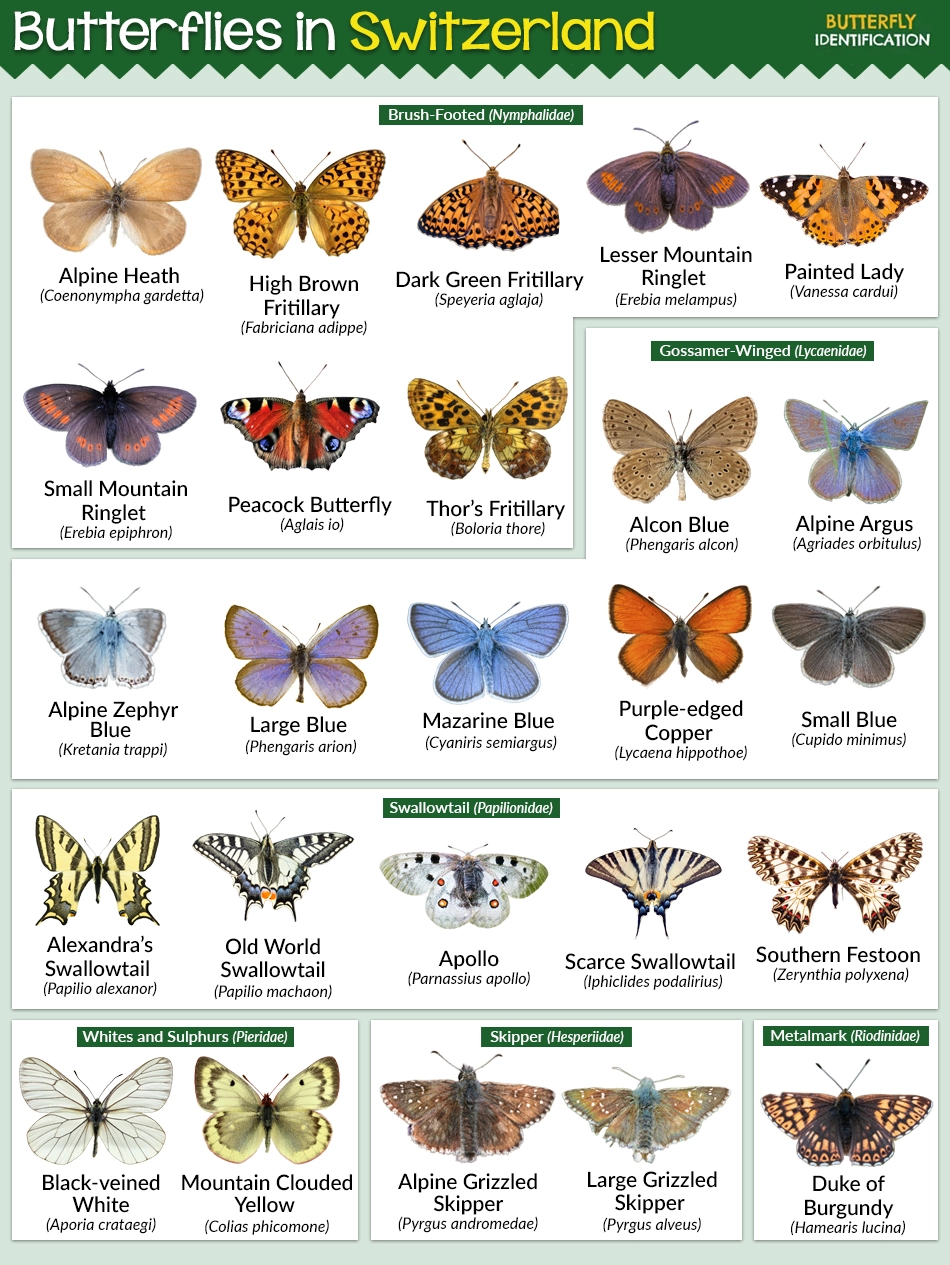
List of Different Butterfly Species of Switzerland
Brush-Footed (Nymphalidae)
- Almond Ringlet (Erebia alberganus)
- Alpine Grayling (Oeneis glacialis)
- Alpine Heath (Coenonympha gardetta)
- Arran Brown (Erebia ligea)
- Assmann’s Fritillary (Melitaea britomartis)
- Blind Ringlet (Erebia pharte)
- Bright Eyed Ringlet (Erebia oeme)
- Cardinal (Argynnis pandora)
- Chestnut Heath (Coenonympha glycerion)
- Comma (Polygonia c-album)
- Common Brassy Ringlet (Erebia cassioides)
- Cranberry Fritillary (Boloria aquilonaris)
- Cynthia’s Fritillary (Euphydryas cynthia)
- Dark Green Fritillary (Speyeria aglaja)
- Dark Rock Brown (Chazara briseis)
- de Lesse’s Brassy Ringlet (Erebia nivalis)
- de Prunner’s Ringlet (Erebia triarius)
- Dewy Ringlet (Erebia pandrose)
- Dryad (Minois dryas)
- Dusky Meadow Brown (Hyponephele lycaon)
- Eriphyle Ringlet (Erebia eriphyle)
- European Nettle-tree Butterfly (Libythea celtis)
- False Heath Fritillary (Melitaea diamina)
- False Ringlet (Coenonympha oedippus)
- Glanville Fritillary (Melitaea cinxia)
- Grayling (Hipparchia semele)
- Great Banded Grayling (Brintesia circe)
- Great Sooty Satyr (Satyrus ferula)
- Grisons Fritillary (Melitaea varia)
- Heath Fritillary (Melitaea athalia)
- Hedge Brown (Pyronia tithonus)
- High Brown Fritillary (Fabriciana adippe)
- Hungarian Glider (Neptis rivularis)
- Large Ringlet (Erebia euryale)
- Large Tortoiseshell (Nymphalis polychloros)
- Large Wall Brown (Lasiommata maera)
- Lesser Marbled Fritillary (Brenthis ino)
- Lesser Mountain Ringlet (Erebia melampus)
- Lesser Purple Emperor (Apatura ilia)
- Lesser Rock Grayling (Hipparchia genava)
- Little Fritillary (Melitaea asteria)
- Map (Araschnia levana)
- Marbled Fritillary (Brenthis daphne)
- Marbled Ringlet (Erebia montanus)
- Marbled White (Melanargia galathea)
- Marsh Fritillary (Euphydryas aurinia)
- Meadow Brown (Maniola jurtina)
- Meadow Fritillary (Melitaea parthenoides)
- Mnestra’s Ringlet (Erebia mnestra)
- Mourning Cloak (Nymphalis antiopa)
- Napaea Fritillary (Boloria napaea)
- Nickerl’s Fritillary (Melitaea aurelia)
- Niobe Fritillary (Fabriciana niobe)
- Northern Wall Brown (Lasiommata petropolitana)
- Painted Lady (Vanessa cardui)
- Pales Fritillary (Boloria pales)
- Peacock Butterfly (Aglais io)
- Pearl-bordered Fritillary (Boloria euphrosyne)
- Pearly Heath (Coenonympha arcania)
- Phoebe Fritillary (Melitaea phoebe)
- Piedmont Ringlet (Erebia meolans)
- Poplar Admiral (Limenitis populi)
- Provençal fritillary (Melitaea deione)
- Purple Emperor (Apatura iris)
- Queen of Spain Fritillary (Issoria lathonia)
- Red Admiral (Vanessa atalanta)
- Ringlet (Aphantopus hyperantus)
- Rock Grayling (Hipparchia hermione)
- Scarce Heath (Coenonympha hero)
- Scotch Argus (Erebia aethiops)
- Shepherd’s Fritillary (Erebia pronoe)
- Silky Ringlet (Erebia gorge)
- Silver-washed Fritillary (Argynnis paphia)
- Small Heath (Coenonympha pamphilus)
- Small Mountain Ringlet (Erebia epiphron)
- Small Pearl-Bordered Fritillary (Boloria selene)
- Small Tortoiseshell (Aglais urticae)
- Sooty Ringlet (Erebia pluto)
- Southern Comma (Polygonia egea)
- Southern Gatekeeper (Pyronia cecilia)
- Southern White Admiral (Limenitis reducta)
- Speckled Wood (Pararge aegeria)
- Spotted Fritillary (Melitaea didyma)
- Stygian Ringlet (Erebia styx)
- Sudeten Ringlet (Erebia sudetica)
- Thor’s Fritillary (Boloria thore)
- Titania’s Fritillary (Boloria titania)
- Tree Grayling (Hipparchia statilinus)
- Tullia’s Ringlet (Coenonympha tullia)
- Tyndarus Ringlet (Erebia tyndarus)
- Violet Frillitary (Boloria dia)
- Wall Brown (Lasiommata megera)
- White Admiral (Limenitis camilla)
- Woodland Brown (Lopinga achine)
- Woodland Grayling (Hipparchia fagi)
- Woodland Ringlet (Erebia medusa)
- Yellow-banded Ringlet (Erebia flavofasciata)
- Yellow-spotted Ringlet (Erebia manto)
Gossamer-Winged (Lycaenidae)
- Adonis Blue (Lysandra bellargus)
- Alcon Blue (Phengaris alcon)
- Alpine Argus (Agriades orbitulus)
- Alpine Zephyr Blue (Kretania trappi)
- Amanda’s Blue (Polyommatus amandus)
- Baton Blue (Pseudophilotes baton)
- Black Hairstreak (Satyrium pruni)
- Blue-spot Hairstreak (Satyrium spini)
- Brown Argus (Aricia agestis)
- Brown Hairstreak (Thecla betulae)
- Chalkhill Blue (Lysandra coridon)
- Chapman’s Blue (Polyommatus thersites)
- Cranberry Blue (Agriades optilete)
- Damon Blue (Polyommatus damon)
- Dorylas Blue (Polyommatus dorylas)
- Dusky Large Blue (Phengaris nausithous)
- Eros Blue (Polyommatus eros)
- Escher’s Blue (Polyommatus escheri)
- European Common Blue (Polyommatus icarus)
- Geranium Argus (Eumedonia eumedon)
- Geranium Bronze (Cacyreus marshalli)
- Glandon Blue (Agriades glandon)
- Green Hairstreak (Callophrys rubi)
- Green-underside Blue (Glaucopsyche alexis)
- Holly Blue (Celastrina argiolus)
- Idas Blue (Plebejus idas)
- Ilex Hairstreak (Satyrium ilicis)
- Iolas Blue (Iolana iolas)
- Lang’s Short-tailed Blue (Leptotes pirithous)
- Large Blue (Phengaris arion)
- Large Copper (Lycaena dispar)
- Long-tailed Blue (Lampides boeticus)
- Mazarine Blue (Cyaniris semiargus)
- Meleager’s Blue (Polyommatus daphnis)
- Northern Brown Argus (Aricia artaxerxes)
- Orion Blue (Scolitantides orion)
- Osiris Blue (Cupido osiris)
- Provençal Short-tailed Blue (Cupido alcetas)
- Purple-edged Copper (Lycaena hippothoe)
- Purple Hairstreak (Favonius quercus)
- Purple-shot Copper (Lycaena alciphron)
- Reverdin’s Blue (Plebejus argyrognomon)
- Scarce Copper (Lycaena virgaureae)
- Scarce Large Blue (Phengaris teleius)
- Short-tailed Blue (Cupido argiades)
- Silver-studded Blue (Plebejus argus)
- Silvery Argas (Aricia nicias)
- Sloe Hairstreak (Satyrium acaciae)
- Small Blue (Cupido minimus)
- Small Copper (Lycaena phlaeas)
- Sooty Copper (Lycaena tityrus)
- Violet copper (Lycaena helle)
- White-letter Hairstreak (Satyrium w-album)
- Lycaena subalpina
Whites and Sulphurs (Pieridae)
- Berger’s Clouded Yellow (Colias alfacariensis)
- Black-veined White (Aporia crataegi)
- Cabbage White (Pieris brassicae)
- Cleopatra (Gonepteryx cleopatra)
- Clouded Yellow (Colias croceus)
- Common Brimstone (Gonepteryx rhamni)
- Dark-veined White (Pieris bryoniae)
- Eastern Bath White (Pontia edusa)
- Green-veined White (Pieris napi)
- Moorland Clouded Yellow (Colias palaeno)
- Mountain Clouded Yellow (Colias phicomone)
- Mountain Dappled White (Euchloe simplonia)
- Orange Tip (Anthocharis cardamines)
- Pale Clouded Yellow (Colias hyale)
- Peak White (Pontia callidice)
- Provance Orange Tip (Anthocharis euphenoides)
- Réal’s Wood White (Leptidea reali)
- Small White (Pieris rapae)
- Southern Small White (Pieris mannii)
- Wood White (Leptidea sinapis)
Metalmark (Riodinidae)
- Duke of Burgundy (Hamearis lucina)
Swallowtail (Papilionidae)
- Alexandra’s Swallowtail (Papilio alexanor)
- Apollo (Parnassius apollo)
- Clouded Apollo (Parnassius mnemosyne)
- Old World Swallowtail (Papilio machaon)
- Phoebus Apollo (Parnassius phoebus)
- Scarce Swallowtail (Iphiclides podalirius)
- Southern Festoon (Zerynthia polyxena)
Skipper (Hesperiidae)
- Alpine Grizzled Skipper (Pyrgus andromedae)
- Carline Skipper (Pyrgus carlinae)
- Chequered Skipper (Carterocephalus palaemon)
- Cinquefoil Skipper (Pyrgus cirsii)
- Dingy Skipper (Erynnis tages)
- Dusky Grizzled Skipper (Pyrgus cacaliae)
- Grizzled Skipper (Pyrgus malvae)
- Large Chequered Skipper (Heteropterus morpheus)
- Large Grizzled Skipper (Pyrgus alveus)
- Large Skipper (Ochlodes sylvanus)
- Lulworth Skipper (Thymelicus acteon)
- Mallow Skipper (Carcharodus alceae)
- Marbled Skipper (Carcharodus lavatherae)
- Oberthür’s Grizzled Skipper (Pyrgus armoricanus)
- Olive Skipper (Pyrgus serratulae)
- Red-underwing Skipper (Spialia sertorius)
- Rozy Grizzled Argus (Pyrgus onopordi)
- Safflower Skipper (Pyrgus carthami)
- Silver-spotted Skipper (Hesperia comma)
- Southern Grizzled Skipper (Pyrgus malvoides)
- Southern Marbled Skipper (Carcharodus baeticus)
- Tufted Skipper (Carcharodus floccifera)
- Warren Skipper (Pyrgus warrenensis)
The Alps are a great place to experience the butterfly diversity of Switzerland.