
Types of Butterflies in South Dakota
South Dakota, because of its diverse geographical locations, provides ideal natural habitat to about 180 butterfly species. The lowlands and wooded areas along the Missouri River, basins of various lakes, and the Black Hills region attract different species every year.
South Dakota does not have any designated state butterfly.
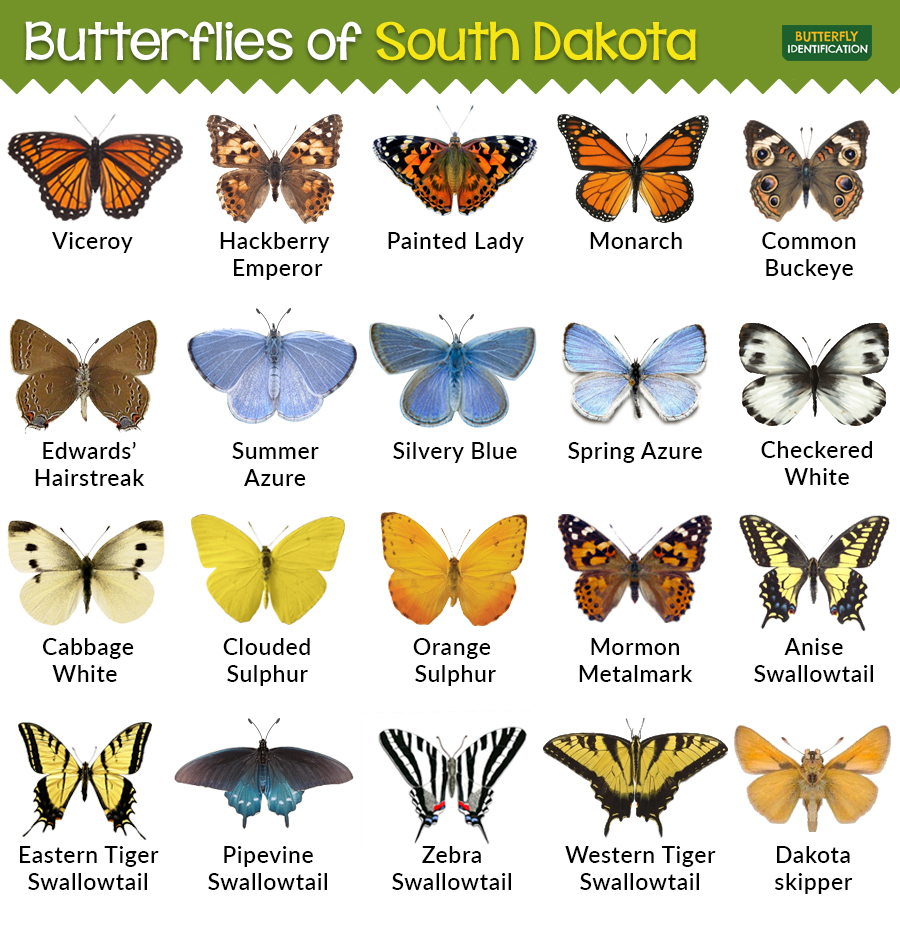
Brush-Footed (Nymphalidae)
- ‘Astyanax‘ Red-spotted Purple (Limenitis arthemis astyanax)
- Common Mestra (Mestra amymone)
- Red-spotted Purple (Limenitis arthemis)
- Viceroy (Limenitis archippus)
- Weidemeyer’s Admiral (Limenitis weidemeyerii)
- White Admiral (Limenitis arthemis arthemis)
- Hackberry Emperor (Asterocampa celtis)
- Tawny Emperor (Asterocampa clyton)
- Aphrodite Fritillary (Speyeria aphrodite)
- Atlantis Fritillary (Speyeria atlantis)
- Callippe Fritillary (Speyeria callippe)
- Coronis Fritillary (Speyeria coronis)
- Edwards’ Fritillary (Speyeria edwardsii)
- Great Spangled Fritillary (Speyeria cybele)
- Gulf Fritillary (Agraulis vanillae)
- Meadow Fritillary (Boloria bellona)
- Mormon Fritillary (Speyeria mormonia)
- Northwestern Fritillary (Speyeria hesperis)
- Regal Fritillary (Speyeria idalia)
- Silver-bordered Fritillary (Boloria selene)
- Variegated Fritillary (Euptoieta claudia)
- Zerene Fritillary (Speyeria zerene)
- Monarch (Danaus plexippus)
- American Snout (Libytheana carinenta)
- American Lady (Vanessa virginiensis)
- California Tortoiseshell (Nymphalis californica)
- Common Buckeye (Junonia coenia)
- Compton Tortoiseshell (Nymphalis vaualbum)
- Eastern Comma (Polygonia comma)
- Field Crescent (Phyciodes pulchellus)
- Gorgone Checkerspot (Chlosyne gorgone)
- Gray Comma (Polygonia progne)
- Green Comma (Polygonia faunus)
- Hoary Comma (Polygonia gracilis)
- Milbert’s Tortoiseshell (Aglais milberti)
- Mourning Cloak (Nymphalis antiopa)
- Northern Crescent (Phyciodes cocyta)
- Painted Lady (Vanessa cardui)
- Pale Crescent (Phyciodes pallida)
- Pearl Crescent (Phyciodes tharos)
- Question Mark (Polygonia interrogationis)
- Red Admiral (Vanessa atalanta)
- Sagebrush Checkerspot (Chlosyne acastus)
- Satyr Comma (Polygonia satyrus)
- Silvery Checkerspot (Chlosyne nycteis)
- Tawny Crescent (Phyciodes batesii)
- Texan Crescent (Phyciodes texana)
- Variable Checkerspot (Euphydryas chalcedona)
- West Coast Lady (Vanessa annabella)
Gossamer-Winged (Lycaenidae)
- Harvester (Feniseca tarquinius)
- Gray Copper (Lycaena dione)
- Gray Copper (Lycaena dione)
- Bronze Copper (Lycaena hyllus)
- Ruddy Copper (Lycaena rubidus)
- Purplish Copper (Lycaena helloides)
- Coral Hairstreak (Satyrium titus)
- Edwards’ Hairstreak (Satyrium edwardsii)
- Banded Hairstreak (Satyrium calanus)
- Acadian Hairstreak (Satyrium acadica)
- Striped Hairstreak (Satyrium liparops)
- Olive (Juniper) Hairstreak (Callophrys gryneus)
- Brown Elfin (Callophrys augustinus)
- Hoary Elfin (Callophrys polios)
- Western Pine Elfin (Callophrys eryphon)
- Marine Blue (Leptotes marina)
- Eastern Tailed-Blue (Cupido comyntas)
- Western Tailed-Blue (Cupido amyntula)
- Spring Azure (Celastrina ladon)
- Summer Azure (Celastrina neglecta)
- Arrowhead Blue (Glaucopsyche piasus)
- Silvery Blue (Glaucopsyche lygdamus)
- Rocky Mountain Dotted-Blue (Euphilotes ancilla)
- Reakirt’s Blue (Echinargus isola)
- Melissa Blue (Plebejus melissa)
- Greenish Blue (Icaricia saepiolus)
- Boisduval’s Blue (Aricia icarioides)
- Shasta Blue (Icaricia shasta)
- Lupine Blue (Plebejus lupini)
- Arctic Blue (Agriades glandon)
White and Sulphurs (Pieridae)
- Cabbage White (Pieris rapae)
- Checkered White (Pontia protodice)
- Olympia Marble (Euchloe olympia)
- Clouded Sulphur (Colias philodice)
- Orange Sulphur (Colias eurytheme)
- Southern Dogface (Colias cesonia)
- Dainty Sulphur (Nathalis iole)
- Little Yellow (Pyrisitia lisa)
- Cloudless Sulphur (Phoebis sennae)
- Barred Yellow (Eurema daira)
- Mexican Yellow (Eurema mexicana)
- Sleepy Orange (Eurema nicippe)
- Falcate Orangetip (Anthocharis midea)
- West Virginia White (Pieris virginiensis)
- Stella Orangetip (Anthocharis stella)
- Large Marble (Euchloe ausonides)
- Olympia Marble (Euchloe olympia)
- Pine White (Neophasia menapia)
- Margined White (Pieris marginalis)
- Mustard White (Pieris oleracea)
- Western White (Pontia occidentalis)
- Spring White (Pontia sisymbrii)
- Great Southern White (Ascia monuste)
- Christina Sulphur (Colias christina)
- Queen Alexandra’s Sulphur (Colias alexandra)
- Large Orange Sulphur (Phoebis agarithe)
- Barred Yellow (Eurema daira)
- Mexican Yellow (Eurema mexicana)
- Little Yellow (Pyrisitia lisa)
- Sleepy Orange (Eurema nicippe)
- Dainty Sulphur (Nathalis iole)
Metalmark (Riodinidae)
- Mormon Metalmark (Apodemia mormo)
Swallowtail (Papilionidae)
- Rocky Mountain Parnassian (Parnassius smintheus)
- Anise Swallowtail (Papilio zelicaon)
- Black Swallowtail (Papilio polyxenes)
- Canadian Tiger Swallowtail (Papilio canadensis)
- Eastern Tiger Swallowtail (Papilio glaucus)
- Giant Swallowtail (Papilio cresphontes)
- Indra Swallowtail (Papilio indra)
- Old World Swallowtail (Papilio machaon)
- Pale Swallowtail (Papilio eurymedon)
- Pipevine Swallowtail (Battus philenor)
- Spicebush Swallowtail (Papilio troilus)
- Two-tailed Swallowtail (Papilio multicaudata)
- Western Tiger Swallowtail (Papilio rutulus)
- Zebra Swallowtail (Eurytides marcellus)
Skipper (Hesperiidae)
- Dakota skipper (Hesperia dacotae)
- Poweshiek skipperling (Oarisma poweshiek)