
Types of Butterflies in Indiana
The midwestern state of Indiana, with its geographical diversity, is home to about 150 different species of butterflies. The northeastern lakes and bogs, the central plains, the southeastern lowlands, the south-central hills, the Ohio-Wabash river lowlands, part of the prairie grassland, the Kankakee area, and the areas near Lake Michigan provide a natural habitat for a wide variety of butterflies.
Indiana does not have a state butterfly, but its designated state insect is Say’s firefly.
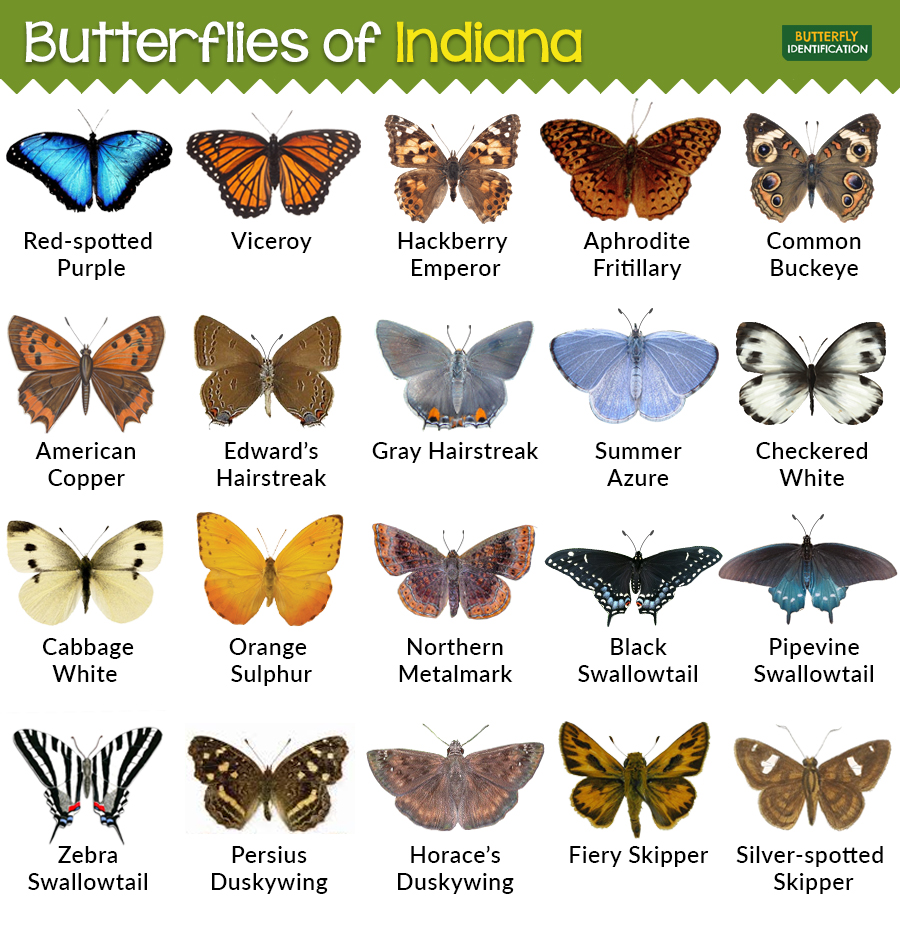
Brush-Footed (Nymphalidae)
- Red-spotted Purple (Limenitis arthemis)
- ‘Astyanax‘ Red-spotted Purple (Limenitis arthemis astyanax)
- Viceroy (Limenitis archippus)
- White Admiral (Limenitis arthemis arthemis)
- Hackberry Emperor (Asterocampa celtis)
- Tawny Emperor (Asterocampa clyton)
- Goatweed Leafwing (Anaea andria)
- Aphrodite Fritillary (Speyeria aphrodite)
- Atlantis Fritillary (Speyeria atlantis)
- Diana (Speyeria diana)
- Great Spangled Fritillary (Speyeria cybele)
- Regal Fritillary (Speyeria idalia)
- Silver-bordered Fritillary (Boloria selene)
- Meadow Fritillary (Boloria bellona)
- Gulf Fritillary (Agraulis vanillae)
- Variegated Fritillary (Euptoieta claudia)
- Monarch (Danaus plexippus)
- American Snout (Libytheana carinenta)
- American Lady (Vanessa virginiensis)
- Painted Lady (Vanessa cardui)
- Red Admiral (Vanessa atalanta)
- Compton Tortoiseshell (Nymphalis vaualbum)
- Mourning Cloak (Nymphalis antiopa)
- Gorgone Checkerspot (Chlosyne gorgone)
- Silvery Checkerspot (Chlosyne nycteis)
- Harris’ Checkerspot (Chlosyne harrisii)
- Eastern Comma (Polygonia comma)
- Gray Comma (Polygonia progne)
- Question Mark (Polygonia interrogationis)
- Satyr Comma (Polygonia satyrus)
- Tawny Crescent (Phyciodes batesii)
- Pearl Crescent (Phyciodes tharos)
- Milbert’s Tortoiseshell (Aglais milberti)
- Baltimore (Euphydryas phaeton)
- Common Buckeye (Junonia coenia)
Gossamer-Winged (Lycaenidae)
- Harvester (Feniseca tarquinius)
- American copper (Lycaena phlaeas)
- Bog copper (Lycaena epixanthe)
- Bronze copper (Lycaena hyllus)
- Dorcas copper (Lycaena dorcas)
- Purplish copper (Lycaena helloides)
- Coral hairstreak (Satyrium titus)
- Acadian hairstreak (Satyrium acadica)
- Edward’s hairstreak (Satyrium edwardsii)
- Banded hairstreak (Satyrium calanus)
- Hickory hairstreak (Satyrium caryaevorum)
- Striped hairstreak (Satyrium liparops)
- Northern oak hairstreak (Satyrium favonius Ontario)
- Frosted elfin (Callophrys irus)
- Henry’s elfin (Callophrys henrici)
- Eastern pine elfin (Callophrys niphon)
- “Olive” juniper hairstreak (Callophrys gryneus gryneus)
- White M hairstreak (Parrhasius m-album)
- Gray hairstreak (Strymon melinus)
- Red-banded hairstreak (Calycopis cecrops)
- Eastern tailed-blue (Everes comyntas)
- Spring azure (Celastrina ladon)
- Summer azure (Celastrina neglecta)
- Appalachian azure (Celastrina neglectamajor)
- Dusky azure (Celastrina nigra)
- Silvery blue (Glaucopsyche lygdamus)
Whites and Sulphurs (Pieridae)
- Checkered white (Pontia protodice)
- Mustard white (Pieris napi)
- West Virginia white (Pieris virginiensis)
- Cabbage white (Pieris rapae)
- Olympia marble (Euchloe olympia)
- Falcate orangetip (Anthocharis midea)
- Clouded sulphur (Colias philodice)
- Orange sulphur (Colias eurytheme)
- Southern dogface (Zerene cesonia)
- Cloudless sulphur (Phoebis sennae)
- Little yellow (Eurema lisa)
- Sleepy orange (Eurema nicippe)
- Dainty sulphur (Nathalis iole)
Metalmark (Riodinidae)
- Northern Metalmark (Calephelis borealis)
- Swamp Metalmark (Calephelis muticum)
Swallowtail (Papilionidae)
- Black Swallowtail (Papilio polyxenes)
- Eastern Tiger Swallowtail (Papilio glaucus)
- Giant Swallowtail (Papilio cresphontes)
- Spicebush Swallowtail (Papilio troilus)
- Pipevine Swallowtail (Battus philenor)
- Zebra Swallowtail (Eurytides marcellus)
Skipper (Hesperiidae)
- Columbine Duskywing (Erynnis lucilius)
- Dreamy Duskywing (Erynnis icelus)
- Funereal Duskywing (Erynnis funeralis)
- Horace’s Duskywing (Erynnis horatius)
- Juvenal’s Duskywing (Erynnis juvenalis)
- Mottled Duskywing (Erynnis martialis)
- Persius Duskywing (Erynnis persius)
- Sleepy Duskywing (Erynnis brizo)
- Wild Indigo Duskywing (Erynnis baptisiae)
- Confusing Cloudywing (Thorybes confusis)
- Southern Cloudywing (Thorybes bathyllus)
- Northern Cloudywing (Thorybes pylades)
- Golden Banded-Skipper (Autochton cellus)
- Hayhurst’s Scallopwing (Staphylus hayhurstii)
- Hoary Edge (Achalarus lyciades)
- Long-tailed Skipper (Urbanus proteus)
- Common Checkered-Skipper (Pyrgus communis)
- Common Sootywing (Pholisora catullus)
- Silver-spotted Skipper (Epargyreus clarus)
- Swarthy skipper (Nastra lherminier)
- Least skipper (Ancyloxypha numitor)
- European skipper (Thymelicus lineola)
- Fiery skipper (Hylephila phyleus)
- Ottoe skipper (Hesperia ottoe)
- Leonard’s skipper (Hesperia leonardus)
- Cobweb skipper (Hesperia metea)
- Indian skipper(Hesperia sassacus)
- Peck’s skipper (Polites peckius)
- Tawny-edged skipper (Polites themistocles)
- Crossline skipper (Polites origenes)
- Long dash (Polites mystic)
- Northern broken dash (Wallengrenia egeremet)
- Little glassywing (Pompeius verna)
- Sachem (Atalopedes campestris)
- Delaware skipper (Anatrytone logan)
- Byssus skipper (Problema byssus)
- Mulberry wing (Poanes massasoit)
- Hobomok skipper (Poanes hobomok)
- Zabulon skipper (Poanes zabulon)
- Yehl skipper (Poanes yehl)
- Broad-winged skipper (Poanes viator)
- Dion skipper (Euphyes dion)
- Duke’s skipper (Euphyes dukesi)
- Black dash (Euphyes conspicua)
- Two-spotted skipper (Euphyes bimacula)
- Dun skipper (Euphyes vestris)
- Dusted skipper (Atrytonopsis hianna)
- Pepper and salt skipper (Amblyscirtes hegon)
- Lace-winged roadside-skipper (Amblyscirtes aesculapius)
- Common roadside-skipper (Amblyscirtes vialis)
- Bell’s roadside-skipper (Amblyscirtes belli)