
Types of Butterflies in Kansas
The midwestern state of Kansas has about 190 species of butterflies, some of which are frequently spotted and the rest, being migratory, are rarely found. Autumn is the best time of the year when their activity increases, as the seasonal flowers like goldenrod, aster, and Maximilian sunflower bloom and produce nectar, attracting swarms of butterflies.
Till now, no butterfly species has been designated as the state butterfly of Kansas.
Brush-Footed (Nymphalidae)
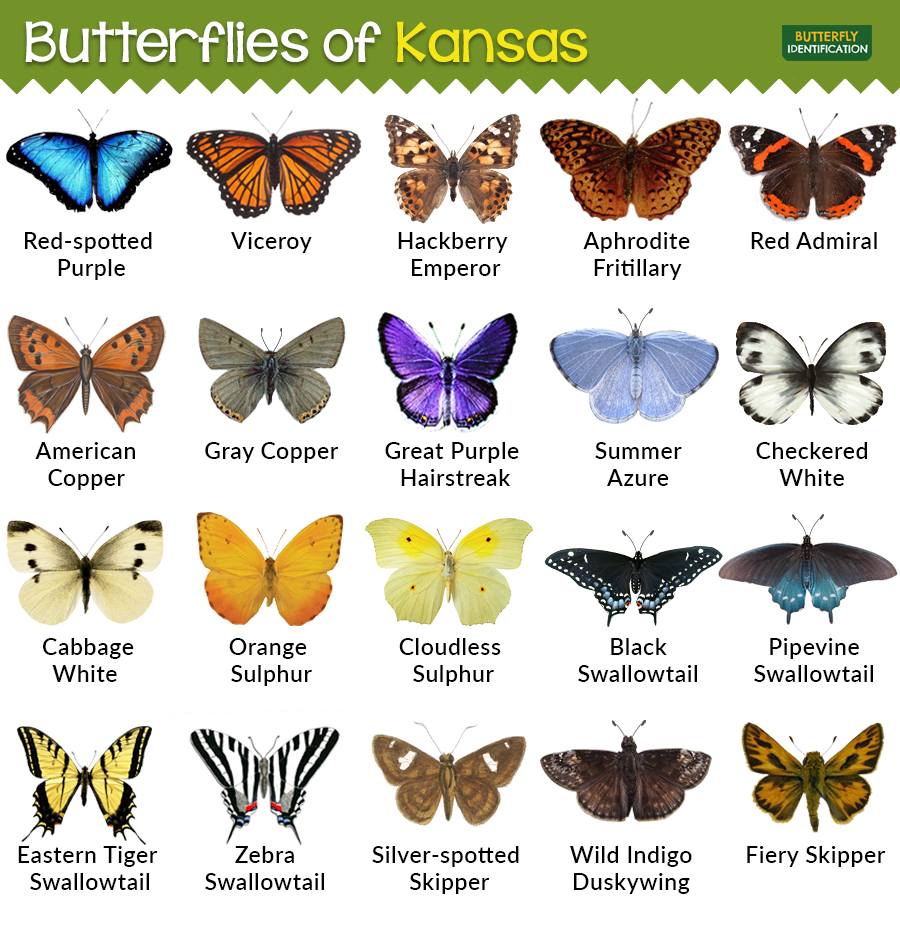
- Red-spotted Purple (Limenitis arthemis)
- Viceroy (Limenitis archippus)
- ‘Astyanax‘ Red-spotted Purple (Limenitis arthemis astyanax)
- Common Mestra (Mestra amymone)
- Ruddy Daggerwing (Marpesia petreus)
- Many-banded Daggerwing (Marpesia chiron)
- California Sister (Adelpha bredowii)
- Florida Purplewing (Eunica tatila)
- Hackberry Emperor (Asterocampa celtis)
- Tawny Emperor (Asterocampa clyton)
- Goatweed Leafwing (Anaea andria)
- Tropical Leafwing (Anaea troglodyta)
- Aphrodite Fritillary (Speyeria aphrodite)
- Edwards’ Fritillary (Speyeria edwardsii)
- Regal Fritillary (Speyeria idalia)
- Great Spangled Fritillary (Speyeria cybele)
- Gulf Fritillary (Agraulis vanillae)
- Isabella’s Heliconian (Eueides isabella)
- Julia Heliconian (Dryas julia)
- Variegated Fritillary (Euptoieta claudia)
- Zebra Heliconian (Heliconius charithonius)
- Banded Orange Heliconian (Dryadula phaetusa)
- Monarch (Danaus plexippus)
- Queen (Danaus gilippus)
- Tiger Mimic-Queen (Lycorea cleobaea)
- American Snout (Libytheana carinenta)
- American Lady (Vanessa virginiensis)
- Baltimore (Euphydryas phaeton)
- Bordered Patch (Chlosyne lacinia)
- Common Buckeye (Junonia coenia)
- Eastern Comma (Polygonia comma)
- Field Crescent (Phyciodes pulchellus)
- Fulvia Checkerspot (Thessalia fulvia)
- Gorgone Checkerspot (Chlosyne gorgone)
- Graphic Crescent (Phyciodes graphica)
- Gray Comma (Polygonia progne)
- Hoary Comma (Polygonia gracilis)
- Malachite (Siproeta stelenes)
- Milbert’s Tortoiseshell (Aglais milberti)
- Mourning Cloak (Nymphalis antiopa)
- Painted Crescent (Phyciodes picta)
- Painted Lady (Vanessa cardui)
- Pearl Crescent (Phyciodes tharos)
- Phaon Crescent (Phyciodes phaon)
- Question Mark (Polygonia interrogationis)
- Red Admiral (Vanessa atalanta)
- Silvery Checkerspot (Chlosyne nycteis)
- Texan Crescent (Phyciodes texana)
- West Coast Lady (Vanessa annabella)
- White Peacock (Anartia jatrophae)
Gossamer-Winged (Lycaenidae)
- Harvester (Feniseca tarquinius)
- American Copper (Lycaena phlaeas)
- Gray Copper (Lycaena dione)
- Bronze Copper (Lycaena hyllus)
- Purplish Copper (Lycaena helloides)
- Great Purple Hairstreak (Atlides halesus)
- Soapberry Hairstreak (Phaeostrymon Alcestis)
- Coral Hairstreak (Satyrium titus)
- Acadian Hairstreak (Satyrium acadica)
- Edwards’ Hairstreak (Satyrium edwardsii)
- Banded Hairstreak (Satyrium calanus)
- Hickory Hairstreak (Satyrium caryaevorus)
- Stray Striped Hairstreak (Satyrium liparops)
- Southern Hairstreak (Satyrium favonius)
- Henry’s Elfin (Callophrys henrici)
- ‘Olive’ Juniper Hairstreak (Callophrys gryneus gryneus)
- White M Hairstreak (Parrhasius m-album)
- Gray Hairstreak (Strymon melinus)
- Red-banded Hairstreak (Calycopis cecrops)
- Dusky-blue Groundstreak (Calycopis isobeon)
- Gray Ministreak (Ministrymon azia)
- Western Pygmy-Blue Brephidium exilis)
- Cassius Blue (Leptotes cassius)
- Marine Blue (Leptotes marina)
- Ceraunus Blue (Hemiargus ceraunus)
- Reakirt’s Blue (Hemiargus isola)
- Eastern Tailed Blue (Cupido comyntas)
- Spring Azure (Celastrina ladon)
- Summer Azure (Celastrina neglecta)
- Silvery Blue (Glaucopsyche lygdamus)
- Melissa Blue (Plebejus Melissa)
- Lupine Blue (Plebejus lupine)
White and Sulphurs (Pieridae)
- Florida White (Appias Drusilla)
- Checkered White (Pontia protodice)
- Western White (Pontia occidentalis)
- Cabbage White (Pieris rapae)
- Great Southern White (Ascia monuste)
- Giant White (Ganyra Josephina)
- Olympia Marble (Euchloe olympia)
- Falcate Orangetip (Anthocharis midea)
- Clouded Sulphur (Colias philodice)
- Orange Sulphur (Colias eurytheme)
- Southern Dogface (Colias cesonia)
- White Angled-Sulphur (Anteos chlorinde)
- Cloudless Sulphur (Phoebis sennae)
- Orange-barred Sulphur (Phoebis philea)
- Apricot Sulphur (Phoebis argante)
- Large Orange Sulphur (Phoebis agarithe)
- Statira Sulphur (Phoebis statira)
- Lyside Sulphur (Kricogonia lyside)
- Mexican Yellow (Eurema Mexicana)
- Tailed Orange (Eurema proterpia)
- Little Yellow (Eurema lisa)
- Mimosa Yellow (Eurema nise)
- Sleepy Orange (Eurema nicippe)
- Dainty Sulphur (Nathalis iole)
Swallowtail (Papilionidae)
- Black Swallowtail (Papilio polyxenes)
- Eastern Tiger Swallowtail (Papilio glaucus)
- Giant Swallowtail (Papilio cresphontes)
- Old World Swallowtail (Papilio machaon)
- Ornythion Swallowtail (Papilio ornythion)
- Ruby-spotted Swallowtail (Papilio anchisiades)
- Spicebush Swallowtail (Papilio troilus)
- Thoas Swallowtail (Papilio thoas)
- Two-tailed Swallowtail (Papilio multicaudata)
- Pipevine Swallowtail (Battus philenor)
- Zebra Swallowtail (Eurytides marcellus)
Skipper (Hesperiidae)
- Silver-spotted Skipper (Epargyreus clarus)
- Southern Cloudywing (Thorybes bathyllus)
- Hayhurst’s Scallopwing (Staphylus hayhurstii)
- Funereal Duskywing (Erynnis funeralis)
- Wild Indigo Duskywing (Erynnis baptisiae)
- Common Checkered-Skipper (Pyrgus communis)
- Common Sootywing (Pholisora catullus)
- Least Skipper (Ancyloxypha numitor)
- Fiery Skipper (Hylephila phyleus)
- Ottoe Skipper (Hesperia ottoe)
- Sachem (Atalopedes campestris)
- Arogos Skipper (Atrytone arogos)
- Delaware Skipper (Anatrytone logan)
- Zabulon Skipper (Poanes zabulon)
- Nysa Roadside-Skipper (Amblyscirtes nysa)
- Common Roadside-Skipper (Amblyscirtes vialis)